
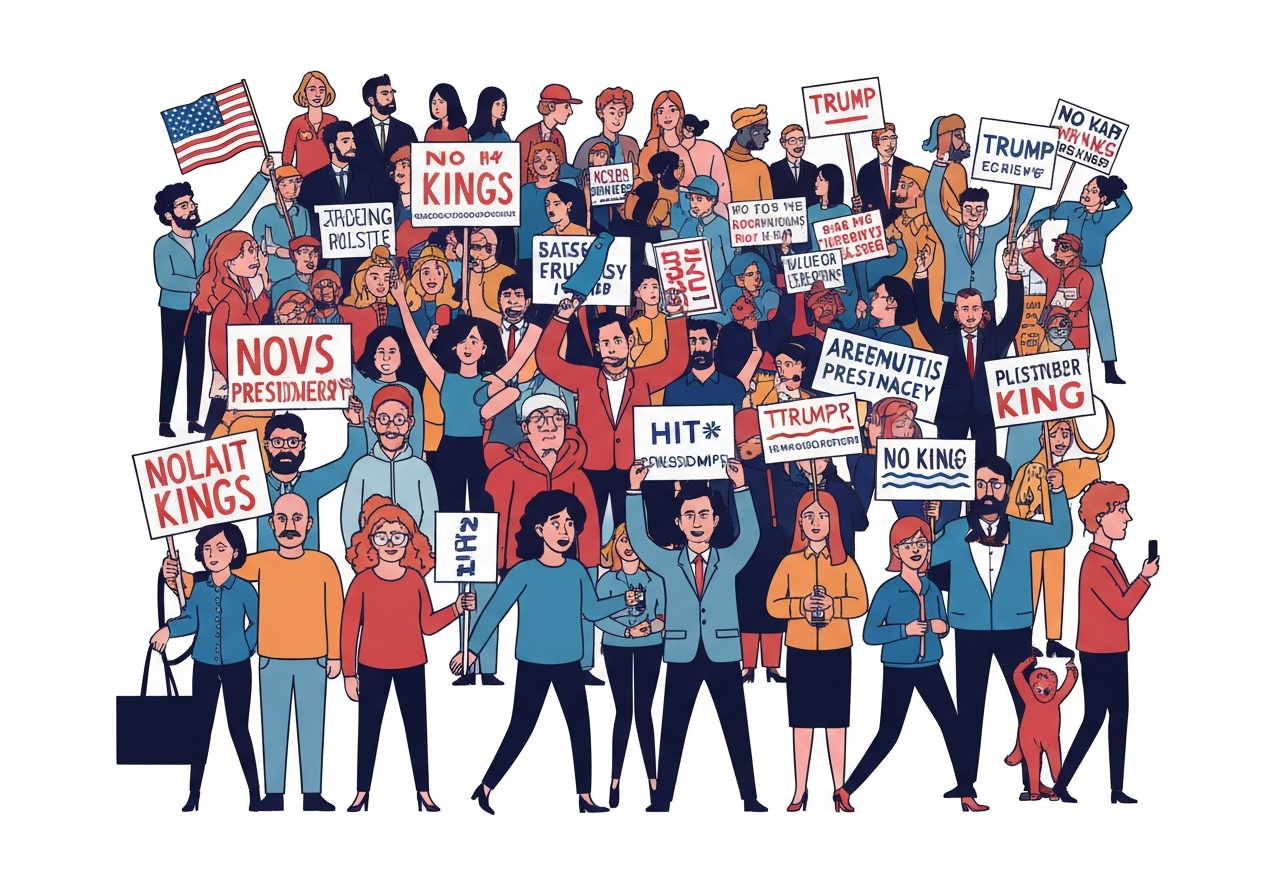
On Saturday, March 28, 2026, coordinated “No Kings” demonstrations mobilized people across all 50 US states and in 16 countries to protest President Donald Trump’s policies, with organizers reporting millions of participants. The protests targeted the administration’s decisions on Iran, immigration enforcement and federal budget priorities, while local actions also raised concerns about research funding and healthcare. Organizers said this was the third nationwide No Kings event and hoped it would surpass previous turnouts; the October demonstration reportedly drew 7 million participants nationwide. Authorities and event coalitions characterized the day as both a national show of force and a dispersed set of local campaigns with varied priorities.
Key Takeaways
- Organizers reported more than 3,000 No Kings events held on March 28, 2026, across all 50 states and 16 countries.
- Indivisible co-founder Ezra Levin predicted the march could be the largest protest in US history ahead of the demonstrations.
- The October No Kings action previously drew an estimated 7 million people nationwide, a benchmark organizers aimed to exceed.
- Rallies addressed multiple grievances: opposition to a US military action with Iran, rising living costs, and heightened federal immigration enforcement.
- About 1,000 people gathered outside the National Institutes of Health (NIH) in Bethesda to protest proposed medical research cuts linked to federal budget priorities.
- The US House passed an eight-week DHS stopgap funding bill by 213 to 203 votes after rejecting a bipartisan Senate deal that omitted ICE and border patrol funding.
- The US Treasury formally disputed a Financial Times story about the treasury secretary’s views on the Federal Reserve, demanding a retraction from the paper’s parent company.
Background
The No Kings protests are the latest in a series of large, decentralized demonstrations against what participants describe as authoritarian tendencies in the Trump administration. The movement draws on coalitions of anti-authoritarian groups, labor unions and grassroots organizations—Indivisible and 50501 among them—seeking to coordinate local actions under a common banner. Organizers view the campaign as a way to maintain sustained pressure outside electoral cycles, combining nationwide messaging with targeted local demands, from healthcare funding to immigration policy changes.
Political polarization, a contentious foreign policy decision that increased the chance of conflict with Iran, and sharp debates over immigration enforcement have all fed into the movement’s growth. Economically, higher living costs and anxiety about federal budget priorities have broadened the coalition beyond typical activist networks. The October No Kings turnout—reported at 7 million nationwide—became a benchmark for the movement and a test of its organizing capacity; Saturday’s events were billed as the third major coordinated action intended to match or surpass that scale.
Main Event
On the ground, the demonstrations varied widely: massive city rallies, smaller local gatherings and issue-specific pickets. In Washington, D.C., and several major cities, large crowds gathered at planned sites, while protests in suburban and rural areas emphasized local impacts of national policies. Organizers said more than 3,000 distinct events took place, a figure that included both large metropolitan marches and small-town vigils. Law enforcement responses were mostly limited to crowd control; there were no widespread reports of major violence associated with the coordinated day of action.
At the NIH campus in Bethesda, roughly 1,000 demonstrators assembled to highlight concerns about cuts to medical research funding and broader health-policy decisions. Protesters carried signs linking research budgets to public health outcomes and argued that proposed federal spending shifts would hinder scientific progress. Local organizers said the NIH demonstration was one node in a national pattern of protests that combined anti-authoritarian messaging with concrete policy demands.
Parallel to the street demonstrations, the US political calendar added combustible elements: the House voted late Friday to pass a DHS stopgap funding bill that would fully fund the department for eight weeks, winning approval by 213 to 203. House Republicans rejected a Senate-brokered compromise that excluded funding for ICE and border patrol, prolonging a budget standoff that has already affected air travel and agency planning. Separately, the Treasury Department escalated a complaint to the Financial Times’ parent company over an article about the treasury secretary and Fed oversight, calling portions of the reporting inaccurate.
Analysis & Implications
The scale and coordination of the March 28 protests signal an evolving strategy among anti-authoritarian groups: combine broad national narratives with targeted local grievances to keep disparate constituencies engaged. If turnout figures reported by organizers are accurate, the movement demonstrates sustained mobilizing capacity that could influence public debate and congressional messaging. However, turnout claims—especially when aggregated across thousands of events—are difficult to verify uniformly, and political actors will contest totals for partisan purposes.
Politically, the demonstrations add pressure on lawmakers during a period of tight budget negotiations and heightened foreign policy tensions. The House’s move to pass an alternative DHS funding bill, and the continued disputes over immigration enforcement funding, indicate competing priorities that protests may amplify rather than resolve. For administration signaling, the Treasury’s public dispute with the Financial Times underscores sensitivity in economic governance debates; it may chill media coverage or prompt closer scrutiny of official communications.
Economically and socially, local demonstrations about NIH funding and living costs highlight how national political events cascade into issue-specific mobilization. Researchers and healthcare advocates worry that any sustained cuts to research budgets would slow projects with long lead times and ripple through regional economies that depend on federal grants. If such concerns gain traction, they could shift some public and legislative opinion away from austerity-style budget moves and toward more targeted funding protections.
Comparison & Data
| Event | Reported Scope | Notable Figures |
|---|---|---|
| March 28 No Kings | Nationwide (50 states) + 16 countries | Organizers: >3,000 events; millions of participants |
| October No Kings | Nationwide | Organizers reported ~7 million participants nationwide |
| NIH Bethesda Demonstration | Local | ~1,000 attendees |
The table above aggregates organizer-reported figures and specific local counts where available. Event tallies from coalitions can differ from police or independent estimates; aggregation across thousands of sites often yields wide ranges. Analysts caution that headline numbers do not capture demographic composition, message focus, or local policy effects, which require separate measurement and follow-up reporting.
Reactions & Quotes
“I would expect March 28 to be the biggest protest in American history,”
Ezra Levin, co-founder of Indivisible (organizer)
Levin’s statement was made publicly in the days before the demonstrations and framed the event as both a scale test and a message to elected officials. Organizers used the line to galvanize volunteers and local groups to maximize turnout on the day.
“We have raised concerns about inaccuracies in the reporting and have lodged a formal complaint,”
US Treasury Department (official statement)
The Treasury’s communication to the Financial Times and its parent company emphasized alleged mischaracterizations of the treasury secretary’s commentary on the Federal Reserve. The escalation illustrates strains between financial-sector coverage and government officials over narrative control.
“Local rallies show how national policy debates become neighborhood issues,”
Independent policy analyst (expert reaction)
Experts noted that the mix of foreign policy, immigration, and budget questions at the demonstrations reflects a broader strategy to link national decisions to everyday concerns like healthcare funding and living costs.
Unconfirmed
- The precise nationwide attendance figure for March 28 remains unverified outside organizer counts; independent tallies vary and some jurisdictions have not published definitive numbers.
- Attribution of specific local impacts (for example, concrete policy reversals tied directly to the demonstrations) is not yet established and requires follow-up reporting.
Bottom Line
March 28’s No Kings actions show the movement’s capacity to mobilize a broad coalition across urban and rural America, linking high-profile national controversies with local policy concerns. Whether the day represents a lasting escalation or a momentary surge will depend on how organizers convert turnout into sustained political influence and whether policymakers respond to the combined pressure on foreign policy, immigration and domestic spending.
In the short term, expect contested claims about turnout and impact, continued congressional fights over DHS and immigration funding, and renewed attention to federal research and healthcare budgets. Journalists and analysts should watch for independent crowd estimates, local follow-up on policy demands, and any administrative responses that change the political calculus ahead of upcoming legislative deadlines.
Sources
- The Guardian (news report summarizing the events)
- Indivisible (organizer coalition website)
- National Institutes of Health (NIH) (official agency site; context on research funding)
- US Department of the Treasury (official statements and correspondence)
- Congress.gov (legislative text and roll-call vote records)