
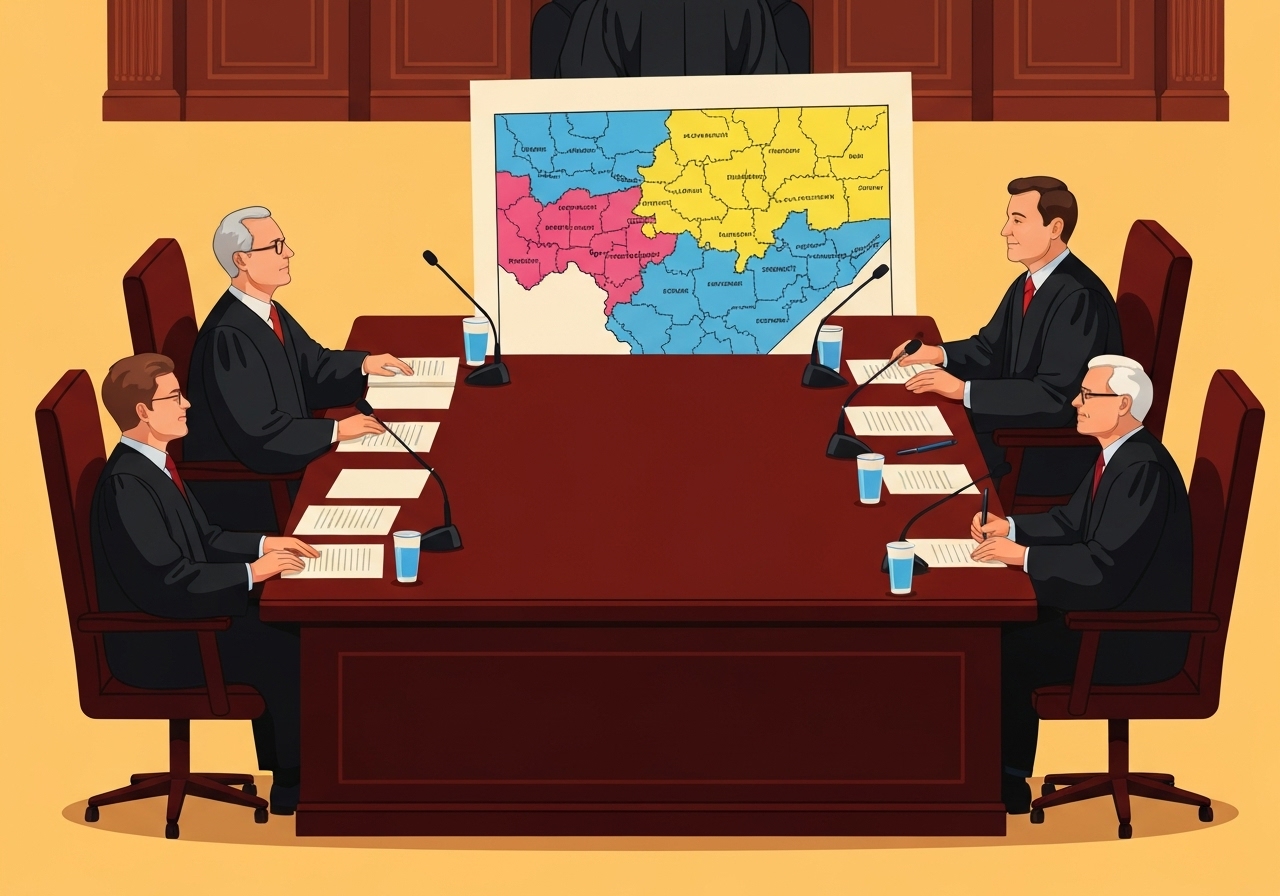
Lead: A federal three-judge panel on Wednesday cleared North Carolina to use a mid-decade congressional map that Republican state lawmakers crafted to try to flip the 1st District to GOP control. The decision follows a mid-November hearing in Winston-Salem and denies preliminary injunction requests from voting-rights groups and private plaintiffs. The map targets the state’s only swing seat, currently held by Democratic U.S. Rep. Don Davis, and is part of a broader, multistate effort tied to former President Donald Trump’s push for mid-decade redistricting ahead of the 2026 contests.
Key Takeaways
- The three-judge federal panel unanimously denied requests for a preliminary injunction after a November hearing, allowing the new map to stand for upcoming filings that begin Dec. 1 for many 2026 races.
- The redraw is aimed at the 1st District, represented by Democrat Don Davis; plaintiffs say the Black voting-age population there falls from 40% under the 2023 map to about 32% in the October plan.
- Republicans now hold 10 of North Carolina’s 14 U.S. House seats; lawmakers hope the new lines will enable flipping an 11th seat by combining changes in the 1st and adjacent 3rd Districts.
- The legal challenge was brought by the state NAACP, Common Cause and voters, asserting First and 14th Amendment violations, including claims of retaliation and race-based tailoring of districts.
- State GOP leaders defended the redraw as a lawful, political decision in a national redistricting effort encouraged by Trump; advocates called the ruling a validation of extreme gerrymandering.
Background
Mid-decade redistricting has been rare, but this year former President Donald Trump urged Republican legislatures in several states to redraw maps outside the usual 10-year Census cycle. North Carolina’s Republican-led General Assembly approved the October map on Oct. 22; gubernatorial sign-off was not required under state law. The move is part of a multistate push that also produced new lines in Texas, Missouri and Ohio, while Democrats have pursued countermeasures in places like California and Virginia.
Challenges to mid-decade plans have moved through a fractured federal court landscape. Lower courts in multiple states initially blocked some redistricting efforts, but the conservative majority on the U.S. Supreme Court has repeatedly stayed those orders. In 2024 the 2023 North Carolina map was used in congressional elections that helped Republicans pick up three seats nationally; plaintiffs who challenged that map alleged unlawful dilution of Black voting strength.
Main Event
The plaintiffs in the October-filed suits argued two principal harms: first, that legislators intentionally moved majority-Black populations out of the 1st District to weaken a Democratic incumbent’s coalition; second, that using five-year-old Census data to redraw districts mid-decade violates equal-representation guarantees under the 14th Amendment. Judges at the Winston-Salem hearing considered those urgings but declined to issue a stay or preliminary block on implementing the lines.
Republican attorneys told the court the adjustments were political and lawful, part of what they described as a nationwide partisan redistricting contest — not racial targeting. They also disputed claims that reliance on older Census figures or alleged retaliatory motives breached Supreme Court precedent. The three-judge panel ultimately found the plaintiffs had not met the high bar for emergency relief.
The practical effect is that the October map will guide candidate filings that for many 2026 races begin Dec. 1, and it reshuffles several counties between the 1st and 3rd Districts. The 3rd District, represented by Republican Greg Murphy, absorbed counties with sizable Black populations that had been in the 1st — a change plaintiffs say reduces Black voting power in the swing district.
Analysis & Implications
Politically, the ruling strengthens Republicans’ short-term prospects in North Carolina by preserving a map crafted to maximize GOP chances. With Republicans already holding 10 of 14 U.S. House seats from the 2023 configuration, the October changes aim to create a pathway to an 11th seat — a gain that would matter to control dynamics in the House nationally. The timing matters: control of the House could influence oversight and the fate of federal policy priorities tied to the Trump-aligned agenda.
Legally, the decision underscores the difficulty plaintiffs face in securing preliminary injunctive relief in redistricting disputes. Courts must weigh both constitutional claims and the potential disruption of elections, and lower courts have been inconsistent across jurisdictions. The Supreme Court’s willingness to stay lower-court injunctions has narrowed immediate remedies for challengers, while leaving open the possibility of later review on the merits.
Demographically, moving sizable Black-population counties out of a district that has elected Black representatives for more than 30 years raises questions about long-term representation and political voice in eastern North Carolina. Plaintiffs frame the change as targeted retaliation against voters who organized and voted in 2024; defenders say it is standard partisan mapmaking. Either way, communities shifted between districts may see different constituent services and policy priorities from their new representatives.
Comparison & Data
| Metric | 2023 Map (1st District) | October 2024 Map (1st District) |
|---|---|---|
| Black Voting-Age Population | ~40% | ~32% |
| U.S. House Seats Controlled (statewide) | Republicans 10 of 14 | Republicans aim for 11 of 14 |
| Recent GOP gains tied to 2023 maps | GOP net +3 seats in 2024; Texas map later engineered to add ~5 Republican seats in another challenge | |
These figures, cited by plaintiffs and public filings, illustrate the scale of demographic change plaintiffs say results from the October redraw. The reduced Black voting-age share in the 1st District is central to claims about diluted influence; statewide seat counts show why both parties see high stakes in the map battle.
Reactions & Quotes
“This decision prevents what opponents called an unlawful circumvention of voters’ will, and keeps in place lines designed to safeguard the administration’s policy priorities,”
North Carolina Senate Leader Phil Berger (statement)
Berger framed the ruling as a defense of the legislature’s choices and a check against Democratic efforts to roll back the map. His remarks reflect the GOP leadership line that redistricting was a legitimate political response to national trends.
“The court’s ruling endorses what critics warn will be the most gerrymandered map in state history,”
Bob Phillips, Executive Director, Common Cause North Carolina
Common Cause and NAACP representatives argued the map intentionally targets Black communities and undermines their electoral influence. Their challenge emphasized First and 14th Amendment claims, and they characterized the ruling as a setback for voting-rights protections.
Unconfirmed
- Whether mapmakers’ motives were predominantly racial or political remains disputed and has not been definitively proven in court.
- How the October map will affect the 2026 general-election outcomes and which specific districts will shift remains uncertain until candidacies are finalized and races are contested.
- Potential Supreme Court review of the underlying claims has not been scheduled and, if it occurs, its timing and scope are unknown.
Bottom Line
The federal panel’s decision keeps in place a contested North Carolina congressional map that plaintiffs say reduces Black voting power in the 1st District and that Republicans say is a lawful partisan redrawing. The ruling has immediate practical effects: it clears the way for candidate filings tied to the 2026 cycle and preserves a configuration that boosted GOP strength in the state in 2024.
Longer term, the case highlights continuing tensions over the limits of partisan redistricting, the role of courts in electoral disputes, and the political leverage that map lines confer. Expect further litigation and political mobilization from voting-rights groups and both parties as campaigns unfold and as courts consider merits and potential appeals.