
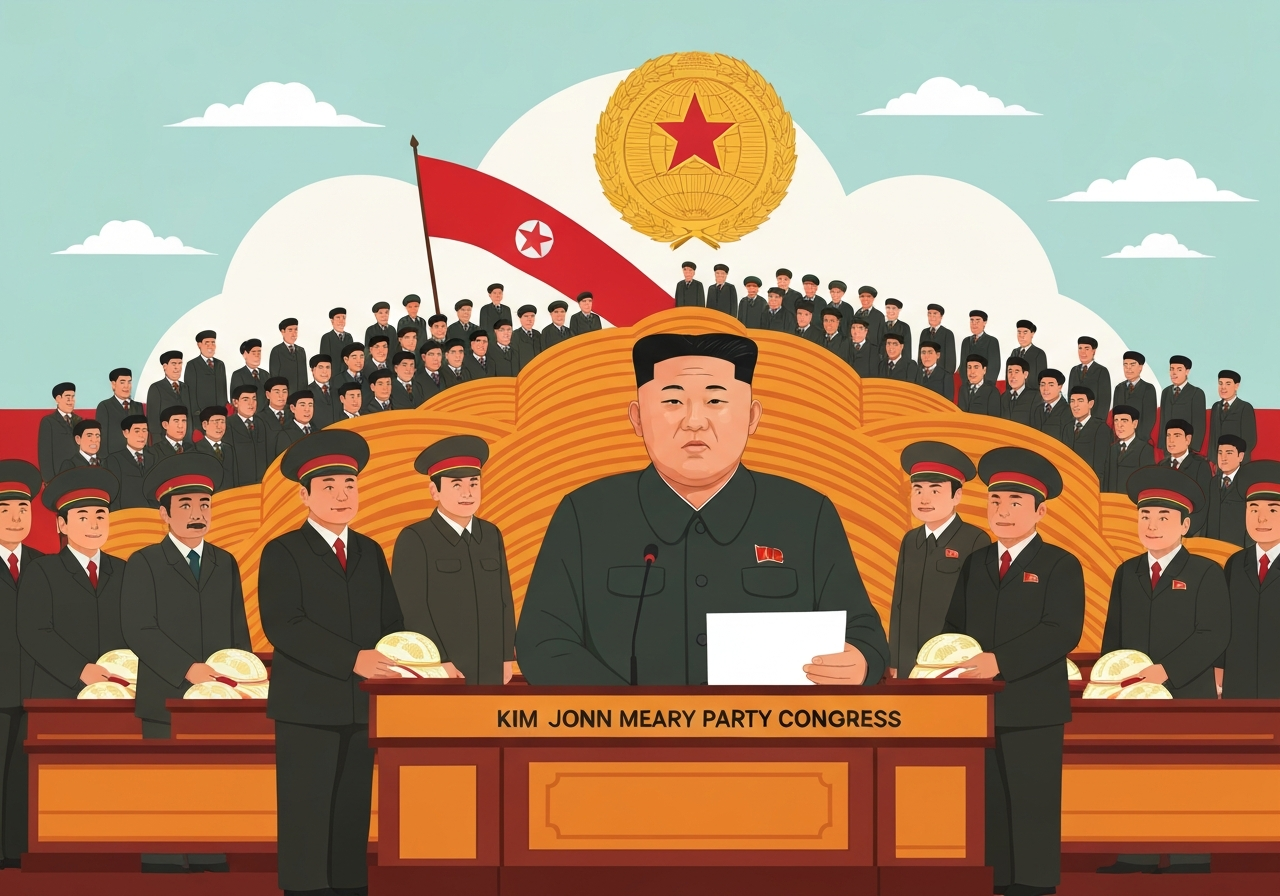
North Korean leader Kim Jong Un opened the Workers’ Party congress in Pyongyang this week, praising what he described as gains in the country’s economy and a strengthened regional standing. The gathering — the regime’s most consequential political event — is expected to set the government’s domestic and foreign policy priorities for the next five years and to reinforce the Kim family’s hold on power. Delegates will likely endorse new economic and military development plans while Kim solidifies his international posture amid deeper ties with Russia and China. Observers also note signals that the leadership may formalize succession arrangements, including the possible elevation of a teenage family member.
Key Takeaways
- The Workers’ Party congress convened in Pyongyang this week and will likely run for several days, setting a five-year policy agenda for the regime.
- Kim Jong Un is entering his 15th year in power and framed recent developments as an “irreversible” strengthening of the state’s position, according to state media reports.
- South Korean analysts estimate roughly 10% economic growth over the past five years, tied to a post-pandemic trade rebound with China and increased arms trade with Russia (Korea Development Institute estimate).
- The leadership has advanced many 2021 weapons priorities: tests of solid-fuel ICBMs, tactical nuclear effort, a first military satellite in 2023, and claims of progress toward a nuclear-propelled submarine.
- Ties with Russia and China have deepened — including reported troop and munitions transfers to Russia — complicating Pyongyang’s standoff with Washington and Seoul.
- Kim appears to be balancing continued hard-line posture toward Seoul with a moderated stance toward Washington to preserve future negotiation options.
Background
The last party congress was held in 2021 amid a weakened economy battered by the COVID-19 pandemic and international sanctions. At that meeting Kim acknowledged economic shortcomings and unveiled a five-year plan through 2025 that emphasized self-reliance and mass mobilization. He also doubled down on nuclear and advanced weapons development as central pillars of national strategy. Since then, Pyongyang has benefited from a partial economic rebound linked to renewed trade with China and, according to some analysts, expanded military-related commerce with Russia.
Regionally, Kim has projected a more assertive posture by deepening relations with Moscow and maintaining high-level contacts with Beijing, including a 2023 summit with Xi Jinping. Those ties have reinforced Pyongyang’s diplomatic room for maneuver and provided technological and material avenues that outside governments say have helped accelerate weapons programs. At the same time, strict internal information controls and state secrecy make independent verification of many economic and military claims difficult, heightening reliance on analyst estimates and open-source indicators.
Main Event
State news agency reports say the congress opened after preliminary sessions. In an address reported by state media, Kim celebrated recent gains and cast the nation’s standing as having strengthened irreversibly since 2021. Official coverage so far has focused on achievement and unity; KCNA did not immediately publish extended remarks on negotiations with the United States or detailed disclosures about the nuclear arsenal at the opening.
The congress is expected to provide a formal venue for adopting fresh five-year plans for both civilian and military development. Party delegates will likely ratify measures to institutionalize internal unity, economic directives, and a prioritized military modernization program that blends nuclear and conventional capabilities. Analysts anticipate the leadership will frame those measures as continuity rather than rupture, reinforcing existing priorities while presenting incremental new targets.
Succession signaling is also on observers’ checklists. Some outside analysts note ceremonial prominence given to a teenage daughter of Kim Jong Un — widely reported to be named Kim Ju Ae and estimated to be about 13 — as potential early-stage positioning within the ruling family’s dynastic structure. Any formal designation would be closely watched for implications about the regime’s political future.
Analysis & Implications
Economically, the regime’s messaging aims to showcase recovery and resilience despite long-term structural weaknesses and sustained sanctions. If outside estimates of roughly 10% growth over five years are accurate, that growth has been uneven and concentrated in sectors linked to cross-border trade and military exports; broadly shared prosperity remains limited. The party’s five-year economic plan will likely stress self-reliance and tightly managed market activity, which could sustain modest gains while keeping political control intact.
On security, Pyongyang has moved from emphasizing strategic nuclear deterrence toward integrating conventional-force improvements alongside nuclear systems. Recent launches and claimed technical milestones — including a military satellite and development of solid-fuel ICBMs — demonstrate progress in delivery systems and operational mobility. Analysts warn that blurring nuclear and conventional roles could lower thresholds for escalation and complicate deterrence calculations for Seoul and Washington.
Diplomatically, the closer relationship with Moscow and continued engagement with Beijing provide Pyongyang with leverage. Moscow’s need for materiel and manpower in Ukraine has reportedly opened channels for transfers that may include weapons or technology. That relationship gives Kim bargaining power but also makes North Korea’s strategic value contingent on the evolving Ukraine conflict and Russia’s future priorities. Meanwhile, Kim’s public rejection of Seoul as a partner for unification further diminishes inter-Korean rapprochement prospects in the near term.
Comparison & Data
| Metric | 2016–2021 | 2021–2024 (estimate) |
|---|---|---|
| Reported economic trend | Stagnation, pandemic shock | Estimated ~10% cumulative growth (KDI) |
| Notable weapons milestones | Plans for advanced systems | Solid-fuel ICBM tests, 2023 military satellite, tactical nuclear claims |
These indicators are drawn from state claims, open-source tracking and South Korean think-tank estimates. The limited transparency of North Korea’s economy and military means figures should be treated as indicative rather than definitive. The comparison underscores a shift from crisis-era contraction toward a period of targeted, state-directed recovery linked to external transactions and military-related activity.
Reactions & Quotes
“The past five years might be the most productive period for North Korean leadership since the 1950s and 1960s.”
Koh Yu-hwan, former president, Korea Institute for National Unification (expert comment)
Koh’s remark was offered to emphasize how outside observers view the leadership’s recent combination of economic and military initiatives as unusually active for the regime.
“We estimate roughly 10% growth over the last five years, driven by a post-pandemic trade rebound and arms-related commerce with Russia.”
Lee Jong-kyu, analyst, Korea Development Institute (think tank estimate)
Lee’s estimate is based on limited data and modeling; South Korean institutes caution the figure is an approximation rather than an official tally.
“State media framed the opening as a confirmation of strengthened state status, while offering little new on nuclear policy at the start of the congress.”
KCNA / North Korean state media (official report)
KCNA’s coverage highlighted achievements and unity but released few specifics about any new operational nuclear directives at the opening session.
Unconfirmed
- The precise identity, formal role or title for Kim’s teenage daughter remains unconfirmed by official announcements; age and name are reported but not independently verified.
- Detailed figures and specific terms for reported troop or munitions transfers to Russia have not been publicly verified by independent sources.
- Claims about progress toward a nuclear-propelled submarine and some advanced weapons systems are asserted by state sources but lack open independent confirmation.
Bottom Line
The congress is primarily a consolidation event: it allows Kim Jong Un to craft a five-year domestic and military roadmap while broadcasting strength to domestic and foreign audiences. Economically, modest recovery signals are likely to be framed as vindication of the regime’s policy mix, even as broad-based development challenges persist under sanctions and structural limits.
On security and diplomacy, the meeting underscores a strategy of hedging — deepening ties with Russia and China while keeping diplomatic options with the United States open. For regional actors, the key watch items are any formal changes to military doctrine, explicit succession moves, and concrete policy shifts that would affect sanctions, arms proliferation risks, or inter-Korean relations.