
Lead
Late on Jan. 19 a powerful coronal mass ejection (CME) struck Earth’s magnetosphere, producing severe (G4) geomagnetic storm conditions and raising the prospect that auroras could be visible across a broad swath of the northern United States the night of Jan. 19–20. NOAA’s Space Weather Prediction Center reported the initial G4-level storming at 2:38 p.m. EST (1938 GMT) on Jan. 19 after the CME shock arrived; the agency expects CME-driven activity to continue through the evening. The eruption originated with an X-class solar flare on Jan. 18, and the ejected material reached Earth at roughly 620–870 miles per second (1,000–1,400 km/s). If the CME’s magnetic orientation favors coupling with Earth’s field and skies are clear, observers from Alaska to Colorado and up the northeastern U.S. could see aurora tonight.
Key takeaways
- NOAA confirmed G4 (severe) geomagnetic storm conditions beginning at 2:38 p.m. EST (1938 GMT) on Jan. 19 after a CME shock arrival.
- The CME was launched in an X-class flare on Jan. 18 and traveled at about 620–870 miles per second (1,000–1,400 km/s).
- Current forecasts place aurora visibility—fully or partially—over 24 U.S. states, from Alaska and Washington to Colorado and New England.
- NOAA’s official strongest storm window is 1–4 a.m. EST (0600–0900 GMT) on Jan. 20, but elevated activity has already been observed earlier in the evening.
- Aurora visibility hinges on the CME’s Bz (magnetic) orientation; southward Bz enhances energy transfer into Earth’s magnetosphere, northward Bz suppresses it.
- Satellite assets such as DSCOVR and ACE will sample the solar wind and confirm the CME’s magnetic structure while the event unfolds.
- Observers should seek dark, northern horizons, allow eyes to dark-adapt, and use cameras or aurora apps for the best chance of detection.
Background
Coronal mass ejections are large expulsions of plasma and magnetic field from the Sun’s corona that, when Earth-directed, can compress and energize our planet’s magnetosphere. The degree of geomagnetic disturbance depends on CME speed, density and most critically the orientation of the embedded magnetic field relative to Earth’s. Space weather agencies use a five-level scale (G1–G5) to classify storm severity; G4 is categorized as severe and can disrupt high-frequency radio communications, create strong auroras, and in extreme cases affect some satellite operations and power systems.
X-class flares are the most energetic solar flares and often accompany fast, Earth-directed CMEs. The Jan. 18 flare that launched this CME was one such event; the resulting ejecta closed the Sun-to-Earth distance quickly, arriving in roughly a day. Agencies such as NOAA’s Space Weather Prediction Center and the U.K. Met Office maintain aurora outlooks that combine satellite solar-wind measurements, magnetospheric models, and historical storm behavior to forecast where the aurora oval may expand during disturbances.
Main event
NOAA reported that a shock from the CME reached Earth at 2:38 p.m. EST (1938 GMT) on Jan. 19, immediately elevating geomagnetic indices into the G4 range. That early shock arrival means the magnetosphere was already stirred well before the overnight maximum forecast window, raising the likelihood that auroras could appear sooner than predicted. Agencies expect the main phase of activity to continue into the late-night and early-morning hours of Jan. 20 as the bulk of the CME passes by.
Forecasters emphasize that the aurora’s southward reach depends on the CME’s Bz—its north or south magnetic component—when it interacts with Earth’s field. A sustained southward Bz allows more solar energy to couple into Earth’s magnetosphere and increases both auroral brightness and the latitudinal extent. Conversely, a predominantly northward orientation tends to deflect incoming energy and suppress visible auroral displays despite high solar wind speeds.
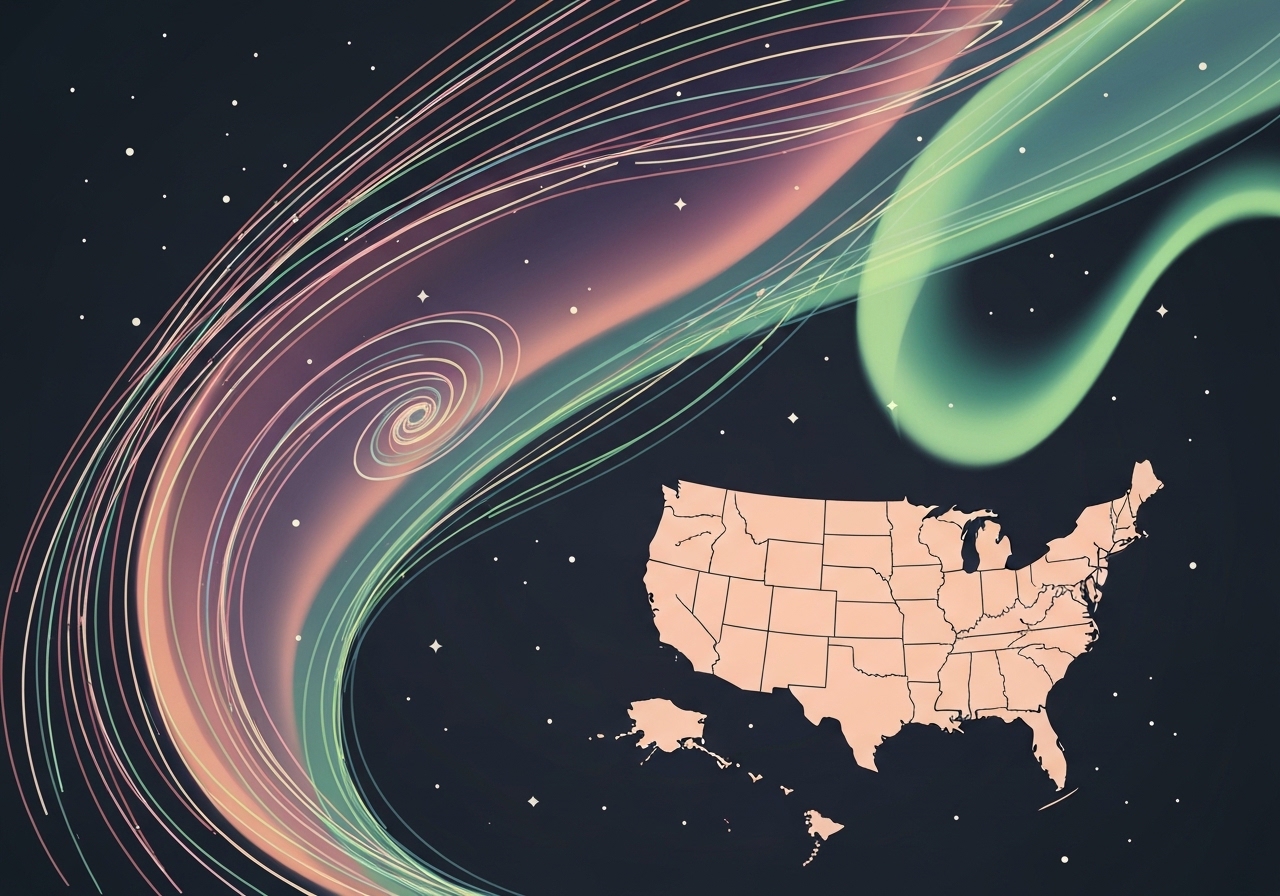
Observers across 24 states currently sit at or above NOAA’s aurora view line for tonight: Alaska, Washington, Oregon, Idaho, Montana, North Dakota, Minnesota, South Dakota, Wisconsin, Wyoming, Michigan, New York, Vermont, Maine, New Hampshire, Massachusetts, Nebraska, Iowa, Illinois, Indiana, Ohio, Pennsylvania, Missouri and Colorado. Local visibility will still vary with cloud cover, light pollution, and moment-to-moment changes in geomagnetic activity.
Analysis & implications
From a scientific perspective, this event highlights how fast CMEs from X-class flares can compress and disturb Earth’s magnetosphere on short timescales. The reported transit speed of 620–870 miles per second places this CME among the faster events, increasing the chance of intense, rapid geomagnetic responses. For space operators and infrastructure managers, a G4-level storm warrants heightened monitoring: satellite teams may switch to safe modes, HF radio users can expect outages at high latitudes, and power grid operators may be on alert for extra induced currents in long transmission lines.
For the public and aurora chasers, the implication is twofold. First, a well-timed southward Bz could produce wide-ranging, vivid displays that push the aurora oval into mid-latitudes, making sightings possible far from normal viewing zones. Second, even when geomagnetic indices are high, aurora occurrence can be patchy and transient; brief intervals of favorable orientation can yield intense displays that vanish minutes later if the magnetic coupling changes. That volatility makes real-time monitoring and local conditions (clouds, moonlight) decisive.
Internationally, strong geomagnetic storms can interfere with navigation systems that depend on magnetically sensitive measurements, and they can elevate radiation levels in near-Earth space, affecting astronaut operations and high-altitude flights on polar routes. Agencies worldwide coordinate alerts and advisories when events reach G3–G5 to help stakeholders mitigate operational impacts.
Comparison & data
| EST (Jan) | GMT | NOAA forecasted activity |
|---|---|---|
| 7 p.m. – 10 p.m. (Jan. 19) | 0000–0300 (Jan. 20) | Minor (G1) possible |
| 10 p.m. – 1 a.m. (Jan. 20) | 0300–0600 (Jan. 20) | Moderate (G2) possible |
| 1 a.m. – 4 a.m. (Jan. 20) | 0600–0900 (Jan. 20) | Severe (G4) possible |
| 4 a.m. – 7 a.m. (Jan. 20) | 0900–1200 (Jan. 20) | Moderate (G2) possible |
| 7 a.m. – 10 a.m. (Jan. 20) | 1200–1500 (Jan. 20) | Strong (G3) possible |
| 10 a.m. – 1 p.m. (Jan. 20) | 1500–1800 (Jan. 20) | Moderate (G2) possible |
| 1 p.m. – 1 a.m. (Jan. 21) | 1800–0600 (Jan. 21) | Minor (G1) possible |
This table reproduces NOAA’s 3-day forecast windows and the agency’s expected activity tiers. The forecast shows the highest chance of severe (G4) conditions overnight between 1–4 a.m. EST (0600–0900 GMT) on Jan. 20, but the earlier shock arrival already generated G4-level indices at 2:38 p.m. EST (1938 GMT) on Jan. 19. Historic comparisons show that fast CMEs with a sustained southward Bz often produce the most expansive auroral reaches, while mixed-field CMEs produce intermittent displays.
Reactions & quotes
NOAA and space-weather observers noted the rapid onset and emphasized monitoring of the CME’s magnetic structure as it evolves.
“The shock arrival has produced severe geomagnetic storming; people in high- to mid-latitudes should watch sky conditions and space weather alerts.”
NOAA Space Weather Prediction Center (official advisory)
Independent researchers and aurora chasers highlighted both the excitement and uncertainty that accompany such fast events.
“Fast-moving, X-class-associated CMEs often deliver strong displays when Bz turns south, but the orientation is the wildcard that decides how far auroras reach.”
Space weather researcher (academic summary)
Unconfirmed
- Whether the CME’s dominant Bz will remain southward for a prolonged interval — this determines whether auroras will expand to mid-latitudes and is not fully known until upstream satellites report.
- Extent of sighting in southern or low-mid-latitude U.S. locations — forecasts show potential for expansion, but localized cloud cover and short-lived magnetic changes could prevent visible displays.
- Any operational impacts to specific satellites or power systems are provisional; agencies may update warnings if conditions evolve beyond current forecasts.
Bottom line
A fast CME launched during an X-class flare on Jan. 18 reached Earth on Jan. 19 and produced G4-level geomagnetic storming early in the evening, creating a realistic chance for auroras across 24 U.S. states tonight. The key variable remains the CME’s magnetic orientation: a sustained southward Bz would boost auroral brightness and push the oval southward, while a northward orientation would limit visible effects despite high solar wind speeds.
Practical advice: if you’re positioned within the forecasted view area, pick a dark site with a clear northern horizon, let your eyes dark-adapt, and use a camera or aurora app to detect faint glows. Keep monitoring official NOAA/Met Office updates and satellite measurements (DSCOVR/ACE) for real-time changes that will determine whether tonight becomes a memorable aurora event or a close miss.
Sources
- Space.com — Media report summarizing NOAA updates and aurora outlooks (news).
- NOAA Space Weather Prediction Center — Official agency forecasts and advisories (official/agency).
- U.K. Met Office — Northern Hemisphere aurora guidance and forecast products (government agency).
- DSCOVR satellite information (NOAA/NASA) — Solar wind monitoring upstream of Earth (official/agency).