
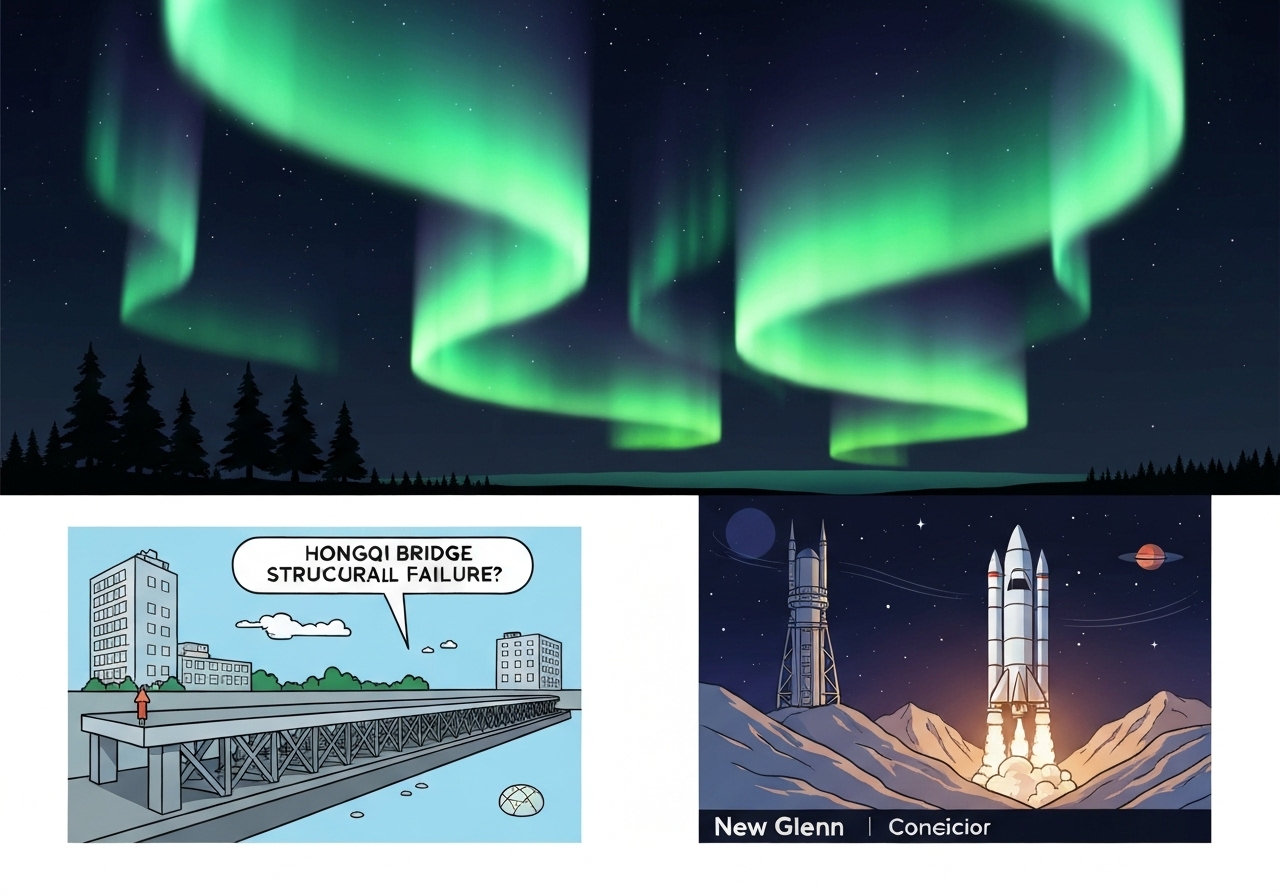
Lead
On Nov. 12, 2025, a burst of space- and earth-focused stories converged: strong solar activity produced auroras visible far south across the United States, astronomers reported possible first-generation star candidates from JWST data, and spaceflight watchers monitored Blue Origin’s New Glenn launch after a weather delay. Ground and public-safety threads also surfaced — an emergent report about a Hongqi bridge collapse has circulated but remains unverified. Collectively, these developments touch astrophysics, planetary defense, space commerce and public health policy.
Key takeaways
- Geomagnetic storms triggered by multiple coronal mass ejections on Nov. 11–12, 2025 produced aurora displays expected as far south as northern California and Alabama.
- Researchers using the James Webb Space Telescope identified candidates for Population III (first-generation) stars in the MACS J0416 cluster; confirmations will require follow-up spectroscopy.
- South Africa’s MeerKAT array detected radio emission from interstellar comet 3I/ATLAS, consistent with natural cometary activity rather than engineered signals.
- Blue Origin’s New Glenn launch, originally scheduled for Nov. 9, was postponed due to weather and targeted a Nov. 12 attempt as part of its first NASA mission.
- Public-health and policy notes: Canada lost measles elimination status after sustained transmission; declines in routine childhood vaccination are cited as drivers.
- New comet C/2025 V1 (Borisov) made a close approach on Nov. 11; it is not interstellar and likely originates from the Oort cloud.
- Cannibal coronal mass ejections — where one CME overtakes another — were identified as the driver of the strong geomagnetic disturbance on Nov. 12.
Background
Solar activity waxes and wanes on roughly 11-year cycles, but individual events such as solar flares and coronal mass ejections (CMEs) can produce short-term spikes in geomagnetic activity. When CMEs intersect Earth’s magnetosphere they compress and energize charged particles, lighting up auroral ovals that occasionally extend to mid-latitudes. Space weather forecasting uses coronagraph imagery and in-situ solar wind measurements to predict storm strength and timing; on Nov. 11–12, multiple CMEs aligned to create unusually strong conditions.
On the astronomical front, the James Webb Space Telescope (JWST) is now deep enough to isolate extremely faint sources in crowded galaxy-cluster fields like MACS J0416. The term Population III refers to primordial stars formed from pristine hydrogen and helium shortly after the Big Bang; locating them tests models of early structure formation. Separately, the recent spate of comets — including the interstellar 3I/ATLAS and the Oort-cloud visitor C/2025 V1 (Borisov) — has reignited public interest in how small bodies inform planetary origins and interstellar exchange.
Commercial and governmental spaceflight activities continue to accelerate competition. Blue Origin’s New Glenn program aims to be a reusable heavy-lift contender, and weather constraints routinely drive schedule slips for high-risk orbital launches. Meanwhile, global institutions convene on climate and health: COP30 in Belém, Brazil, seeks implementation progress on emissions reductions, and public health authorities flagged measles resurgence as vaccination rates fell after the COVID-19 disruption.
Main event
Geomagnetic storms arriving Nov. 11–12 were the product of at least three solar ejecta, one of which overtook a preceding CME to form a merged, faster front — a so-called cannibal CME. Ground-based aurora watchers and satellite operators noted elevated Kp indices and expanded auroral visibility. Forecasts predicted auroral displays over wide swaths of the continental United States, prompting photographers and citizen scientists to share imagery with media outlets.
In observational cosmology, a JWST team reported candidate detections consistent with Population III star clusters in MACS J0416. The signals are faint and interpretation depends on model assumptions about stellar metallicity and nebular emission; researchers emphasize that spectroscopic confirmation is needed before claims can be finalized. If confirmed, such detections would constrain when and how the first luminous objects reionized the cosmos and seeded later galaxy growth.
MeerKAT’s detection of radio emission from 3I/ATLAS provided new diagnostics of the interstellar visitor’s active chemistry and dust–gas interactions. Radio signatures are expected from natural cometary processes — for example, molecules and ionized gas interacting with solar wind — and current analyses favor a natural origin. Simultaneously, astronomers clarified that prior reports of the comet’s ‘death’ were premature: the object remains observable and is tracked through its Dec. 19 closest approach timeline.
Blue Origin delayed New Glenn’s maiden NASA-affiliated mission from Nov. 9 due to poor weather and targeted a subsequent window on Nov. 12. The launch’s success or further slip will have implications for commercial heavy-launch reliability and competition with incumbents such as SpaceX. Blue Origin characterizes New Glenn as an important step for reusable, high-capacity orbital access.
Analysis & implications
Space weather events that drive mid-latitude auroras also pose operational risks: heightened geomagnetic activity can disrupt satellite electronics, increase drag on low-Earth satellites, and induce currents in power grids. The Nov. 11–12 storms illustrate the need for robust forecasting and resilient infrastructure, especially as satellite constellations proliferate. Utilities and satellite operators will review anomaly logs from the interval to assess impact.
Potential JWST detections of Population III candidates carry outsized theoretical weight. Confirmed first-generation stars would anchor models of early chemical enrichment and the timing of cosmic reionization. However, the margin for interpretive error is substantial; lensing effects in cluster fields, contamination by foreground sources, and uncertain stellar population synthesis models demand cautious follow-up with spectroscopy and independent teams.
The radio observations of 3I/ATLAS diminish popular-alien explanations and instead enrich our empirical picture of how irradiated interstellar bodies evolve. Knowing that interstellar comets can emit measurable radio signatures helps refine search strategies for rare interstellar visitors and informs models of outgassing and particle-solar wind interactions. Continued multiwavelength monitoring is key to constraining composition and structure.
Commercial launch delays like New Glenn’s weather hold are routine, but their cumulative effect matters: schedule slippage affects flight manifest, investor confidence and competition timelines. A successful launch would bolster Blue Origin’s commercial case; another delay or failure could alter procurement calculus for customers seeking reliable heavy-lift services.
Comparison & data
| Event | Date | Key detail |
|---|---|---|
| Aurora (geomagnetic storm) | Nov. 11–12, 2025 | Visibility as far south as northern California and Alabama |
| C/2025 V1 (Borisov) | Closest approach Nov. 11, 2025 | Oort-cloud origin; high eccentricity |
| 3I/ATLAS (interstellar) | Ongoing tracking; closest approach Dec. 19, 2025 | MeerKAT radio detection; natural activity likely |
| New Glenn launch (Blue Origin) | Original: Nov. 9; delay to: Nov. 12, 2025 | Weather-caused slip; first NASA mission for vehicle |
The table summarizes timing and distinguishing features of the principal stories discussed. Readers should note that orbital dates are observational close-approach times and can differ slightly from launch or encounter windows used operationally.
Reactions & quotes
Officials at the United Nations Framework Convention on Climate Change framed COP30 as an implementation-focused summit even as attendance by some major emitters was limited. The UN’s executive secretary stressed urgency ahead of negotiators’ technical work.
“We must move much, much, faster on both reductions of emissions and strengthening resilience,”
Simon Stiell — UN Climate Change Executive Secretary (statement at COP30 opening)
In scientific retrospection about landmark mathematics, Grigori Perelman’s withdrawal from prizes and public life remains a cultural footnote; his terse reply to a reporter years later captures his reticence.
“You are disturbing me. I am picking mushrooms,”
Grigori Perelman — reported response in 2010
On the comet question, astronomers and radio specialists emphasized natural explanations after MeerKAT’s measurements, urging ongoing observation rather than sensational claims.
Unconfirmed
- Reports of a Hongqi bridge collapse are circulating but lack independent confirmation from emergency services or government statements at the time of writing.
- Some early interpretations of JWST candidates as definitive Population III stars remain provisional pending spectroscopic confirmation and independent analyses.
- Rumors that 3I/ATLAS is an artificial probe are unsupported by current radio and optical datasets and are considered unlikely by most specialists.
Bottom line
The Nov. 11–12 news mix underscores how rapidly different fields intersect: solar storms affect ground infrastructure and create public spectacle, cutting-edge telescopes probe the universe’s first light, and commercial launch cadence shapes the near-term space economy. Each story carries practical follow-ups — from grid and satellite resilience planning to spectroscopic campaigns with JWST and ground telescopes to routine launch-readiness checks for New Glenn.
Readers should expect clarifications: JWST candidate identifications will be tested with deeper spectroscopy, 3I/ATLAS will continue to be monitored through its Dec. 19 vicinity, and official confirmation is required before treating the Hongqi bridge reports as established fact. Together these threads illustrate science’s iterative process and the value of patient verification.