
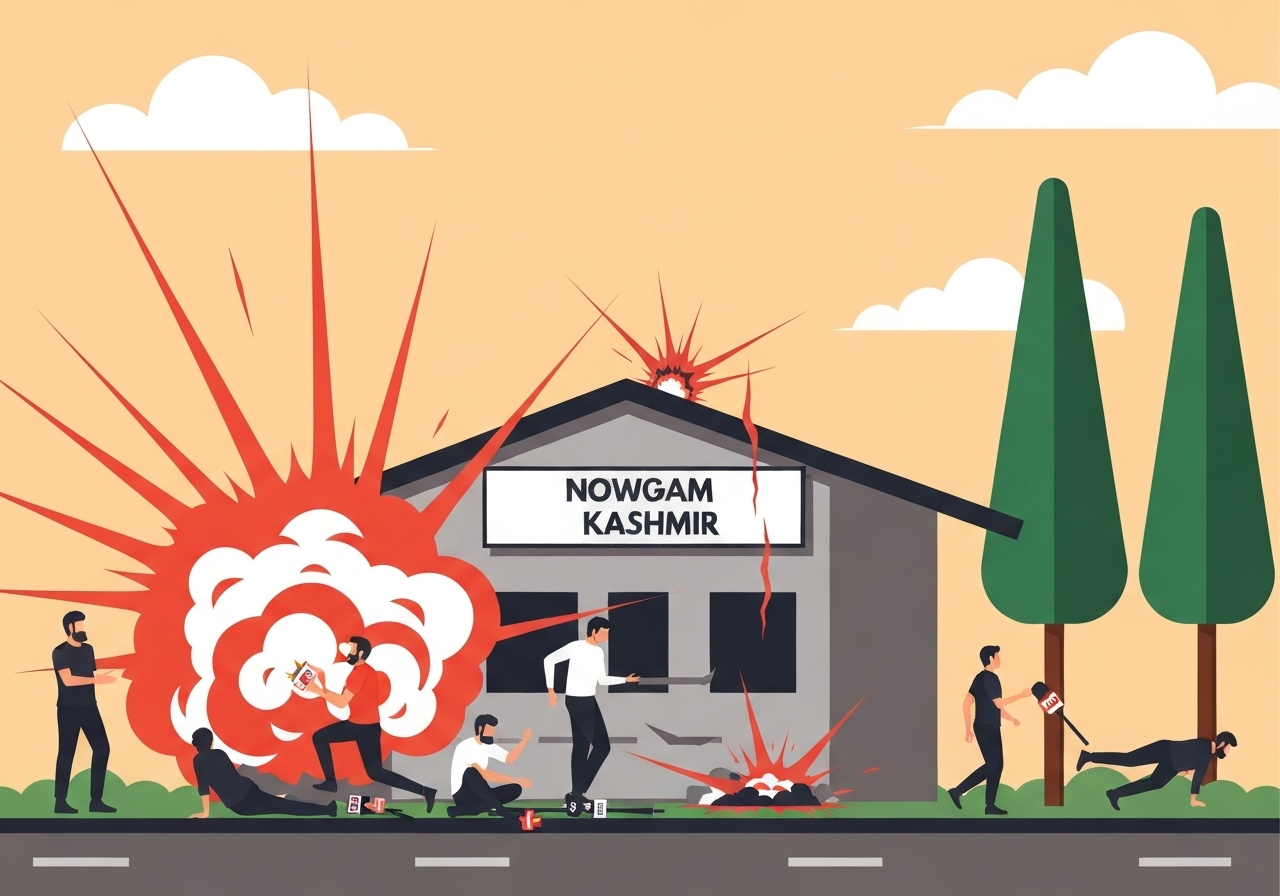
On Friday evening a cache of confiscated explosives detonated at Nowgam police station in Srinagar, Indian-administered Kashmir, killing nine people and injuring 32, police said. The explosives had been seized earlier in the week in Faridabad, Haryana and were being prepared for forensic examination when the blast occurred at about 23:20 local time (17:50 GMT). Regional police described the detonation as accidental and not a terrorist attack, and authorities have opened an inquiry into the handling of the material. The station and nearby buildings were heavily damaged, and emergency teams are treating the wounded and securing the site.
Key Takeaways
- Nine people were confirmed dead and 32 injured after an explosion at Nowgam police station in Srinagar on Friday evening.
- The explosives originated from a seizure in Faridabad, Haryana earlier in the week and were being sent for forensic analysis when they detonated at around 23:20 local time (17:50 GMT).
- Police say the blast was an accidental detonation, not a terrorist act; the director general of police called speculation unnecessary.
- Most victims were police officers and forensic personnel; among the dead were two crime scene photographers and a tailor who had accompanied the team.
- The police station and adjacent buildings sustained severe structural damage; vehicles were destroyed and debris was found up to 100–200 metres away, according to reporting at the scene.
- Lieutenant Governor Manoj Sinha ordered a probe and expressed condolences, asking for a speedy recovery of the injured.
Background
The Kashmir region has seen a long-running security focus, with local authorities regularly seizing weapons and explosives as part of counterinsurgency and criminal investigations. Confiscated material is commonly transported to regional laboratories for forensic testing to establish origin, composition and links to criminal or militant networks. Proper chain-of-custody and secure packaging are standard procedure, but incidents involving explosive material during transport or storage, while rare, present acute safety risks for handling teams.
In recent years authorities have tightened protocols for evidence movement across Indian states; yet the logistics of moving hazardous items from distant locations such as Faridabad in Haryana to forensic labs in Jammu and Kashmir complicate operational control. The Nowgam blast comes days after a separate car explosion in Delhi that the government called a terror incident, heightening public concern about both deliberate attacks and accidental detonations. Local police forces, forensic units and prosecutors rely on careful evidence handling to build legal cases, so any breach can have legal and operational consequences.
Main Event
Police briefings say the explosives were packaged and readied for dispatch to a forensic laboratory when a handling mishap caused detonation at the Nowgam police station. The director general of police, Nalin Prabhat, described the event as a “very unfortunate mishap” and said the devices were to be examined by forensic teams. The blast occurred at approximately 23:20 local time and produced a powerful shock that shattered windows, collapsed parts of the station and ignited nearby vehicles.
First responders found multiple bodies at the scene and carried the wounded to hospitals across Srinagar; most of the fatalities were members of the police and allied forensic staff present for evidence processing. Police said debris and human remains were projected significant distances from the blast site, amplifying the tragedy for nearby residential areas. Local emergency services reported widespread structural damage to adjacent buildings and burned-out vehicles described as charred husks by officers at the site.
Manoj Sinha, the region’s Lieutenant Governor, posted condolences on social media and publicly ordered an official probe into the circumstances of the detonation. Investigators have sealed the scene and begun collecting witness statements while forensic teams — where safe to operate — will attempt to reconstruct the sequence of events. Authorities have emphasised that the incident is being treated internally as an accidental explosion rather than an act of terrorism.
Analysis & Implications
The immediate policy question is whether standard operating procedures for storing, handling and transporting seized explosives were followed. If protocols were breached, the findings may trigger revisions in chain-of-custody rules and additional training for local teams that handle hazardous evidence. Forensics units nationwide could face renewed scrutiny over capacity and the availability of secure, proximate testing facilities to reduce long-distance transfers.
Politically, the explosion risks intensifying public scrutiny of administrative oversight in a region already sensitive to security failures. Local officials will likely be pressed for transparent, time-bound findings to avoid speculation; any perceived delay or lack of clarity could inflame public anxiety. The government will also need to reconcile the characterization of this blast as accidental with the recent Delhi car blast, differentiating response measures for deliberate attacks versus handling accidents.
Operationally, police forces across India may review their evidence storage and transport arrangements to limit on-site processing of highly unstable material. Investments in mobile containment units, stricter inventory controls and mandatory remote forensic processing could follow, but these measures require funding, training and a timeline that will be closely watched by oversight bodies and the public. The incident highlights how a single handling error can produce outsized human and material costs, underscoring the stakes of evidence management practices.
Comparison & Data
| Incident | Date | Location | Casualties | Note |
|---|---|---|---|---|
| Nowgam police station explosion | Friday (around 23:20 local) | Srinagar, Indian-administered Kashmir | 9 killed, 32 injured | Explosives seized earlier in Faridabad; being sent for forensics |
| Delhi car blast | Days earlier | Delhi | Several killed | Government described as a “terror incident”; separate investigation |
The table places the Nowgam detonation alongside a recent Delhi incident to show differing official characterisations: authorities call the Nowgam event accidental, while the Delhi blast has been described by the government as a terror incident. Comparing the two underscores the operational need to distinguish security responses and forensic priorities between deliberate attacks and accidental detonations.
Reactions & Quotes
Officials emphasised the accidental nature of the blast while promising an investigation and emergency support to victims and families.
An accidental detonation occurred during handling; any other speculation into the cause is unnecessary.
Regional police chief (Nalin Prabhat)
The region’s civilian leadership reacted publicly, offering condolences and ordering inquiries to establish exactly what went wrong in handling the seized material.
I have ordered a probe to ascertain the cause of the accidental explosion. Deeply anguished by the loss of precious lives.
Lieutenant Governor Manoj Sinha
Local emergency crews and neighbours described a large blast with significant collateral damage, reporting destroyed vehicles and debris scattered into nearby residential areas.
The intensity of the blast damaged neighbouring houses and vehicles; rescue teams are working to recover victims and help the injured.
On-scene emergency responder (summary)
Unconfirmed
- Exactly how the handling error occurred — the specific action or equipment failure that triggered the detonation — has not yet been verified by investigators.
- Whether any procedural lapses, such as inadequate packaging or deviations from chain-of-custody protocol, directly contributed to the blast remains under investigation.
- Reports that human remains were found up to 100–200 metres away are based on initial accounts and will be subject to official forensic confirmation.
Bottom Line
The Nowgam explosion is a severe accidental detonation with major human and material consequences, claimed by officials as unrelated to terrorism. It exposes vulnerabilities in how hazardous forensic evidence is handled and transported, and will likely prompt procedural reviews and stronger containment measures. Authorities face immediate pressure to publish a clear, evidence-based account of what went wrong to prevent misinformation and to reassure the public and probe participants.
In the coming weeks, investigators’ findings will determine whether the incident leads to local administrative changes, national policy adjustments on evidence transport, or investments in safer forensic infrastructure closer to seizure sites. For families of the victims and local communities, the urgent needs are medical care, transparent answers and steps that meaningfully reduce the risk of a repeat tragedy.
Sources
- BBC News — international media report summarising official statements and on-scene accounts
- Jammu & Kashmir Police — official police website (institutional/official)