
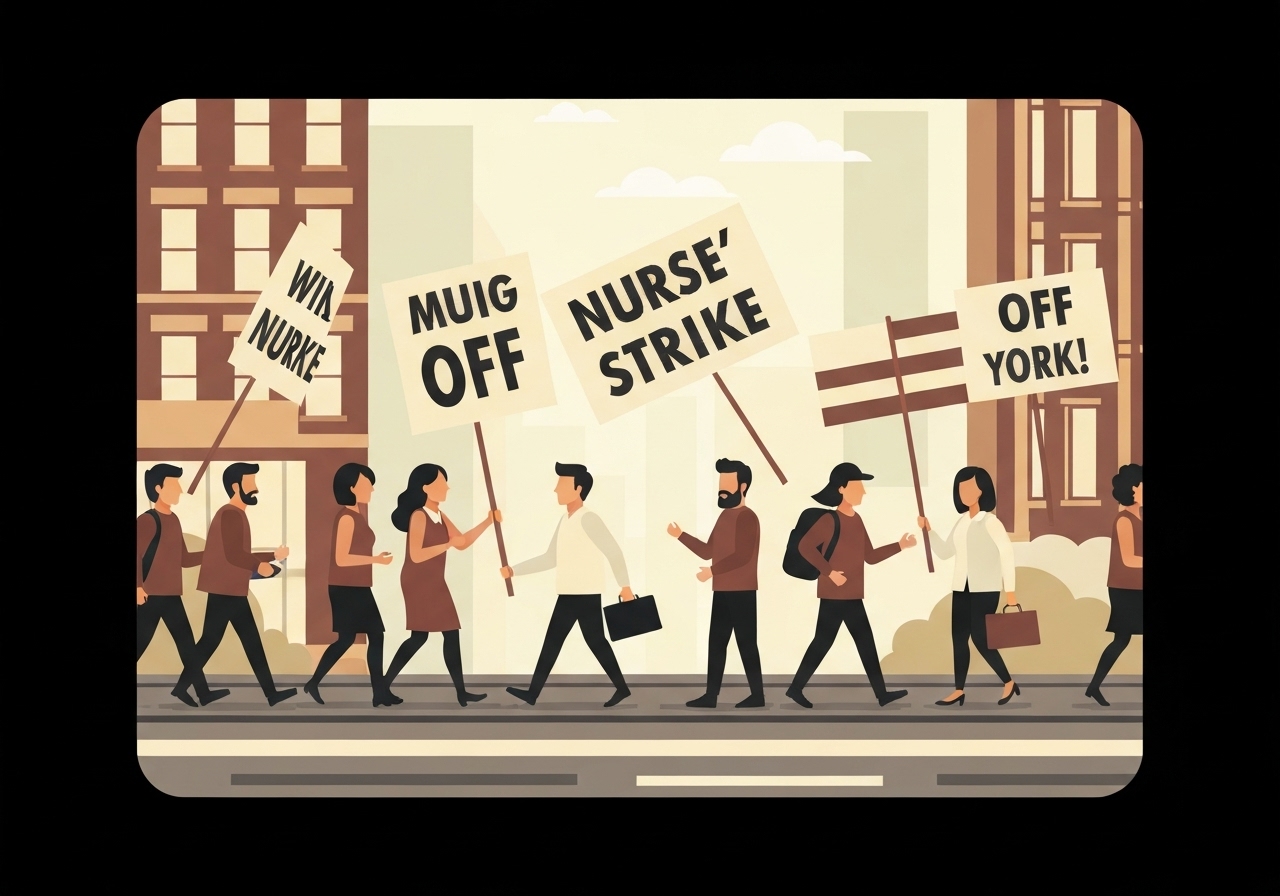
The largest nurses strike in New York City history began on January 12, 2026, when negotiators for five major private hospital systems and the New York State Nurses Association (NYSNA) failed to reach a new contract by the union’s deadline. Nearly 15,000 nurses walked out at Mount Sinai Hospital, Mount Sinai Morningside, Mount Sinai West, NewYork-Presbyterian facilities in Manhattan and Montefiore Einstein in the Bronx; pickets began at 6 a.m. at Mount Sinai and 7 a.m. at the other hospitals. Governor Kathy Hochul declared a state of emergency as state and city officials mobilized contingency staffing and Department of Health oversight to preserve patient care. Hospitals said they had contingency plans—including more than 1,400 temporary or reassigned nurses at Mount Sinai—and the union said the strike was necessary to press demands on pay, staffing and benefits.
Key takeaways
- Scale: NYSNA says nearly 15,000 nurses struck on Jan. 12, 2026 across five private hospital systems in NYC, the largest nurses walkout in city history.
- Hospitals affected: Mount Sinai Hospital, Mount Sinai Morningside, Mount Sinai West, NewYork-Presbyterian (Manhattan locations) and Montefiore Einstein (Bronx) began picketing between 6–7 a.m.
- Union demands: NYSNA cites a roughly $3.6 billion package and seeks pay increases (union references near-40% raises), safer staffing ratios, full health coverage and stronger workplace protections.
- Hospital response: Institutions called the strike “reckless,” announced contingency staffing (Mount Sinai cited 1,400 qualified nurses) and said emergency departments would remain open.
- Government action: Gov. Kathy Hochul declared a state of emergency and issued executive orders to deploy Department of Health staff to impacted hospitals to protect continuity of care.
- Local politics: New York City Mayor Zohran Mamdani publicly joined picketers and urged both sides to return to bargaining, emphasizing nurses’ value and the need to maintain care.
- Operational impact: Hospitals advised patients not to delay care; some families reported access and prescription pickup difficulties for striking staff, which hospitals said could be mitigated by alternate arrangements.
Background
The walkout grew from months of contract negotiations between NYSNA and large, privately run hospital systems in New York City. The union argues that rising workloads, increasing workplace violence and shrinking benefits have left nurses overstretched while the city’s largest health systems report strong revenues. NYSNA says its package addresses wages, staffing ratios, health coverage and retirement security, while hospitals counter that certain union proposals are unaffordable and operationally risky.
Past nursing actions in New York and elsewhere have centered on safe-staffing and pay; unions point to research linking staffing levels to patient outcomes, and employers cite tight budgets, regulatory pressures and complex payer mixes. This dispute widened because some systems reached separate agreements earlier (for example, Northwell Health facilities in Nassau County reached deals), leaving the five private systems named by NYSNA in dispute as the union set a Jan. 12 deadline.
Main event
On the morning of Jan. 12, picketers assembled outside multiple hospital entrances. NYSNA said Mount Sinai nurses began walking off at 6 a.m.; other hospitals started picketing roughly an hour later. Union leaders held a news conference describing the action as a last resort after weekend bargaining failed to bridge gaps on core demands.
Hospital leaders released statements condemning the strike and emphasizing patient safety preparations. Montefiore said it was preparing for a strike that could last multiple weeks; Mount Sinai said it had mobilized roughly 1,400 qualified and specialized nurses to maintain care. NewYork-Presbyterian similarly described contingency measures and said negotiations could continue during the walkout.
Officials took steps to avoid disruptions: Gov. Hochul issued executive orders to allow the state Department of Health to assign personnel to impacted facilities; Montefiore and others said emergency departments and urgent services would remain open. Hospitals urged patients to follow direct instructions from providers about appointments and to continue seeking emergency care as needed.
Analysis & implications
Short-term effects are likely to include operational strain on inpatient units, elective procedure rescheduling and higher use of temporary staffing. Hospitals’ contingency plans mitigate immediate risk to critical care, but prolonged reliance on agency or reassigned personnel can increase costs and create continuity challenges for patients with complex needs.
Economically, the union’s cited $3.6 billion package and near-40% wage figure, if achieved, would represent a material increase in labor costs for systems already navigating thin margins and mixed payer reimbursement. Hospitals argue such increases would force trade-offs elsewhere; the union contends better pay and staffing will reduce turnover and improve long-run quality and costs.
Politically, the strike has local and state visibility. Mayor Mamdani’s presence on picket lines signals municipal support for nurses’ demands, while Gov. Hochul’s emergency declaration signals state intent to prioritize patient access. The divergence between municipal support and executive measures to maintain staffing suggests a delicate balance between backing labor concerns and ensuring uninterrupted care.
Comparison & data
| Hospital | Borough | Pickett start time | Notes |
|---|---|---|---|
| Mount Sinai Hospital / Morningside / West | Manhattan | 6:00–7:00 a.m. | Mount Sinai said ~1,400 qualified nurses mobilized as contingency |
| NewYork-Presbyterian (Manhattan locations) | Manhattan | 7:00 a.m. | Stated contingency staffing and continued negotiations; EDs open |
| Montefiore Einstein | The Bronx | 7:00 a.m. | Preparing for a multi-week strike; reported operational contingency plans |
The table summarizes public statements and on-the-ground timing. While total union numbers are reported as nearly 15,000 across the five systems, individual-hospital strike counts were not uniformly disclosed by either side; hospitals emphasize continuity-of-care measures while the union highlights scale and coordinated action.
Reactions & quotes
The value of nurses is not negotiable; they deserve dignity, respect and fair pay.
Zohran Mamdani, Mayor of New York City
Mayor Mamdani joined picketers and urged both sides back to negotiations, framing the strike as a demand for dignity and livable pay in the city.
NYSNA leaders continue to press a $3.6 billion proposal and are committed to securing safe staffing and coverage.
NYSNA (union statement)
The union emphasized its economic package and said the strike is necessary after bargaining stalled over core protections including staffing and benefits.
We remain resolute in our commitment to providing safe and seamless care, regardless of how long the strike may last.
Montefiore senior executive (press statement)
Hospital officials framed the walkout as disruptive and pledged to keep emergency services open while seeking to maintain patient safety through contingency staffing and operational adjustments.
Unconfirmed
- The precise breakdown of the nearly 15,000 striking nurses by individual hospital has not been published by all parties and remains unconfirmed.
- Claims that union proposals would prevent termination of nurses found impaired by drugs or alcohol on the job were cited by hospital statements; the exact contractual language and its interpretation remain disputed and unverified publicly.
- Reports of individual nurses being denied prescription pickups or visitor access at Montefiore emerged from social media and a video; hospitals say alternate arrangements exist, but some specific incidents lack independent verification.
Bottom line
The Jan. 12, 2026 nurses strike in New York City is both a labor flashpoint and a stress test for urban hospital systems and civic authorities. In the short term, hospitals and state agencies are focusing on maintaining emergency and critical care through contingency staffing and executive actions; patients are advised to seek necessary care and follow provider guidance.
Longer term, the outcome will shape labor costs, staffing practices and political dynamics in a city where pay, housing costs and quality of life are integral to workforce retention. Negotiations remain the primary pathway to resolution; the immediate outlook depends on whether the union and hospital systems can narrow differences on wages, staffing and benefits without prolonged disruption to patient care.