
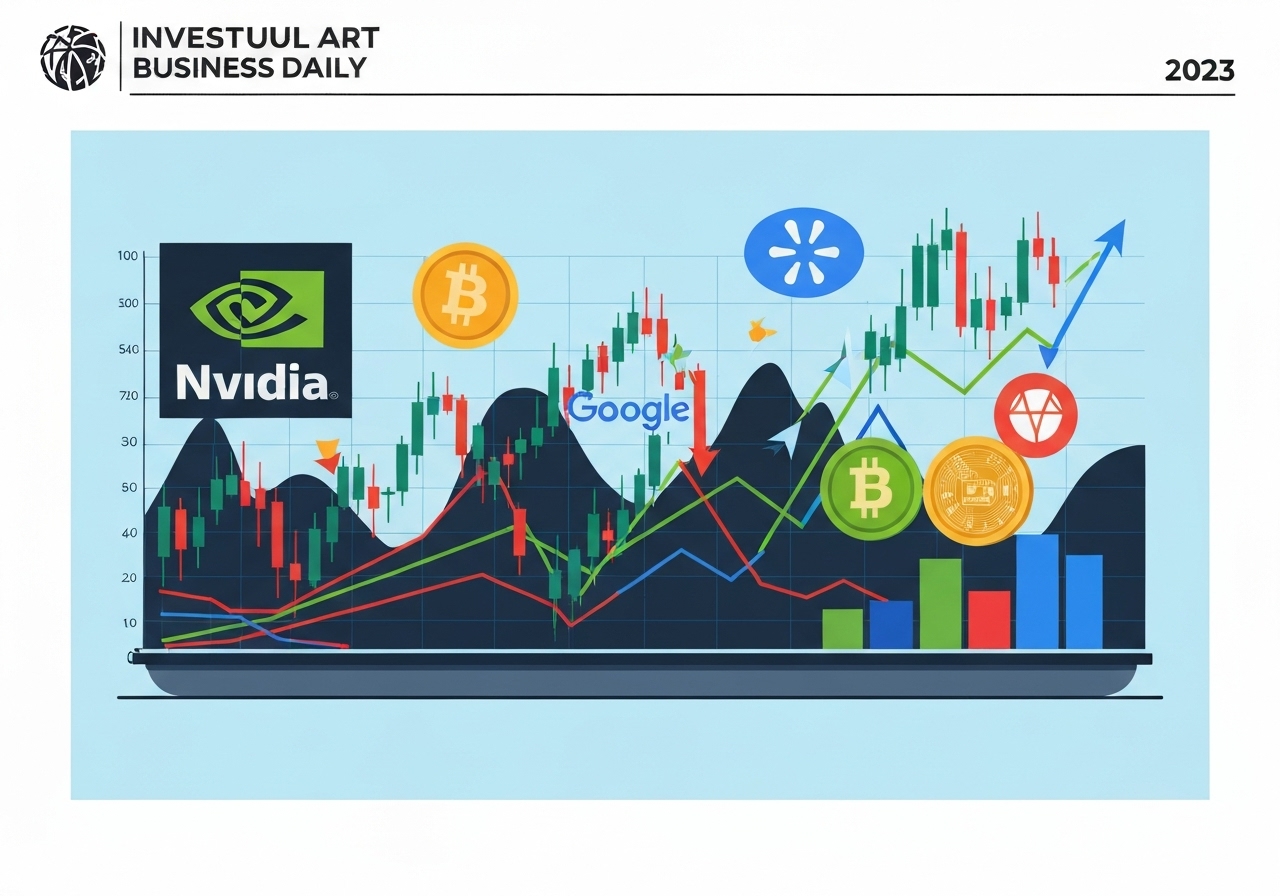
Major U.S. stock indexes fell sharply this week as a reversal in Nvidia’s post‑earnings move and weakness in bitcoin dragged technology and chip names lower. The S&P 500 and Nasdaq both closed beneath their 50‑day moving averages for the first time in months, amplifying selling pressure across growth and AI‑related sectors. Traders attempted a rally on Thursday after Nvidia initially gapped up on results, but the chip giant reversed and led declines that carried into the broader market before a partial bounce on Friday amid hopes for earlier Federal Reserve easing.
Key Takeaways
- The S&P 500 and Nasdaq closed below their 50‑day moving averages this week, a technical threshold not breached in months.
- Nvidia (NVDA) initially jumped on earnings but reversed and was a primary driver of declines across chip and AI stocks.
- Bitcoin sold off alongside equities, contributing to risk‑asset weakness and headline volatility.
- Walmart and Google showed relative strength, acting as defensive and large‑cap anchors in the market.
- Market internals were negative: breadth weakened with more decliners than advancers across major exchanges.
- Traders cited renewed concern about valuation in AI plays and the timing of Fed rate cuts as catalysts for the selloff.
Background
U.S. equity markets have been navigating a landscape of strong corporate earnings from marquee technology firms, persistent inflation readings and shifting expectations about Federal Reserve policy. In recent months, gains were concentrated in a smaller group of large‑cap growth names, many tied to artificial intelligence investment themes. That concentration made the indexes vulnerable to headline reversals when any of the leaders sold off.
Semiconductor companies and AI‑related stocks had outperformed for much of the year as investors priced in robust demand for AI hardware and software. However, that outperformance also stretched valuations relative to historical norms. Meanwhile, cryptocurrencies such as bitcoin have been correlated with risk appetite, so sharp moves in digital assets can amplify swings in technology stocks.
Main Event
On the day Nvidia reported results, the stock initially gapped higher after hours and reopened with bullish momentum as investors parsed the company’s revenue and guidance. The early lift briefly buoyed other chip and AI suppliers, suggesting a potential sectorwide relief rally. Market participants quickly reassessed the headlines, and Nvidia reversed course, triggering stop‑losses and prompting quick de‑risking by short‑term holders.
The reversal in Nvidia pressured chip ETFs and suppliers, and that selling spilled into broader growth names that had been extended. The pullback pushed the S&P 500 and Nasdaq below key technical support at their 50‑day moving averages, a threshold many quantitative strategies and trend‑following traders monitor. That technical break increased volatility and widened intraday price swings.
Bitcoin fell during the same sessions, reducing risk appetite among certain investor groups and adding to cross‑asset pressure. At the same time, defensive and large‑cap names produced relative outperformance: Walmart held up on steady consumer demand signals, and Alphabet (Google) showed resilience due to its diversified ad and cloud revenue streams.
Friday saw a partial rebound as some traders bought the dip on hopes the Fed might move sooner toward rate cuts; however, the weekly damage remained notable, leaving investors debating whether the move was a short‑term correction or the start of a broader trend reversal.
Analysis & Implications
The technical breach of the 50‑day moving averages for both the S&P 500 and Nasdaq is significant because it changes the risk posture for momentum‑driven funds and algorithmic strategies that use moving averages for buy/sell signals. When widely observed technical levels fail, it can accelerate outflows and force crowded positions to unwind quickly.
Nvidia’s intraday reversal underscores the market’s sensitivity to headline risk in a narrow leadership market. Even when earnings are generally favorable, investors are increasingly focused on forward guidance and margin dynamics. That scrutiny disproportionately affects names with high valuation multiples tied to future growth assumptions, particularly AI plays and high‑multiple chipmakers.
A sustained correlation between bitcoin and growth equities raises the prospect of larger cross‑market contagion when risk assets move together. For portfolio managers, the joint movement reduces diversification benefits and requires recalibration of hedges and liquidity buffers, especially for funds with leverage or concentrated positions.
On the macro front, the partial bounce driven by renewed rate‑cut expectations highlights how monetary policy messaging can counteract or amplify earnings‑driven volatility. If the Fed’s timeline for easing shortens, it could reinvigorate risk assets; conversely, any surprise of extended tightness would likely prolong the correction, particularly among richly valued growth stocks.
Comparison & Data
| Item | Recent Move / Event |
|---|---|
| S&P 500 | Closed below 50‑day moving average this week |
| Nasdaq | Also closed below its 50‑day moving average |
| Nvidia (NVDA) | Gapped up on earnings then reversed lower intraday |
| Bitcoin | Declined alongside equities, increasing risk‑off pressure |
| Walmart & Google | Exhibited relative strength during the selloff |
The table above summarizes the core market moves and leadership shifts. While precise daily percentage changes varied across sessions, the qualitative pattern—leadership reversal, technical breaches, and defensive outperformance—was clear across major indices and sector groups.
Reactions & Quotes
Traders and strategists offered quick takes as the market moved. Below are short excerpts of market commentary and reporting to capture the immediate reaction and institutional view.
“Investors initially cheered Nvidia’s results, but the follow‑through selloff shows how sensitive the market is to guidance and position concentration.”
Investor’s Business Daily (news)
Market outlets highlighted that a narrow group of megacaps had been supporting index gains, so any weakness among them can disproportionately affect headline performance.
“The break below the 50‑day moving average is a technical development that many trend systems watch; it can trigger outsized flows when breached.”
Market strategist commentary (industry report)
Analysts noted that automated trading and funds that use moving averages for risk controls may have amplified the move.
“Retail interest in cryptocurrencies like bitcoin remains a volatility amplifier, pulling risk appetite in both directions.”
Market desk summary (news aggregation)
Observers pointed to cross‑asset links between crypto and equities as an important consideration for portfolio construction going forward.
Unconfirmed
- The exact contribution of algorithmic trading to the speed and magnitude of the selloff is not fully quantified and remains under review.
- Reports that large institutional reallocations caused the intraday reversal in Nvidia are not independently verified.
- The timing and scale of any Fed rate adjustments remain uncertain and subject to incoming economic data.
Bottom Line
This week’s action reminded investors that markets led by a handful of high‑growth names are vulnerable to rapid reversals when headlines or guidance disappoint. The technical break under the 50‑day moving averages for the S&P 500 and Nasdaq raises the odds of further near‑term volatility, particularly if leadership remains weak.
That said, pockets of resilience—exemplified by Walmart and Google—highlight that the selloff was uneven. Portfolio managers should reassess concentration risk, review liquidity plans, and consider hedges while watching economic data and Fed communications for cues on the policy path that could restore investor confidence.
Sources
- Investor’s Business Daily (news report)