
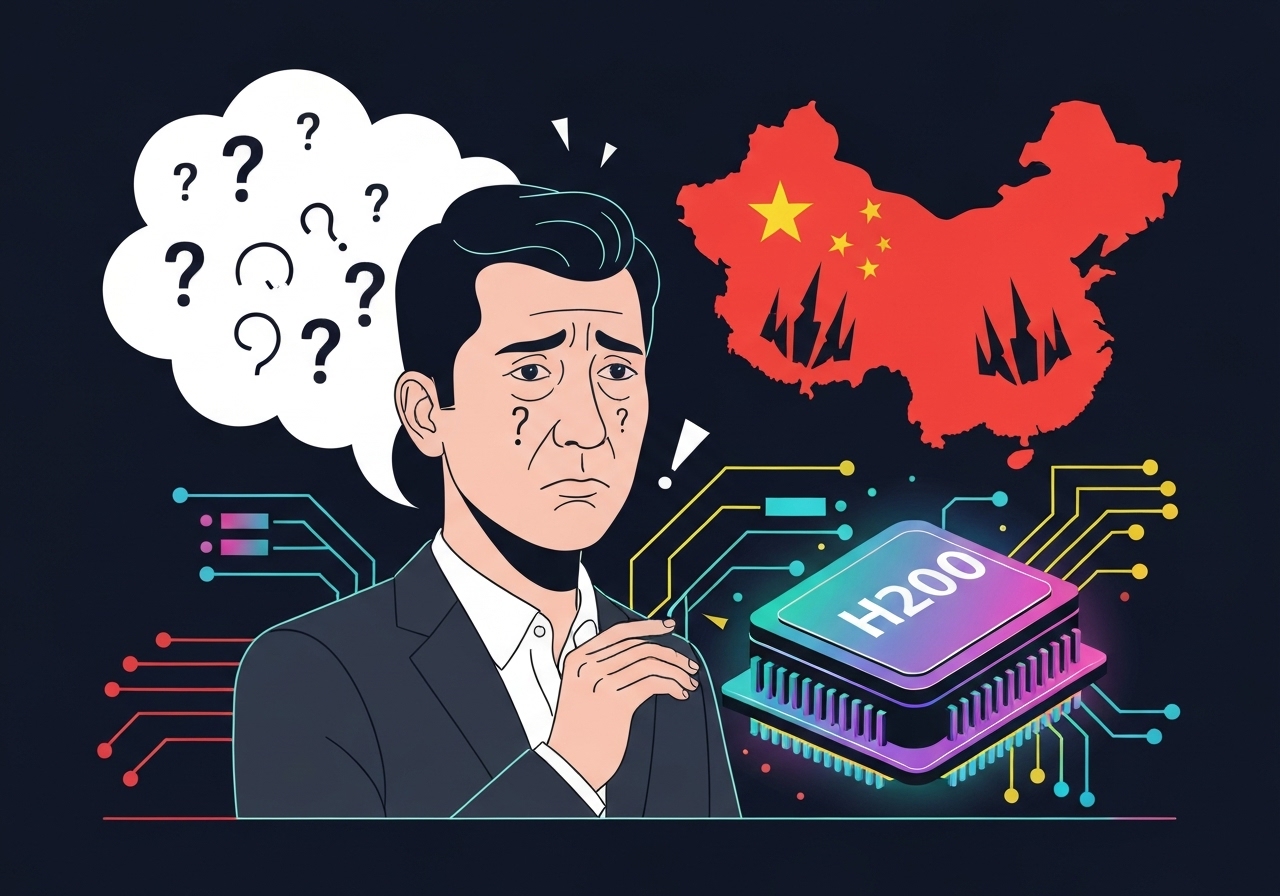
Lead: On December 3, 2025, after meeting President Donald Trump at the U.S. Capitol, Nvidia CEO Jensen Huang told reporters he was uncertain whether Chinese authorities would accept the company’s H200 artificial-intelligence chips if U.S. export restrictions were eased. Huang said he and Trump discussed export controls but declined to provide specifics. The exchange follows reports that Trump administration officials have been weighing whether to permit H200 sales to China, leaving the potential commercial pathway unclear.
Key takeaways
- Meeting: Jensen Huang met President Donald Trump at the U.S. Capitol on December 3, 2025; Huang spoke with reporters later that day.
- Central statement: Huang said he and the president “talked about export controls” but would not disclose details to the press.
- Uncertainty: Huang expressed uncertainty about whether Beijing would allow Chinese companies to buy Nvidia’s H200 chips if U.S. rules changed.
- Policy context: Bloomberg reported that U.S. administration officials have discussed lifting restrictions to allow H200 sales to China, a potentially significant policy shift.
- Commercial stakes: The H200 is a current-generation AI accelerator for high-performance workloads; any change in export rules could affect cloud providers and enterprise buyers in China.
Background
The U.S. has in recent years placed limits on the export of the most advanced AI chips to certain foreign markets, citing national-security and strategic-competition concerns. Nvidia, as a leading supplier of high-performance AI accelerators, sits at the center of commercial, technological and policy debates about how to balance U.S. economic interests with security priorities. Chinese cloud operators and AI developers are major customers of foreign AI hardware when access is permitted, and changes in U.S. policy can quickly reshape procurement plans and partnerships.
Washington’s internal discussions about whether to ease restrictions for specific products like the H200 reflect a broader tension: allowing sales can benefit U.S. firms’ revenues and global technology leadership, while potentially enabling adversaries’ capabilities. Stakeholders include Nvidia, U.S. national-security officials, the White House, and Chinese purchasers and regulators; each has competing commercial and strategic incentives shaping the outcome.
Main event
On December 3, 2025, Huang met with President Trump at the U.S. Capitol. Afterward, Huang addressed reporters and confirmed that export controls were raised in their conversation, but he declined to disclose substantive details about policy direction or concessions. Bloomberg’s reporting that day said U.S. administration officials had been debating whether to permit H200 sales to China; Huang’s public comments neither confirmed nor denied any imminent change.
When asked specifically whether Beijing would allow Chinese companies to buy H200 processors if U.S. restrictions were relaxed, Huang said he did not know whether Chinese authorities would accept them. He thus left unresolved both the U.S. side’s willingness to change rules and the Chinese side’s readiness to approve purchases if rules changed. The episode underscores that policy decisions, commercial approvals, and customer acceptance are separate filters that must all align before cross-border sales can proceed.
The lack of specificity from Huang — a principal industry actor — has left market participants and analysts watching for formal signals from the U.S. administration and from Chinese regulators. Until either government issues clear guidance, procurement teams at cloud providers and enterprises face planning uncertainty for capacity and product road maps.
Analysis & implications
If U.S. officials decide to relax export controls to allow H200 sales to China, the immediate commercial upside would be increased addressable demand for Nvidia and potential revenue gains tied to sales and service agreements. For Chinese cloud providers and AI developers, access to H200-class accelerators would enable higher-performance model training and inference workloads compared with some domestic alternatives, at least in the near term.
However, Beijing’s acceptance is not guaranteed. Regulatory review, national-security scrutiny, licensing conditions and political signaling all influence whether Chinese firms could or would purchase U.S.-made advanced chips. Even with a U.S. license pathway, Chinese authorities might impose conditions, require local testing, or prioritize domestic suppliers as part of industrial-policy goals.
Geopolitically, a decision to permit H200 exports could be interpreted in two opposite ways: as a pragmatic step to preserve U.S. commercial leadership and supply-chain integration, or as a tactical loosening that risks technology transfer. The outcome will shape allies’ and rivals’ approaches to export controls, dual-use technology governance and multinational corporate strategy in semiconductor supply chains.
Comparison & data
| Date | Event | Source type |
|---|---|---|
| Dec 3, 2025 | Huang meets President Trump; discusses export controls and later answers reporters | News report |
| Dec 3, 2025 | Bloomberg reports U.S. officials debated allowing H200 sales to China | Investigative news |
The table above summarizes the publicly reported timeline from December 3, 2025. Absent formal statements from the White House or Chinese regulators, the timeline captures reporting and on-the-record remarks from Nvidia’s CEO rather than definitive policy decisions.
Reactions & quotes
Below are selected on-the-record comments and their context.
“We talked about export controls.”
Jensen Huang, Nvidia CEO
This concise remark was Huang’s acknowledgment that export-policy topics were discussed during his meeting at the U.S. Capitol; he stopped short of outlining specifics or signaling any commitment from either administration or company.
“Administration officials have been weighing whether to allow H200 sales to China.”
Bloomberg reporting (news)
That reporting line captures the ongoing internal U.S. debate. It is a journalistic summary of officials’ deliberations rather than a direct governmental pronouncement; no formal policy change had been announced as of December 3, 2025.
Unconfirmed
- Whether the U.S. will formally relax export controls to permit sales of the H200 to China — no official decision was announced on December 3, 2025.
- Whether Chinese regulators would approve or impose conditions on H200 imports if the U.S. changes its rules — Beijing’s position has not been publicly stated.
- Any timetable for potential licensing, certification, or commercial roll-out for H200 sales to Chinese buyers — no public schedule has been released.
Bottom line
Huang’s comments on December 3, 2025 signal that discussions about AI chip exports are happening at the highest levels, but they do not confirm an outcome. Market participants should treat the event as an indication of active policy deliberation rather than a confirmation that cross-border sales of the H200 will proceed.
Close watchers — customers, investors and policymakers — should look for formal statements from the White House, the Commerce Department (or equivalent licensing authorities), and Chinese regulators for definitive guidance. Until such announcements appear, procurement and strategic-planning decisions will need to factor in both the commercial upside of broader access and the regulatory and geopolitical risks that could delay or restrict sales.
Sources
- Bloomberg — news report (media)