
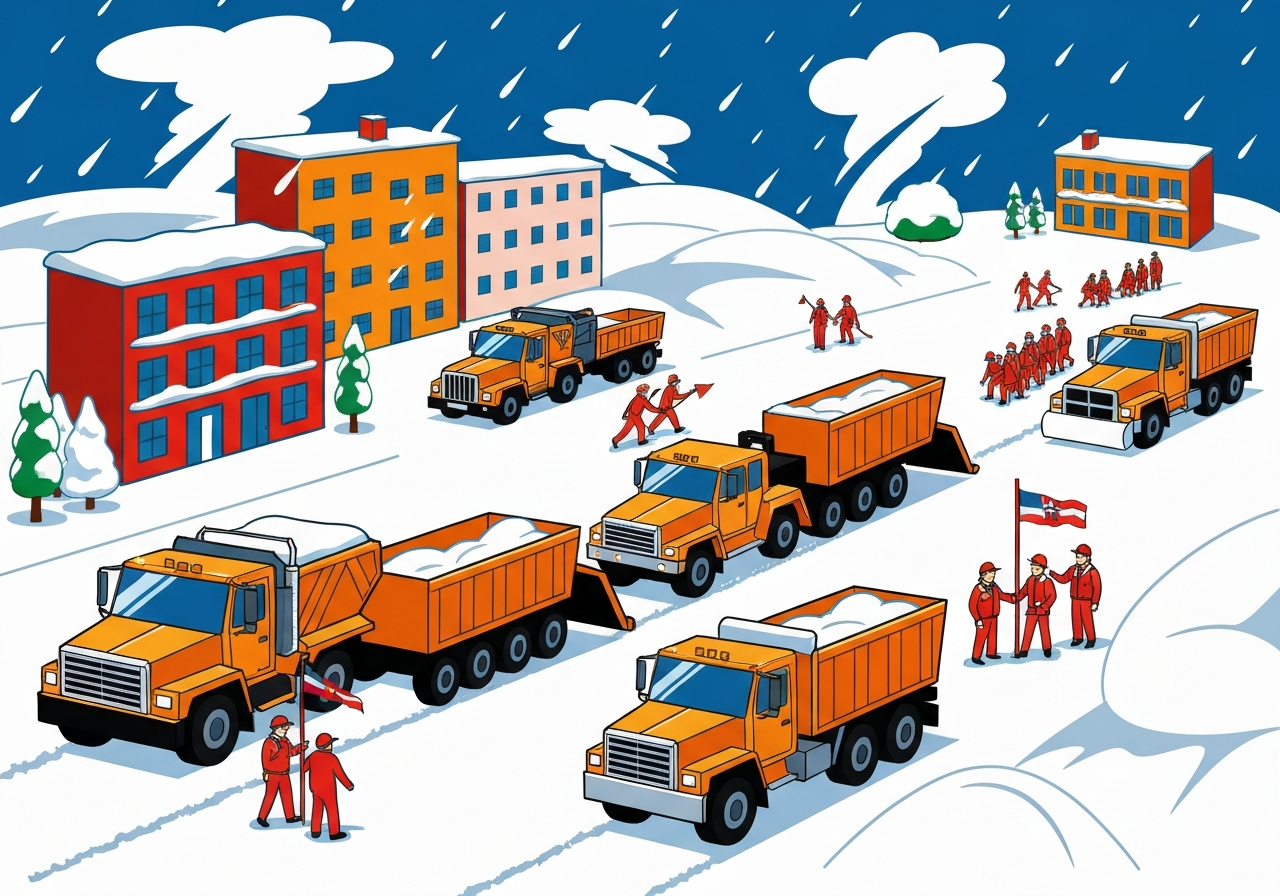
Lead: On Feb. 25, 2026, New York State dispatched personnel and heavy equipment to Massachusetts after a blizzard dumped more than two feet of snow across the southeastern part of the commonwealth, with Fall River reporting in excess of 36 inches. Governor Kathy Hochul approved the deployment following a formal request from Massachusetts officials; the response includes crews and apparatus from the New York State Thruway Authority, the New York State Department of Transportation and the New York Power Authority. The mission is intended to help clear impassable streets and restore mobility while preserving New York’s own readiness for ongoing winter operations. New York’s contribution totals 78 people and 81 pieces of equipment, sent under the Emergency Management Assistance Compact.
- Key Takeaways:
- New York deployed 78 personnel and 81 pieces of equipment to Massachusetts on Feb. 25, 2026, to assist snow removal after a major blizzard.
- The New York State Thruway Authority sent 10 large dump trucks and 16 staff, including 12 operators, two supervisors and two mechanics.
- The New York State Department of Transportation supplied 58 people (46 operators) and 69 pieces of equipment, including 12 loaders and 12 skid steers.
- The New York Power Authority contributed two lowboy tractor-trailers to move heavy equipment and drivers between states.
- The deployment was made under the Emergency Management Assistance Compact (EMAC), which enables interstate resource sharing and cost reimbursement.
- Fall River, MA, reported more than 36 inches of snow; the southeastern Massachusetts region received more than two feet in many locations.
Background:
The blizzard that struck the Northeast this week accelerated down the coast and produced historic snowfall totals in parts of Massachusetts, overwhelming municipal clearance capacity in several cities. Southeastern Massachusetts saw pockets of snowfall above two feet, with Fall River exceeding 36 inches, leaving many residential streets unplowed and emergency access hindered. States commonly request interstate help when local resources are outpaced; Massachusetts asked for assistance to speed reopening of roadways and restore critical services.
New York’s response reflects standing mutual-aid arrangements among states. The Emergency Management Assistance Compact (EMAC), ratified by Congress, provides the legal and financial framework for such aid—covering personnel protections, equipment status and potential cost reimbursement. Key New York agencies—the Thruway Authority, the Department of Transportation (DOT) and the Power Authority—have established snow-response fleets and cross-trained crews that can be mobilized to support neighboring jurisdictions.
Main Event:
Governor Kathy Hochul authorized the deployment after Massachusetts formally requested help as storm crews continued round-the-clock operations to clear arterial and neighborhood streets. The Thruway Authority contributed 10 large dump trucks and deployed 16 staff members, broken down into 12 equipment operators, two supervisors and two mechanics to maintain continuous operations. The state DOT dispatched 58 personnel—46 operators plus supervisors, management and safety representatives—and 69 items of equipment, listing 12 loaders, 12 skid steers, 10 lowboy trailers, 12 equipment trailers and a mix of patrol and service vehicles.
The New York Power Authority added two lowboy tractor-trailers specifically to transport heavy snow-removal machines and drivers across state lines. Officials emphasized that the deployment was coordinated to minimize disruption to New York’s own winter readiness while providing targeted support where Massachusetts’ capacity was strained. Logistics teams coordinated vehicle staging, crew lodging and fuel resupply to ensure sustained operations on arrival.
State officials said the teams will focus first on primary and secondary roads that are blocking emergency access and critical supply routes, then move to residential streets as conditions and resources allow. The deployment is structured to allow reimbursement of mission costs under EMAC and to protect deployed personnel under the sending-state employment frameworks. New York officials also signaled readiness to extend support if Massachusetts requests additional resources.
Analysis & Implications:
Interstate mutual aid reduces the time municipalities spend clearing essential corridors after large storms, but it requires careful coordination. Sending 78 personnel and 81 pieces of equipment is substantial for a single interstate mission and reflects the severity of conditions in parts of Massachusetts. The mix of operators, supervisors and mechanics is designed not only to operate machines but also to sustain them and maintain safety oversight under prolonged deployment.
Operationally, transporting heavy loaders and dump trucks across state lines adds logistical friction—lowboy trailers and staging areas must be secured, crews require lodging and meals, and equipment needs refueling and maintenance. EMAC’s reimbursement rules cover many of these costs, but paperwork and settlement timelines can be lengthy, meaning local budgets may temporarily absorb expenditures before federal or interstate funds arrive. That financial lag can influence how quickly states choose to offer or scale back assistance.
Politically and publicly, visible mutual aid can ease pressure on affected communities and signal intergovernmental solidarity. For Massachusetts residents, an influx of well-equipped out-of-state crews can shorten road closures and speed restoration of deliveries and emergency services. For New York, the decision balances helping a neighbor against preserving resources for any continuing winter impacts at home—especially as forecasts remained variable in the broader region.
Comparison & Data:
| Agency | People | Equipment (selected) |
|---|---|---|
| New York State Thruway Authority | 16 (12 operators, 2 supervisors, 2 mechanics) | 10 large dump trucks |
| New York State Department of Transportation | 58 (46 operators + staff) | 69 pieces (12 loaders, 12 skid steers, 10 lowboy trailers, others) |
| New York Power Authority | — (drivers for transport) | 2 lowboy tractor-trailers |
| Total (NY contribution) | 78 | 81 pieces |
This table summarizes the deployment as announced on Feb. 25, 2026. The listed equipment emphasizes heavy-clearance machinery prioritized for main arteries and choke points. Matching operators to appropriate machines and ensuring mechanic support reduces out-of-service time for critical assets during extended operations.
Reactions & Quotes:
New York leadership framed the mission as a practical extension of interstate support during extreme weather events, while Massachusetts officials stressed immediate operational need.
“I am grateful to all of our first responders and snow removal staff who have worked tirelessly throughout this historic blizzard to keep impacted communities in New Yorkers safe.”
Governor Kathy Hochul (paraphrased)
Hochul’s statement noted New York’s continued snow-response readiness and the desire to assist Governor Healey and Massachusetts residents in recovery. Officials said gratitude reflected both the effort of working crews and the cooperative nature of the deployment.
“When this week’s historic storm sped up the East Coast, Massachusetts was hit even harder than New York.”
Terry O’Leary, Acting Commissioner, NY Division of Homeland Security and Emergency Services (paraphrased)
Acting Commissioner O’Leary highlighted the decision as a neighborhood-to-neighborhood response and framed the deployment as additional manpower and machinery rather than a long-term resource transfer.
Unconfirmed:
- Exact arrival times and on-the-ground deployment schedule for all crews after crossing into Massachusetts were not published at the time of reporting.
- The precise list of Massachusetts municipalities that will receive New York crews was not specified beyond general references to southeastern communities.
- Detailed cost estimates and the timeline for EMAC reimbursement had not been released publicly.
Bottom Line:
New York’s dispatch of 78 personnel and 81 pieces of equipment to Massachusetts on Feb. 25, 2026, is a significant, coordinated interstate response to a historic blizzard that left parts of southeastern Massachusetts buried under more than two feet of snow. The mix of dump trucks, loaders, skid steers and specialized transport indicates an emphasis on reopening primary routes and restoring emergency access quickly.
EMAC provides the legal and financial structure for the mission, but practical execution—transport, lodging, fuel and equipment servicing—will determine how fast communities see normal traffic resumed. Readers in impacted areas should monitor local public works and state emergency-management channels for arrival times, prioritized road lists and safety guidance.
Sources:
- Syracuse.com — regional news report summarizing state release and deployment details (media).
- MassLive / photo credit — local reporting and image attribution for Fall River coverage (local media).
- Emergency Management Assistance Compact (EMAC) — compact overview and member-state framework (official/interstate organization).