
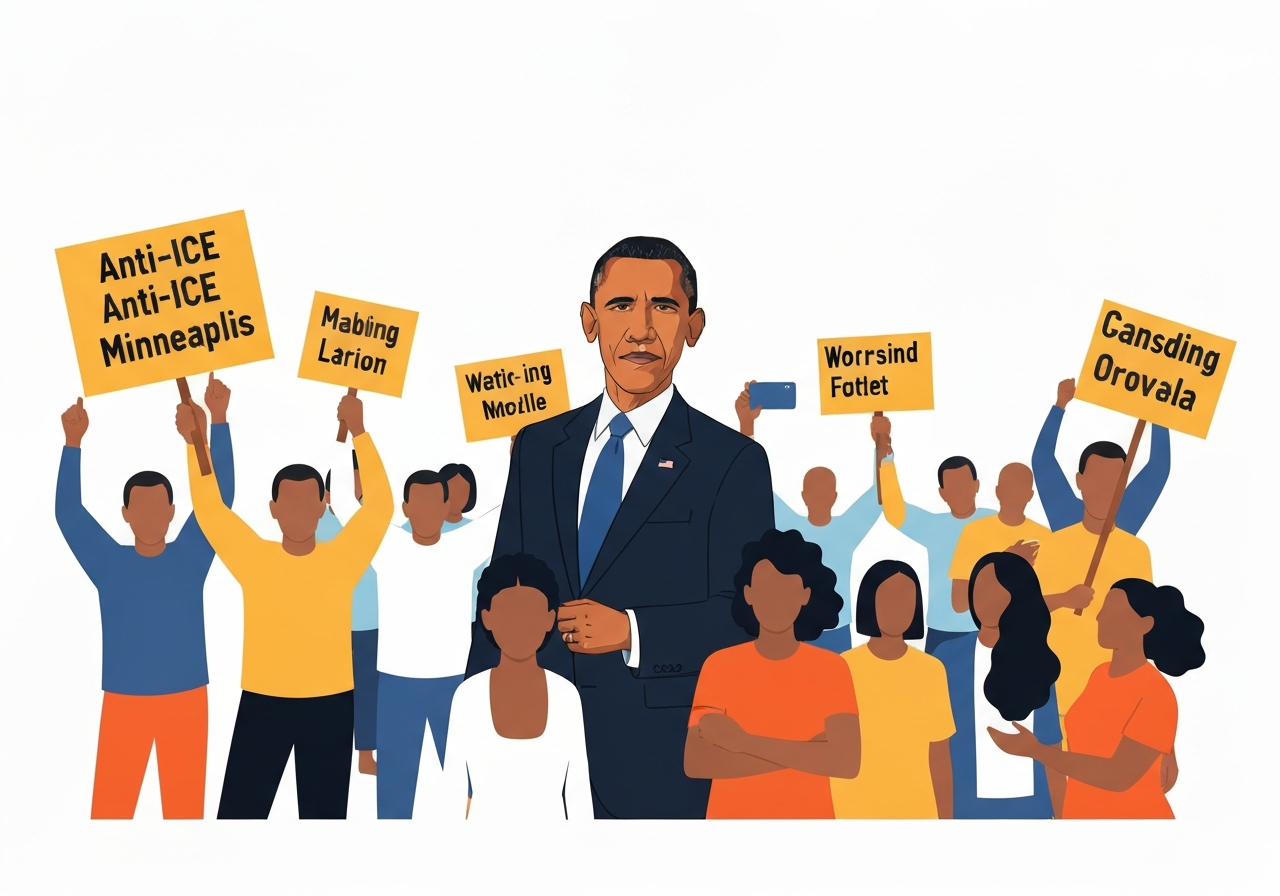
Former President Barack Obama publicly expressed support for protesters in Minneapolis who confronted a large-scale Immigration and Customs Enforcement (ICE) operation, telling progressive interviewer Brian Tyler Cohen on Saturday that citizen action shaped the outcome. Obama described the agency’s tactics in the Twin Cities as having an “unprecedented” character and said the national response would ultimately be decided by the American people. His remarks came amid sustained demonstrations in the Twin Cities that intensified after the deaths of Renee Good and Alex Pretti during federal enforcement activity. In the interview and in a separate joint statement with Michelle Obama, the former first couple called the killing of Alex Pretti a “heartbreaking tragedy” and raised concerns about accountability.
Key Takeaways
- Barack Obama voiced public support for Minneapolis demonstrators during a February 14, 2026 interview with Brian Tyler Cohen, citing civic power in shaping policy and practice.
- Obama described ICE and other federal agents’ actions in Minneapolis–St. Paul as “unprecedented,” listing tactics such as removing people from homes and aggressive crowd control.
- The Twin Cities protests followed the deaths of Renee Good and Alex Pretti during federal operations; the Obamas called Pretti’s death a “heartbreaking tragedy.”
- Tom Homan, a senior Trump administration border official, announced a drawdown of immigration enforcement in Minnesota after the escalations and fatalities.
- Protesters and some local officials have framed the drawdown as a victory for public pressure; federal officials cite operational reassessment after the incidents.
- Obama emphasized that the resolution of these tensions depends on broad public engagement rather than unilateral executive action.
Background
The Minneapolis–St. Paul region has been a focal point for protests over federal immigration enforcement during early 2026, with community groups, civil rights organizations and local leaders vocally opposing recent ICE tactics. Tensions escalated after two residents, Renee Good and Alex Pretti, were killed during confrontations with federal agents; those deaths triggered reviews by local authorities and renewed scrutiny of federal intervention in cities. Activists and witnesses described a pattern of aggressive enforcement measures in residential neighborhoods and public spaces, while federal officials have defended operations as part of broader immigration policy enforcement. National attention grew as other cities, including Los Angeles, registered parallel demonstrations and public statements of concern.
Federal agencies say law-enforcement actions are intended to enforce immigration statutes and protect public safety, but the scale and method of recent deployments prompted questions about authorization, rules of engagement and oversight. Critics point to a lack of clear public guidelines in the Minneapolis actions and to tactics described by witnesses and leaders as intimidating or indiscriminate. Local elected officials and civil legal groups have demanded transparency, and some prosecutors and municipal leaders have opened inquiries. The dispute over tactics has become part of a wider debate about federal role, local control and civil liberties during enforcement operations.
Main Event
Speaking on Brian Tyler Cohen’s program on Saturday, Obama praised citizens who turned out in the Twin Cities and elsewhere to oppose enforcement tactics they saw as excessive. He framed the protests as an expression of Americans upholding core civic values and said the country’s direction would be determined by public consensus and activism rather than unilateral force. In his interview, Obama catalogued behaviors he said marked the Minneapolis deployment as unusual: agents removing people from homes, tactics reported to involve children, and the use of crowd-control measures such as tear gas against bystanders. Those descriptions echoed accounts circulating among witnesses and in local reporting, which portrayed the operations as both highly visible and contentious.
Tom Homan, described by the administration as a senior border official, confirmed a pullback of federal immigration enforcement in Minnesota after the fatalities and increased public scrutiny. Homan’s announcement followed days of protests and statements from local and national figures demanding review and restraint. Supporters of the enforcement action argued it targeted criminal networks and was lawful; opponents countered that tactics endangered civilians and lacked accountability. The drawdown decision has been portrayed by many protesters and community leaders as evidence that public pressure influenced federal choices.
Separately, the Obamas released a written statement last month criticizing federal law-enforcement behavior in Minnesota as operating without sufficient accountability and as appearing designed to intimidate residents. The statement, issued by Barack and Michelle Obama, called for clearer legal and ethical constraints and urged an impartial investigation into the events that led to fatalities. Local advocacy groups and civil-rights lawyers have echoed calls for independent inquiries and for reforms to federal protocols governing urban enforcement. Federal agencies say they will review operations, but details of any formal investigation or timelines have not been fully disclosed.
Analysis & Implications
Politically, the episode sharpens a national fault line over immigration enforcement and federal intervention in cities. High-profile remarks from a former president add weight to local grievances and can amplify demands for oversight, potentially pressuring congressional committees and the Department of Homeland Security (DHS) to pursue reviews. If sustained, public opposition could prompt new legislative or rule-making efforts to restrict certain federal tactics or to require greater coordination with municipal authorities. Conversely, the administration may respond by defending its legal authority to conduct operations it deems necessary for immigration control, setting up a protracted legal and political contest.
Legally, the deaths of Renee Good and Alex Pretti and allegations about operational conduct increase the likelihood of civil litigation and possible criminal inquiries. Independent reviews—by state prosecutors, inspector generals, or special counsels—would examine chain of command, rules of engagement and whether proper training and oversight were in place. Outcomes of such processes could lead to policy changes at ICE and DHS, settlements, or disciplinary measures for individual agents if misconduct is found. Yet legal processes are often slow and their findings may not resolve broader community distrust.
From an enforcement perspective, the announced drawdown in Minnesota could signal a tactical pause that preserves federal authority while reducing immediate confrontations. That approach may defuse short-term tensions but could also prompt calls for permanent changes to engagement protocols when operating in densely populated urban areas. Nationally, the incident may influence how cities negotiate memoranda of understanding with federal agencies and how local law enforcement coordinates—or distances itself—from federal immigration actions. The longer-term effect on migration policy depends on whether political momentum translates into binding rules or remains a subject of intermittent public criticism.
Comparison & Data
| Characteristic | Feb 2026 Minneapolis Operation | Typical ICE Urban Operation (Recent Years) |
|---|---|---|
| Visibility | High — large federal presence, reported street-level engagements | Variable — often less conspicuous, targeted arrests |
| Local Coordination | Reportedly limited public guidance to cities | Often coordinated with local agencies or conducted covertly |
| Civilian Response | Mass protests and citywide backlash | Occasional public pushback, usually smaller scale |
The table summarizes qualitative differences reported by local media and witnesses: the Minneapolis operation was notably visible and prompted broader civic mobilization compared with many prior urban enforcement actions. Public records requests, oversight reviews and reporting will be necessary to produce firm numerical comparisons. For now, available information indicates an unusually large and contested federal presence in the Twin Cities during February 2026.
Reactions & Quotes
Obama’s interview placed emphasis on citizen agency and the need for a national conscience to shape responses to enforcement practices. He referenced Minneapolis as a recent example of public influence and urged Americans to stick to stated values as the country navigates enforcement and civil-rights tensions. His comments were widely circulated by national outlets and discussed across social media platforms by both supporters and critics.
“We just saw this in Minnesota, in Minneapolis.”
Barack Obama
That short remark was used by Obama to illustrate his broader point that public mobilization can alter government action. Media and political commentators immediately debated whether the Minneapolis protests directly caused policy adjustments or merely contributed to a larger decision-making process. Observers noted the interplay between street protests, local officials’ calls for oversight, and federal statements about operational reassessment.
The Obamas’ written comment on the fatalities framed the deaths as a national concern transcending party lines and called attention to accountability. Their statement accused federal enforcement of operating without proper accountability in Minnesota and suggested tactics that appeared intended to intimidate residents. The release added a high-profile moral critique from a former first couple, intensifying calls for formal inquiries.
“A heartbreaking tragedy”
Barack and Michelle Obama (joint statement)
Advocates used the Obamas’ language to press prosecutors and oversight bodies for prompt investigation. Critics of the Obamas said the couple’s political prominence should not substitute for due process and formal review. Local leaders responded by reiterating requests for transparency and documentation of federal actions.
Federal officials, including Tom Homan, described the operational posture and later announced a drawdown in Minnesota. Homan framed the change as an operational recalibration in light of recent events, while maintaining that enforcement was intended to address crime and immigration violations. His remarks underscored the administration’s balancing act between pursuing enforcement priorities and managing public and political fallout.
Federal enforcement will be drawing down in Minnesota following recent escalations.
Tom Homan (administration official)
After Homan’s statement, local advocates saw the drawdown as confirmation that protest and scrutiny can influence federal tactics. Legal experts cautioned that an announced reduction in activity does not itself produce accountability or remedial policy changes. The sequence of events has therefore shifted attention to what formal investigations or policy reforms might follow.
Unconfirmed
- Whether children were deliberately used as bait in Minneapolis operations: that allegation was cited by witnesses and by Obama in description, but independent verification is not yet publicly documented.
- Direct causation between mass protests and the administration’s decision to draw down enforcement in Minnesota: protests preceded the drawdown, but a formal causal link has not been established by an independent review.
- Full details of rules of engagement and internal authorization for the operation: agencies have said reviews will occur, but official findings or released operational orders have not been published.
Bottom Line
The Minneapolis episode has become a focal point for national debate about how and when federal immigration enforcement should operate in U.S. cities. High-profile criticism from Barack and Michelle Obama, combined with visible public protests and subsequent federal statements, underscores a widening dispute over tactics, accountability and local consent. Short-term tactical changes, such as the announced drawdown, may reduce immediate confrontation but do not by themselves resolve deeper governance and oversight questions.
Expect sustained pressure for independent investigations, greater transparency, and potential policy proposals aimed at restricting certain federal practices in urban settings. Whether those efforts produce durable reform will depend on the outcomes of investigations, judicial rulings, and the balance of political power in Congress and the courts. For now, the Minneapolis events have elevated scrutiny and highlighted the role of civic mobilization in shaping enforcement policy.
Sources
- The Guardian — National news reporting on Obama’s interview and the Minneapolis events (news).
- Brian Tyler Cohen (YouTube) — Progressive interviewer who conducted the February 14, 2026 conversation (online media).