
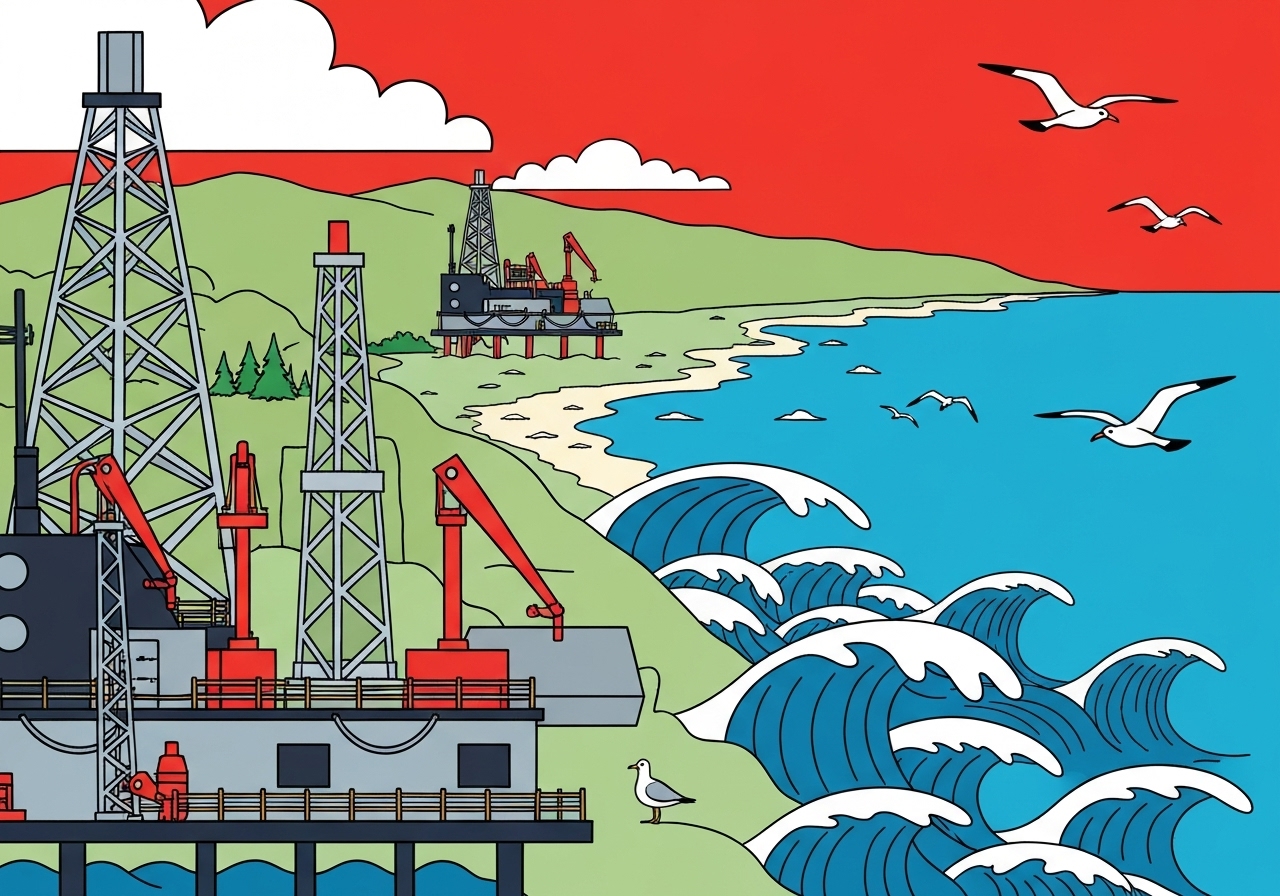
Lead: The Trump administration on Thursday unveiled a sweeping proposal to open new federal waters to oil leasing off the coasts of California and Florida, advancing a five-year plan that would be the first major expansion of offshore drilling in decades. The proposal includes six lease sales off California between 2027 and 2030 and new Gulf parcels at least 100 miles from Florida’s shoreline, while also calling for more than 20 Alaska lease sales including a High Arctic area more than 200 miles offshore. The move is presented by officials as a boost to U.S. energy production and jobs, but it has prompted immediate bipartisan and environmental pushback over coastal risks and economic impacts.
Key Takeaways
- The administration proposes six offshore lease sales along the California coast between 2027 and 2030, the first such new leasing in federal West Coast waters since the mid-1980s.
- New drilling parcels are proposed in the Gulf of Mexico at least 100 miles from Florida’s shore in a newly designated South-Central Gulf region, distinct from the Eastern Gulf moratorium in place since 1995.
- The plan would also compel more than 20 lease sales off Alaska, including a High Arctic area located over 200 miles offshore.
- Interior Secretary Doug Burgum said expanded leasing is intended to keep U.S. oil production high and preserve energy-sector jobs, noting it will take years before production reaches market.
- Industry groups such as the American Petroleum Institute hailed the plan as historic for unlocking offshore resources; coastal leaders and environmental groups warn of economic and ecological harm.
- Florida Republicans including Sen. Rick Scott and Gov. Ron DeSantis’s office urged reconsideration or protections for tourism-dependent coasts.
- California Governor Gavin Newsom and federal lawmakers emphasized legal and political resistance, citing past spills and decades-long restrictions on new federal West Coast leases.
Background
Federal policy on offshore drilling has shifted in recent administrations. Since 1995, drilling in the eastern Gulf of Mexico—covering waters off Florida and part of Alabama—has been effectively moratoriumed because of spill-risk concerns. On the West Coast, federal leasing has been dormant since the mid-1980s, though existing California platforms continue to produce from older leases.
President Trump, after taking office for a second time in January, has prioritized rapid expansion of fossil-fuel production as part of a stated goal of U.S. “energy dominance.” That agenda has included reversing previous restrictions on future offshore leasing and sidelining some federal support for offshore wind and other clean-energy programs.
Main Event
The Interior Department’s five-year leasing plan announced Thursday lays out a schedule of lease sales: six sale events targeted along California’s federal outer continental shelf between 2027 and 2030, new Gulf parcels at least 100 miles from Florida beaches in a South-Central Gulf region, and more than 20 sales off Alaska including a High Arctic area more than 200 miles offshore. Officials framed the timetable as forward-looking but acknowledged that development, permitting and production could take years.
Interior Secretary Doug Burgum characterized the plan as a way to sustain jobs and domestic energy supply. Industry representatives pointed to existing West Coast infrastructure and California’s long history as an oil-producing state as evidence the region can accommodate additional activity.
Opposition formed quickly. In Florida, Gov. Ron DeSantis’s spokesperson said the administration should re-evaluate, while Sen. Rick Scott urged that the state’s coasts remain off-limits. In California, Gov. Gavin Newsom vowed to use legal and policy tools to defend the coastline, invoking past spills and the state’s climate leadership.
Environmental advocates warned of heightened risks to marine ecosystems and coastal economies. They cited historical accidents—most notably the 1969 Santa Barbara spill and the 2010 Deepwater Horizon disaster—as reasons the proposed expansion could imperil fisheries, tourism and endangered species habitat.
Analysis & Implications
Economically, the administration argues expanded leasing could support domestic petroleum output and preserve offshore industry employment. However, analysts note a long lead time between lease award and significant production, and that market prices, permitting, and legal challenges will strongly influence outcomes.
Politically, the plan sharpens a divide between federal priorities and several state governments. California and Florida rely heavily on tourism and coastal recreation; elected officials from both states signaled readiness to pursue legal and legislative pushback, potentially creating protracted litigation or congressional responses.
Environmentally, opening new federal waters carries quantifiable spill-risk and habitat-disruption concerns. Conservation groups emphasize that expanded activity increases cumulative risk to whale feeding grounds, shorelines and commercial fisheries—impacts that could translate into measurable local economic losses if incidents occur.
Internationally, a policy that increases U.S. fossil-fuel output may influence global markets and climate-policy dynamics. It could also affect U.S. credibility in international climate forums, where commitments to curb emissions are weighed against domestic production decisions.
Comparison & Data
| Region | Proposed Lease Sales | Distance from Shore | Notes |
|---|---|---|---|
| California | 6 (2027–2030) | Federal outer continental shelf | First new federal West Coast leasing since mid-1980s |
| Florida (Gulf) | Parcels in South-Central Gulf | At least 100 miles | Distinct from Eastern Gulf moratorium (1995) |
| Alaska | 21+ proposed | High Arctic >200 miles | Large-scale Arctic targeting |
The table clarifies the administration’s geographic and temporal targets. While lease counts and distances are explicit in the plan, projected volumes of recoverable oil and precise timelines for commercial production were not provided with the announcement, and would depend on bid response, permitting timelines and development economics.
Reactions & Quotes
“This is not just a little bit offshore drilling. This is the entire California coast, every inch of Alaska, even the eastern Gulf of Mexico.”
Rep. Jared Huffman (Democrat)
Rep. Huffman framed the proposal as a broad opening of previously constrained federal waters, underlining a national-scale environmental concern and bolstering state-level opposition.
“There is no way to drill for oil without causing devastating impacts. The risk is unacceptable.”
Maggie Hall, Environmental Defense Center (advocacy)
Environmental advocates stressed biological and shoreline risks, citing whale feeding grounds off Santa Barbara and the long-term consequences of spills for fisheries and tourism.
“By moving forward with the development of a robust, forward-thinking leasing plan, we are ensuring that America’s offshore industry stays strong, our workers stay employed, and our nation remains energy dominant for decades to come.”
Interior Secretary Doug Burgum (official statement)
Burgum’s statement highlights the administration’s emphasis on jobs and energy supply; officials also acknowledged that development timelines mean production gains would accrue over years rather than immediately.
Unconfirmed
- Precise volumes of recoverable oil from the proposed California, Gulf, and High Arctic parcels have not been released and remain subject to geological assessment.
- Timelines for when any new wells would begin producing commercial volumes are estimates at this stage and depend on permitting and market conditions.
- Specific legal challenges and the scope of state-level responses (e.g., coastal protections or litigation) are likely but not yet finalized.
Bottom Line
The administration’s plan represents a decisive policy shift toward expanding offshore fossil-fuel development across multiple U.S. regions—California, the Gulf off Florida and Alaska’s outer shelf—while acknowledging that any production gains will take years to materialize. Proponents emphasize jobs, infrastructure and energy security; opponents counter that the economic value of clean beaches, fisheries and coastal tourism, plus ecological risks, make the expansion politically and socially costly.
Expect sustained legal and political confrontation: state leaders and environmental groups have already signaled aggressive responses, and industry supporters may face permitting and market hurdles before large-scale production begins. For communities and policymakers, the core questions will be the trade-offs between near-term energy objectives and long-term coastal and climate risks.
Sources
- Associated Press (news report)
- American Petroleum Institute (industry association)
- Environmental Defense Center (environmental advocacy)