
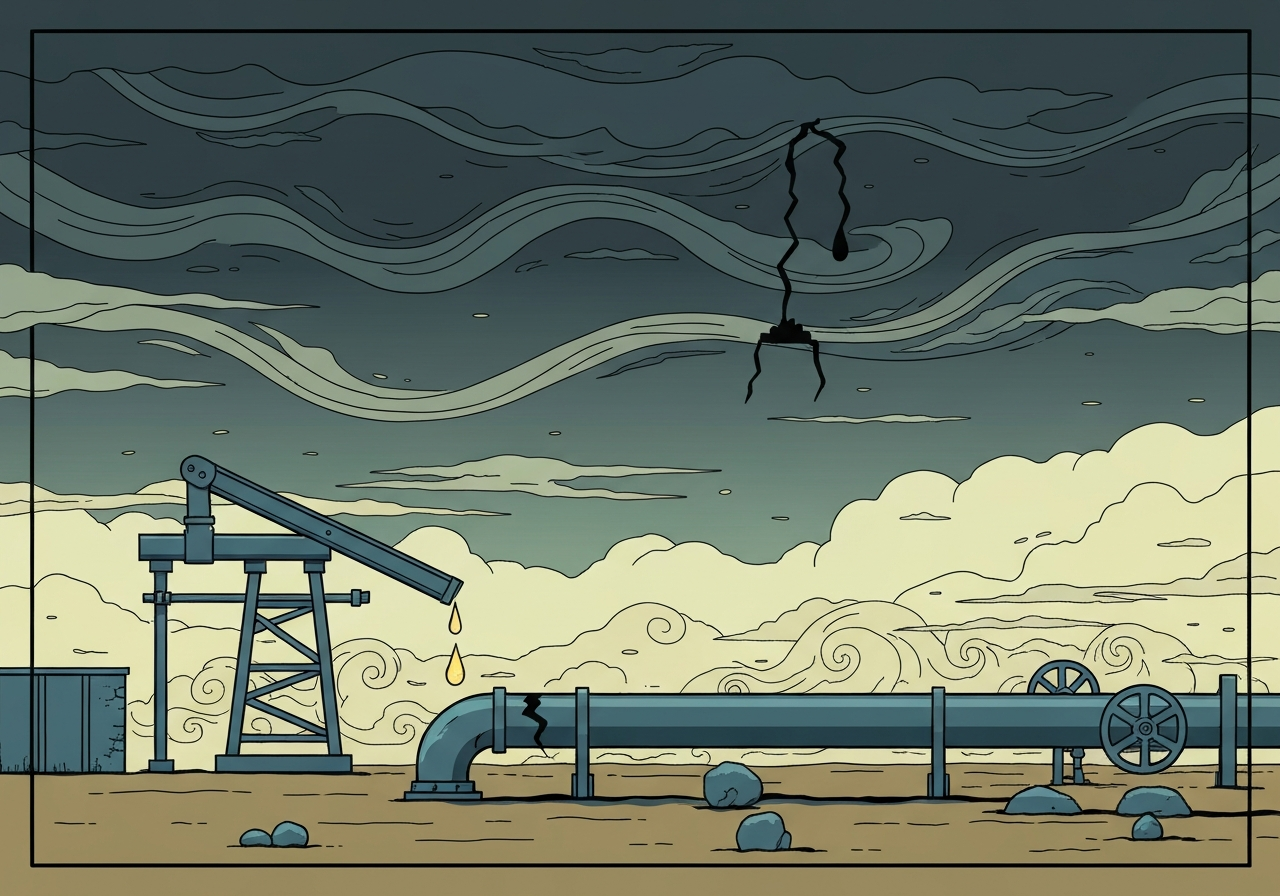
A rapidly widening U.S.-Israeli campaign against Iran has pushed tanker traffic through the Strait of Hormuz toward an effective shutdown, triggering the largest disruption to oil output in modern history and sharp spikes in energy prices. Over the past week crude surged about 36%, forcing Gulf producers to curtail exports as storage tanks fill and ports close. Analysts warn that continued interdiction of the strait could send oil well above current levels and deepen an already fragile global economic outlook. The duration and intensity of the conflict are now the decisive variables for energy markets and economic risk.
Key Takeaways
- Crude oil jumped roughly 36% in the past week amid attacks in and around the Strait of Hormuz, pushing Brent to $92.69 and WTI to $90.90 per barrel on Friday.
- The Strait of Hormuz handles about 20% of global oil and liquefied natural gas (LNG) flows; disruptions there have effectively halted exports from several Gulf states.
- Iraq has cut production by about 60%, from roughly 4.3 million barrels per day to about 1.7–1.8 million bpd; Kuwait and the UAE have also reduced output.
- Qatar has throttled LNG output, sending Asian spot LNG prices nearly twofold higher and European gas prices up about 50% since fighting intensified.
- U.S. measures include a $20 billion tanker reinsurance program and offers of naval escort; analysts say protecting the full tanker fleet is logistically daunting.
- Experts warn the worst outcome would be physical damage to Gulf energy infrastructure and a prolonged closure of the strait, producing long-term supply shortfalls.
Background
The current crisis traces institutional and political roots back decades, including the 1979 Iranian revolution and subsequent patterns of strike action and geopolitical confrontation in the Gulf. Over the last half-century the region has been both a major oil supplier and a recurring flashpoint for interruptions that ripple across world markets. The shale revolution has reshaped the energy map—boosting U.S. production and giving importing countries more policy tools—yet global flows still depend heavily on the narrow chokepoint of the Strait of Hormuz. Recent strikes on shipping and threats to export facilities have reopened a familiar vulnerability: when the strait becomes unsafe, global supplies tighten rapidly.
Multiple state and non-state actors have a stake in the outcome. Iran, facing military pressure and sanctions, has signaled willingness to escalate maritime attacks; Gulf exporters seek to keep crude moving and economies stable; and Western powers are balancing military responses, diplomatic pressure and efforts to secure trade routes. Market participants were already sensitive to supply risks; the present spike comes on top of those pre-existing concerns, compressing time for policy responses and market rebalancing.
Main Event
Over the past week, Iran launched attacks on vessels transiting the Strait of Hormuz, and retaliatory U.S.-Israeli strikes have hit targets inside Iran, including a major refinery near Tehran that feeds civilian and military demand. These operations have made routine tanker traffic perilous and prompted many shipping companies to suspend transits or reroute around long-distance alternatives. The disruption coincided with a rapid filling of regional storage and port capacity, prompting producing states to cut output because they had nowhere safe to send oil.
Iraq announced a roughly 60% output cut, taking production down to an estimated 1.7–1.8 million barrels per day from about 4.3 million bpd before the escalation. Kuwait and the United Arab Emirates also scaled back shipments. Qatar reduced some LNG flows, contributing to sudden price jumps in Asian spot markets and sharp increases in European gas benchmarks. Market liquidity thinned as traders reacted, amplifying price volatility.
U.S. officials proposed a $20 billion reinsurance scheme to lower tanker insurance premiums and said the U.S. Navy could escort vessels if required. Still, analysts caution that escorting the global fleet through the narrow strait is a substantial logistical challenge and may not prevent intermittent attacks, especially from drones or small craft. Iran has threatened to expand target sets to include civilian infrastructure such as desalination plants, raising concerns about humanitarian and environmental consequences if hostilities continue.
Analysis & Implications
In the near term, the shock is primarily a supply-side event: physical exports are constrained, inventories are rising in the Gulf, and traders are pricing in a premium for shipping and geopolitical risk. If the strait remains effectively closed, markets face not just immediate price spikes but structural shortages that could persist until alternate infrastructure or new supply sources come online. That process could take months or longer, particularly for LNG, where liquefaction capacity is concentrated and difficult to scale quickly.
Macroeconomic effects would follow. Higher energy costs ripple through transport, manufacturing and household budgets, slowing growth and raising inflation globally. Central banks already watching inflation trends could be forced into difficult trade-offs between containing price pressures and supporting growth. Some emerging-market borrowers with large energy import bills could face balance-of-payments stress, increasing the risk of financial strain beyond commodity markets.
Politically, the crisis amplifies pressure on governments to present credible security solutions without widening the conflict. Military options carry the risk of further escalation and damage to critical infrastructure; diplomatic channels are constrained by demands from leaders on both sides. The longer the disruption persists, the greater the incentive for importing nations to accelerate diversification—such as expanding strategic petroleum reserves, fast-tracking LNG term contracts from alternative suppliers, or increasing short-term fuel conservation measures.
Comparison & Data
| Metric | Pre-conflict | Recent |
|---|---|---|
| Brent crude | — | $92.69 per barrel |
| WTI | — | $90.90 per barrel |
| Iraq production | ~4.3 million bpd | ~1.7–1.8 million bpd |
| Price change (week) | — | ~+36% crude |
| Strait of Hormuz flow | — | ~20% of global oil & LNG |
The table above summarizes immediate numerical shifts cited by market observers: benchmark oil prices in the low $90s, a steep short-term rise in crude, and a dramatic production cut in Iraq. These moves reflect both physical stoppages and precautionary cuts by producers. While some metrics (like pre-conflict baseline prices) varied day-to-day, the directional picture is clear: supply availability has tightened sharply and prices show a pronounced risk premium.
Reactions & Quotes
The fear is that oil flowing through the Gulf could be interdicted by an extended war, producing skyrocketing energy prices and a deep global recession.
Daniel Yergin, vice chair, S&P Global (Financial Times op-ed)
Yergin framed the situation as the realization of a long-feared scenario dating to the 1970s: an extended Gulf conflict that chokes off seaborne flows. His view emphasizes the macroeconomic stakes and the historic dimension of current disruptions.
Trying to protect so many ships is a massive logistical undertaking; a few successful strikes could turn a serious incident into a massive oil shock.
Robin Brooks, senior fellow, Brookings Institution (Substack note)
Brooks highlighted the practical limits of naval escorts and insurance solutions, arguing that a single successful attack could trigger cascading market effects. That assessment underpins skepticism about short-term fixes restoring normal flows.
We will continue to press the military and diplomatic options to secure passage and deter attacks, and we have proposed financial measures to stabilize shipping costs.
U.S. administration official (public statements)
U.S. statements have emphasized a mix of security and market interventions—naval escorts and reinsurance—as ways to mitigate the disruption. Analysts note these measures help but are unlikely to be sufficient if the strait remains intermittently closed.
Unconfirmed
- Extent of damage to Gulf water and desalination infrastructure: reports of threats and targeting are circulating, but widespread, sustained damage has not been independently verified.
- Longer-term closure scenarios for the Strait of Hormuz remain projections; while flows are currently constrained, a permanent or multi-month blockade has not been confirmed.
- Claims that U.S. naval escorts will fully restore safe passage are contested by analysts and lack empirical demonstration under sustained attack conditions.
Bottom Line
The conflict has already produced the largest short-term disruption to oil and gas flows in recent memory, forcing steep output cuts and sending energy prices sharply higher. Markets are pricing significant geopolitical risk, but the ultimate economic damage will hinge on how long the strait remains insecure and whether major infrastructure is damaged.
Policy responses—military protection, insurance schemes, and diplomatic efforts—may blunt the worst outcomes but are unlikely to erase the premium attached to risk while hostilities continue. For consumers and businesses, higher energy costs, potential supply rationing, and inflationary pressures are the near-term threats; for policymakers, the choice will be managing escalation while shoring up alternative supplies and stabilizing markets.
Sources
- Fortune — media report summarizing market moves and expert commentary
- S&P Global — industry/analysis (Daniel Yergin, vice chair)
- Brookings Institution — think tank analysis (Robin Brooks)
- Financial Times — media (op-ed referenced)