
Lead
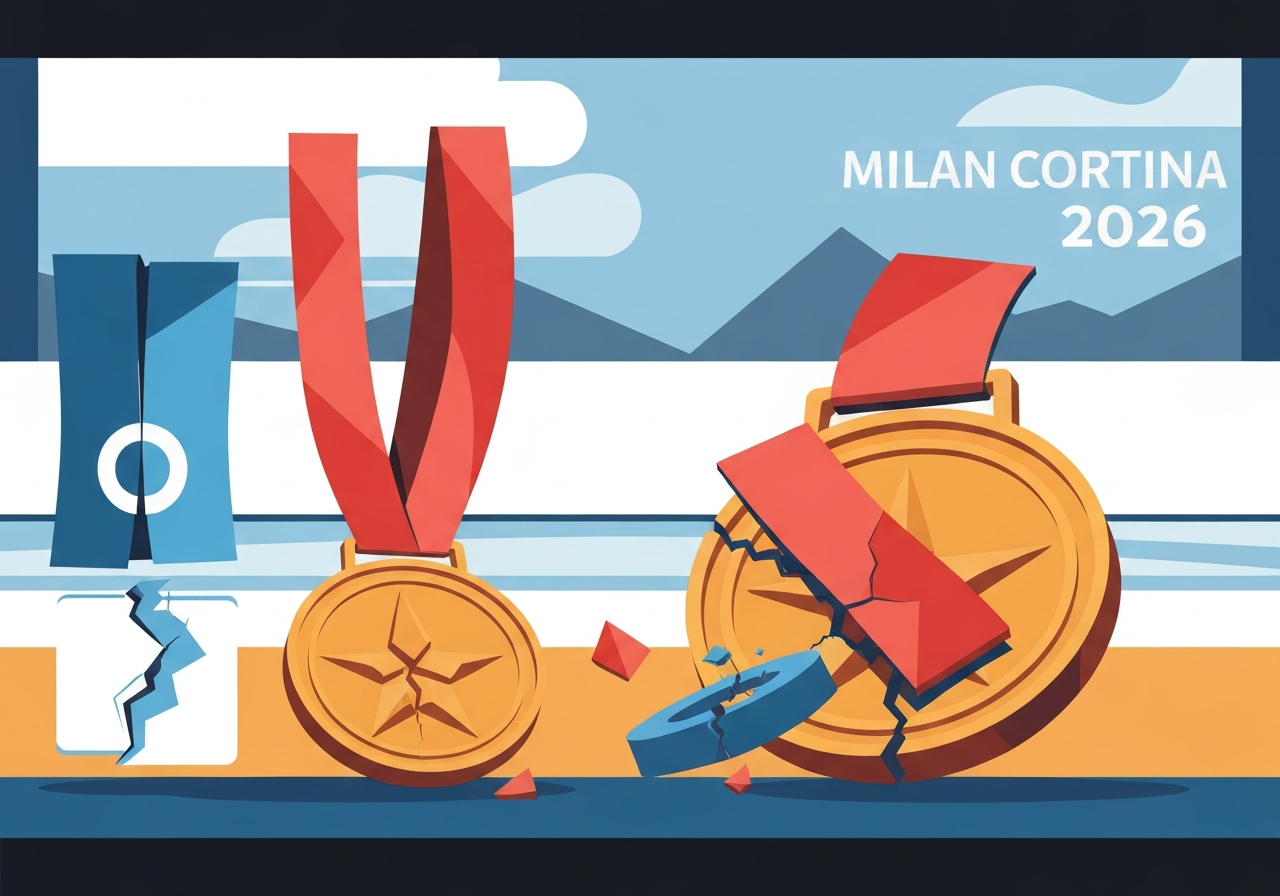
Less than a week into the 2026 Milan Cortina Winter Games, at least four athletes have reported their podium medals fracturing, detaching or splitting immediately after ceremonies. Incidents include U.S. alpine skier Breezy Johnson’s gold cracking into three pieces after she celebrated a 0.04-second victory and U.S. figure skater Alysa Liu’s team medal separating from its ribbon. Organizers say they are investigating potential manufacturing or design faults and have pledged to resolve the issue for affected athletes. Officials and national teams are assessing whether replacements will be issued.
Key Takeaways
- At least four medal failures have been reported in Milan Cortina 2026’s opening week, including gold, silver and bronze pieces from multiple nations.
- Breezy Johnson’s gold (won by 0.04 seconds over Emma Aicher) cracked into three pieces during celebration; Alysa Liu’s team medal detached from its ribbon.
- Organizing committee operations chief Andrea Francisi confirmed officials are “paying maximum attention” and investigating the matter publicly on Monday.
- Reporting by Reuters cites a likely connection point: a legally required breakaway mechanism in the medal cord designed to prevent choking may be involved.
- This year’s medal is a two-part inclined design; the inlet where ribbon meets medal has a new geometry to keep the ribbon off the medal face.
- Each gold medal contains 500 g sterling silver plated with 6 g pure gold (approximate market value ~$2,400); a silver medal (500 g sterling silver) is worth roughly $1,400.
- Paris 2024 had earlier durability complaints: 220 replacement requests were recorded by February 2025, about 4% of medals awarded.
Background
Olympic medals are redesigned for every Games to reflect host-city identity and innovation; Milan Cortina’s 2026 award is formed of two inclined halves with contrasting finishes meant to symbolize the partnership of the two host cities. Organizers also introduced a new inlet where the fabric ribbon connects to the medal so the ribbon does not cover the medal face — a visual and engineering change compared with prior editions. By law, many countries and venues require a breakaway feature on wearable cords to reduce strangulation risk; that safety requirement influences how ribbons and fasteners are engineered.
Precious metals still form the core of medals: modern gold awards are mostly sterling silver coated with gold rather than solid gold, and rising commodity prices have pushed intrinsic values higher than in recent Games. Durability complaints are not unprecedented — after Paris 2024, athletes reported chipping and surface degradation and the French mint handled replacement requests. Those precedents have heightened sensitivity among athletes and federations when any damage appears early in a tournament.
Main Event
The incidents surfaced publicly over two days of competition. Breezy Johnson, who won the women’s downhill by 0.04 seconds over Germany’s Emma Aicher, showed reporters a gold medal that had cracked into three pieces after falling from her neck while she celebrated. Johnson explained she had been jumping at the ceremony when the medal fell and then split; she later advised teammates not to jump while wearing the medals.
Figure skater Alysa Liu posted on Instagram showing a team-event gold separated from its ribbon, noting on camera that the medal “didn’t need the ribbon” and holding the metal in one hand and the blue ribbon in the other. Swedish cross-country skier Ebba Andersson told national broadcasters that her silver fell in the snow and broke in two, and German biathlete Justus Strelow was filmed noticing his bronze had detached and that a small clasp-like piece had come off as he celebrated with teammates.
Milan Cortina organizers responded at a Monday press conference. Andrea Francisi, chief games operations officer, said the committee had “seen the images” and was devoting priority attention to the situation because the medal moment is central to athletes’ experiences. Organizers said a formal technical check was under way and that they would work with manufacturers and national committees to determine next steps.
Analysis & Implications
At face value these incidents are a public-relations and logistical problem: medals are a once-in-a-lifetime symbol for athletes, and visible failures during ceremonies undermine the perceived quality of the Games and the athlete experience. Organizers must balance rapid remediation (replacements) with a systematic technical review to avoid repeating fixes that do not address root causes. An immediate, robust process for replacing damaged medals is likely to be expected by federations and athlete commissions.
The possible involvement of a breakaway safety mechanism complicates armchair fixes. Breakaway cords are mandated or recommended in many jurisdictions to prevent choking when a medal or credential is accidentally yanked; weakening that mechanism could improve retention but raise safety risk. If the inlet or clasp tolerances are too tight or if a newly introduced part interacts poorly with the two-piece medal geometry, stress concentrations at that joint could produce fractures when medals are dropped or when athletes move energetically.
From a manufacturing perspective, accelerated failure in multiple medals suggests either a consistent design weakness, a batch production fault (materials or finishing), or installation error at the ribbon-mount interface. A systematic failure across nations points toward a production or design commonality rather than isolated mishandling. Any replacement program will need serial numbers, provenance checks and engraving duplication to preserve records and ensure identical replacements.
Comparison & Data
| Item | Specification / Note |
|---|---|
| Gold medal composition | 500 g sterling silver coated with 6 g pure gold — market value ~ $2,400 |
| Silver medal composition | 500 g sterling silver — market value ~ $1,400 |
| Paris 2024 replacements | 220 requests by Feb 2025 (~4% of medals awarded) |
| Milan Cortina reported breaks | At least 4 athletes within first week (multinational incidents) |
The table shows both the material stakes and a recent parallel from Paris 2024, where a measurable share of medals required replacement after athletes reported deterioration. Milan Cortina’s early count is far smaller in absolute terms but notable because the incidents occurred immediately during or after ceremonies rather than over weeks of wear. That timing increases public scrutiny and accelerates the need for an organizing response.
Reactions & Quotes
Athletes, national teams and the organizing committee have all issued short public responses, underscoring mixed frustration and calls for swift action.
“Well, I was jumping up and down in excitement, and it fell off.”
Breezy Johnson, U.S. alpine skier
Johnson displayed the fractured medal to reporters and advised peers to avoid jumping while wearing medals until the issue is resolved.
“We are paying maximum attention to this matter… the moment they are given it [to be] absolutely perfect.”
Andrea Francisi, Chief Games Operations Officer, Milan Cortina organizing committee (official)
The organizing committee emphasized an active investigation and the emotional importance of the medal presentation.
“Are they not meant to be celebrated?”
German Biathlon Team, Instagram post (team account)
The German team’s social post highlighted athlete frustration and asked whether medals were durable enough for celebrations.
Unconfirmed
- Whether the legally required breakaway mechanism is the definitive cause of all reported fractures remains unverified pending technical inspection.
- It has not yet been officially confirmed whether all affected athletes will receive identical replacement medals or what the replacement timeline will be.
Bottom Line
Early medal failures at Milan Cortina 2026 have triggered an urgent technical review and raised questions about how new design features interact with safety hardware and manufacturing tolerances. While only a handful of incidents have been reported so far, their timing — immediately during or after medal ceremonies — magnifies reputational and emotional stakes for athletes and organizers.
Expect the organizing committee to prioritize both immediate athlete remedies (replacement medals, repairs or temporary fixes) and a formal report on root causes. Longer term, this episode may prompt stricter pre-distribution durability testing and clearer guidance on celebration practices when medals are worn on the podium.
Sources
- Yahoo News — news outlet (original report provided)
- Reuters — international news agency (reporting on breakaway mechanism and technical details)
- BBC Sport — public broadcaster (coverage of national committees and replacement questions)
- The New York Times — national newspaper (background on medal composition and market values)
- People — news magazine (coverage of Paris 2024 medal complaints and replacements)