
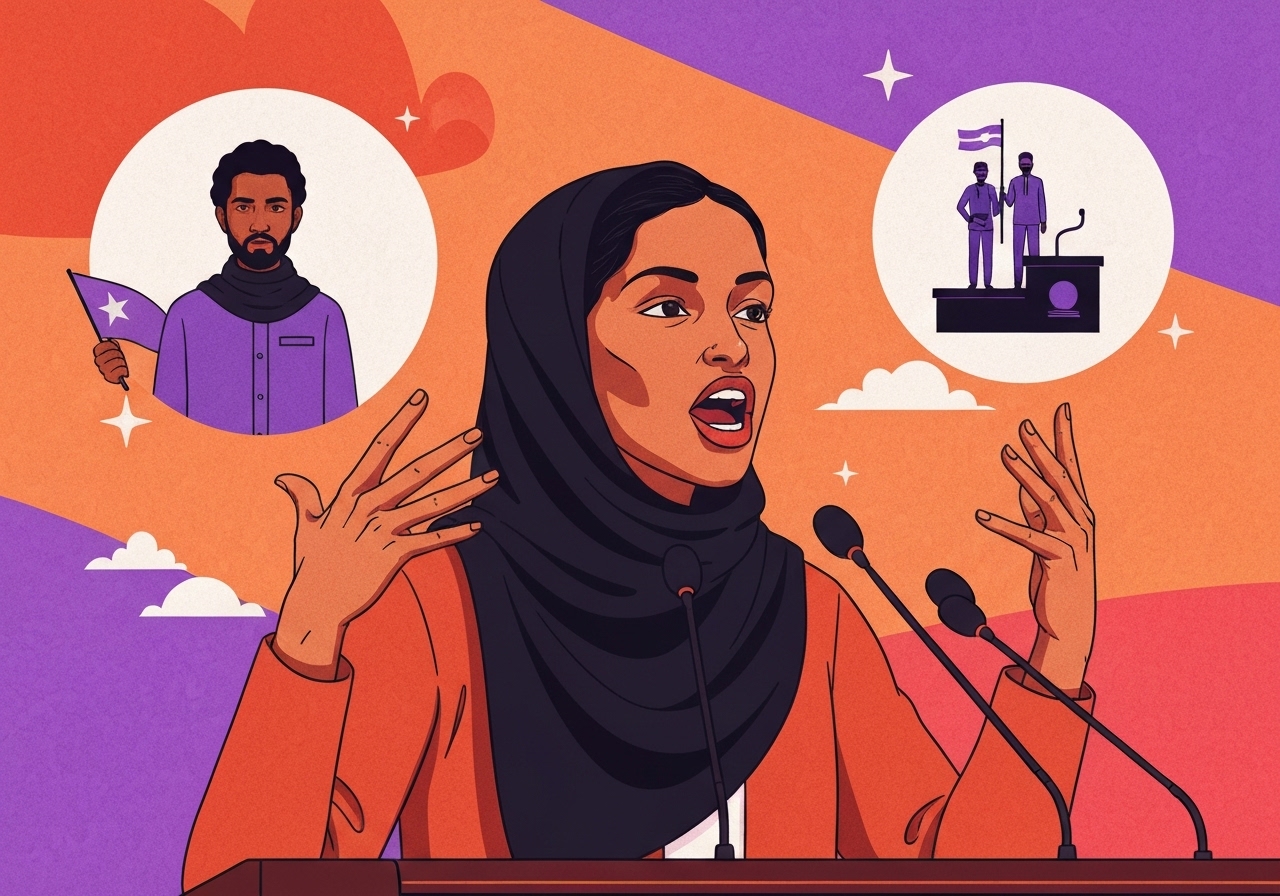
On 7 December 2025, Representative Ilhan Omar defended Somali residents of her Minnesota district after President Donald Trump described the community as “garbage” during a White House cabinet meeting. Speaking on CBS’s Face the Nation, Omar called the president’s language “completely disgusting” and warned that dehumanizing rhetoric can spur violent acts against targeted groups. The exchange followed weeks of heightened scrutiny of fraud prosecutions involving Somali Minnesotans and recent federal restrictions on immigration cases from Somalia and 18 other countries. Local officials and community leaders have moved to limit federal enforcement activity in response.
Key takeaways
- Rep. Ilhan Omar publicly rebuked President Trump on 7 December 2025, calling his descriptions of Minnesota’s Somali community “completely disgusting.”
- Trump reportedly called the community “garbage” and said many should be sent back to Somalia; he also alleged Somalis had taken “billions and billions” from the U.S.
- The administration has paused or restricted immigration cases for Somalis and people from 18 other countries, prompting concerns about stepped-up enforcement in the Minneapolis–St. Paul metro area.
- Dozens of Somali residents have been convicted in several fraud schemes investigated over multiple years; one prominent case involving Feeding Our Future led to a founder’s conviction in March 2025.
- One major set of charges was filed about three years ago, reflecting a multi‑year investigative timeline rather than a single recent surge.
- Minneapolis Mayor Jacob Frey signed an order barring use of city-owned parking facilities for immigration enforcement operations in response to enforcement fears.
- Treasury Secretary Scott Bessent said his department is probing whether misappropriated funds were routed to al-Shabaab; that linkage remains under investigation and unproven.
- Omar confirmed donations tied to some defendants were returned to her campaign “a couple years ago,” and she has publicly called the fraud itself “reprehensible.”
Background
Minnesota hosts one of the largest Somali diasporas in the United States, concentrated in the Minneapolis–St. Paul metro area. Over the past decade the community has become a visible civic and economic presence while also drawing attention from federal and state authorities on issues ranging from refugee resettlement to law enforcement. Representative Ilhan Omar, born in Somalia and elected as a Democrat, has been a prominent advocate for Somali Americans and a frequent target of partisan attacks.
In recent years federal and state prosecutors investigated multiple schemes involving false claims for meal reimbursements and other public benefits. Some of those inquiries culminated in prosecutions and convictions, including a high-profile case tied to Feeding Our Future; the investigations span several years, with at least one major set of indictments filed roughly three years before 2025. Advocates say the cases have been seized on by national political actors to stoke broader anti-immigrant sentiment.
Main event
The immediate flashpoint came during a cabinet meeting where President Trump, according to multiple reports, described Minnesota’s Somali community in demeaning terms and suggested some should be returned to Somalia. He also asserted — without public evidence made available at the time — that Somalis had extracted “billions” from U.S. programs. Those remarks were picked up by national media and prompted an on-air response from Omar the following day.
On CBS’s Face the Nation, Omar criticized the president’s language as dehumanizing and dangerous, saying such rhetoric can embolden individuals to commit violence. She also acknowledged and condemned the fraud prosecutions in Minnesota, saying she had been among the first members of Congress to call for investigations and calling the criminal activity “reprehensible.”
The Trump administration’s decision to curb immigration case processing for Somalia and 18 other countries has heightened anxiety among Somali residents and advocates, who anticipated increased enforcement presence in the Minneapolis–St. Paul metro area. In reaction, Minneapolis Mayor Jacob Frey issued an executive order limiting the use of city-owned parking facilities for immigration enforcement operations, citing public-safety and civil‑liberties concerns.
Federal officials have also raised a separate concern: Treasury Secretary Scott Bessent said his department is probing whether funds tied to some of the fraud cases were diverted to al-Shabaab, the Somalia-based militant group. House Republican lawmakers have echoed calls for further investigation into potential terrorism links, while Omar and others dispute any proven connection.
Analysis & implications
Politically, the episode highlights how localized criminal cases can be nationalized in a presidential campaign. By framing the Minnesota prosecutions as evidence of broader governance failures, the White House has shifted attention from policy debates to immigration and security rhetoric, areas that historically energize certain voter blocs. For Somali Americans in Minnesota, the mix of prosecutions and presidential denunciations risks increased social stigma and heightened fear of interaction with public agencies.
Legally, the fraud convictions represent discrete outcomes for individual defendants, but allegations of terrorism financing would, if substantiated, trigger separate investigative and prosecutorial processes. Omar and other critics argue that conflating criminal fraud with terrorism amplifies stigma without adding clarity. Investigators face the challenge of tracing financial flows across domestic benefit programs and international channels, a technically complex task that can take years to resolve.
At the municipal level, actions like Mayor Frey’s executive order illustrate how local authorities can try to blunt the immediate operational impact of federal enforcement. Such measures can reduce friction between immigrant communities and local services in the short term, but they do not alter federal immigration priorities. The tension between local sanctuary-type policies and federal enforcement is likely to persist as a political flashpoint.
Comparison & data
| Case / Topic | Key date | Noted outcome |
|---|---|---|
| Feeding Our Future | Founder convicted in March 2025 | Conviction of organization founder |
| Major indictments referenced | Charges filed ~2022 | Multi-year investigations leading to later convictions |
| Immigration restrictions | Late 2025 (administration policy) | Processing limited for Somalia + 18 countries |
The table shows the staggered timeline: indictments and investigative work began years before the most recent convictions and policy moves. That sequencing matters when assessing whether recent political statements are responses to new facts or to long-running legal processes.
Reactions & quotes
Omar’s on-air retort framed the president’s remarks as an attack on American constituents and a risky form of dehumanization.
“These are Americans that he is calling ‘garbage’. This is completely disgusting,”
Rep. Ilhan Omar (D‑MN), Face the Nation
Omar also reiterated that she had called for rigorous investigation of the fraud allegations and said any stolen funds tied to terrorism would represent a failure of law enforcement to identify and charge the right offenses.
“If there was a linkage in that … then that is a failure of the FBI and our court system,”
Rep. Ilhan Omar (D‑MN)
Treasury Secretary Scott Bessent publicly described a probe into whether funds were diverted to al-Shabaab, a claim that has been repeated by some House Republicans and which has driven part of the political response.
“We are investigating whether the taxpayer money was going to al‑Shabaab,”
Secretary Scott Bessent, U.S. Department of the Treasury (official statement)
Unconfirmed
- Allegations that stolen benefit funds were sent to al‑Shabaab remain under investigation and have not been publicly proven in court.
- President Trump’s claim that “billions and billions” were taken by Somalis has not been substantiated with publicly released accounting that ties the total to the identified convictions.
- Reports that donations from defendants to Omar’s campaign directly funded wrongdoing are not supported by public evidence; Omar says the donations were returned years ago.
Bottom line
The confrontation between Rep. Ilhan Omar and President Trump over the Somali community in Minnesota crystallizes a broader national debate: how to balance enforcement of fraud and criminal prosecutions with protection of immigrant communities from stigmatizing rhetoric and intrusive federal operations. The fraud convictions reflect concrete law‑enforcement outcomes, but political leaders have used those cases to advance competing narratives about immigration, security and governance.
For residents of the Minneapolis–St. Paul metro area, the immediate consequences are practical and psychological — added fear of enforcement and a sense of being publicly targeted. In the months ahead, investigators will need to publish clear, evidence‑based findings about any alleged terrorism links, and policymakers will have to weigh enforcement priorities against the risks of inflaming social divisions.
Sources
- The Guardian — news report summarizing statements and reactions (media)
- CBS News / Face the Nation — broadcaster; platform for Rep. Omar’s interview (media/broadcast)
- The New York Times — opinion page where Rep. Omar published an op‑ed (media/opinion)
- U.S. Department of the Treasury — official statements and ongoing investigations (official)
- City of Minneapolis — Mayor’s Office — local government actions, including executive orders (official)