
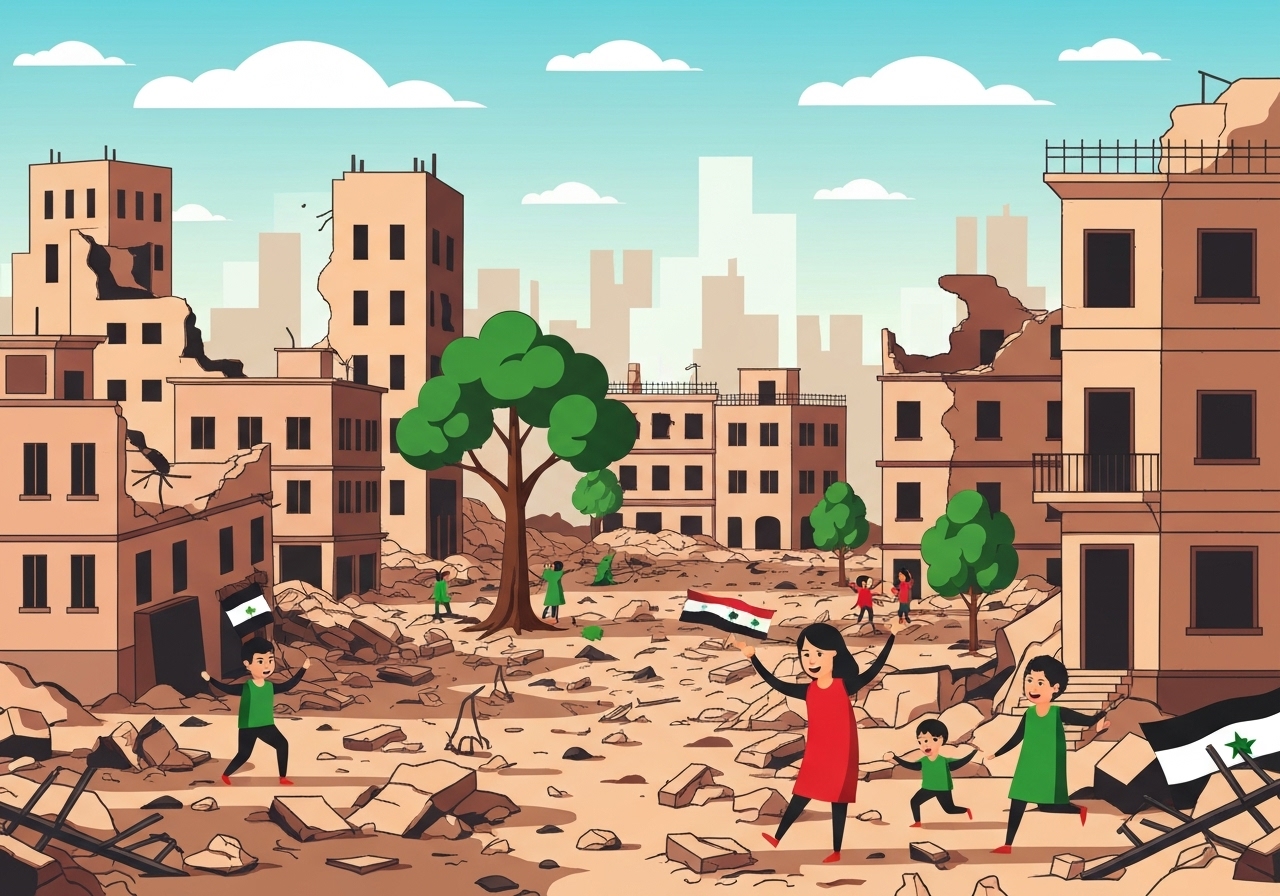
On 8 December 2024 a rapid offensive led by the rebel militia Hayat Tahrir al-Sham (HTS) culminated in the collapse of Bashar al‑Assad’s government after nearly 14 years of civil war. Assad and members of his family reportedly fled to Russia, and in January 2025 HTS leader Ahmad al‑Sharaa was installed as interim president. Over the subsequent year the country has seen improvements in some services and a reopening to international diplomacy, but security remains fragmented, basic infrastructure is severely damaged and political reconciliation is incomplete. Syrians and outside observers differ on whether gains to date signal a durable transition or a fragile pause between cycles of violence.
- Rapid regime change: HTS led the December 8, 2024 offensive that took control of Damascus and other key areas within roughly two weeks, precipitating Assad’s flight to Russia.
- Leadership change: Ahmad al‑Sharaa became interim president in January 2025 and has since addressed the UN General Assembly (September) and visited the White House (November), a first Syrian visit to Washington since 1946.
- Returns and displacement: About 2.9 million Syrians have returned — roughly 1.9 million internally displaced people plus over 1 million returnees from abroad.
- Missing and justice needs: Independent estimates of people still missing range from 140,000 to 300,000; a national missing‑persons commission was formed in May, alongside a slower‑moving commission on regime crimes.
- Reconstruction scale: Early cost estimates for rebuilding run between $250 billion and $400 billion, with many projects unfunded and local services still widely damaged.
- Basic services: More than half of water networks and four out of five electricity grids are reported destroyed or non‑functional; Mercy Corps satellite analysis shows partial recovery in nighttime lighting, but gains are uneven.
- Economy: The World Bank projected 1% GDP growth for 2025; sanctions have been largely lifted and Gulf investment pledges exist, yet a quarter of Syrians remain in extreme poverty.
Background
The Assad family governed Syria for more than half a century: Hafez al‑Assad took power in 1971 and his son Bashar succeeded him in 2000. Longstanding authoritarian governance, sectarian tensions and economic grievances fed a popular uprising in 2011 that escalated into a protracted civil war involving domestic factions and foreign militaries. Russia supported the Assad government militarily during the conflict; other regional and global powers backed various opposition groups. Over those 14 years the war produced vast displacement, large-scale destruction of infrastructure and widespread allegations of human rights abuses by multiple parties.
HTS evolved during the conflict from a constellation of Islamist factions into the dominant armed group in several northwestern provinces; by late 2024 it mounted a coordinated nationwide offensive that overturned the existing balance of power. International attention focused both on preventing further humanitarian collapse and on how a post‑Assad order would handle accountability, reconstruction and minority protections. The new interim authorities have emphasized stability and return of state services while also navigating rivalries with local forces, remnants of pro‑Assad networks and extremist cells that exploit governance gaps.
Main Event
On 8 December 2024 HTS forces launched a fast, multi‑axis offensive that encountered relatively little organized defense from Assad loyalists in many urban centers. Within about two weeks key government installations fell and the Assad family left the country; public broadcasts and local reports described a swift transfer of control rather than prolonged street fighting in the capital. In January 2025 Ahmad al‑Sharaa — a former militant figure who had been on international sanction lists — was declared interim president by the new authorities.
Following the takeover, visible signs of aerial bombardment and barrel‑bomb attacks largely ceased, and Russian air strikes on medical facilities reportedly declined. Nevertheless, UN and EU briefings describe a fragmented security picture: clashes continue in multiple areas, local militias and minority community forces sometimes resist central directives, and criminality and retaliatory attacks have been reported. Extremist groups, notably a resurgence of Islamic State elements in isolated pockets, have exploited security vacuums to stage attacks.
Political steps have included a national dialogue and work on a new constitution; parliamentary elections earlier in the year used indirect methods such as electoral colleges and are described by observers as an initial re‑entry into electoral processes rather than full democratization. Local governance and policing vary widely across territories controlled by HTS, allied brigades and community councils, producing a patchwork of order that complicates nationwide reform and reconciliation efforts.
Analysis & Implications
Security improvement in major urban centers has been sufficient to reduce some forms of wartime violence, but the underlying drivers of instability remain. Pro‑Assad networks reportedly operate clandestinely, and the uneven presence of transitional institutions means law enforcement and judicial functions are weak in many districts. That weakness raises the risk of revenge attacks against alleged former regime collaborators and community reprisals that could re‑ignite broader conflict dynamics.
Transitional justice is a central unresolved issue: in May the interim government created two independent commissions, one focused on missing persons and another on crimes committed by the former regime. The missing‑persons commission has been more active, while the commission on regime crimes has progressed more slowly, according to advocacy groups. Human Rights Watch and other organizations caution that investigations should be impartial and should also examine abuses by non‑state actors to avoid perpetuating cycles of impunity.
Politically, the interim authorities face a dilemma: consolidating control quickly can deliver stability but risks recreating authoritarian patterns; opening space for inclusive politics risks short‑term disorder but could produce sustainable legitimacy. Analysts describe the current moment as pivotal — small shifts in policy, protection of minority rights and credible electoral processes could anchor a pluralistic trajectory, but setbacks in reconciliation or sustained external attacks could push the country back toward centralized coercion.
Economically, reconstruction needs are immense and financing remains uncertain. Gulf pledges and the lifting of many Assad‑era sanctions have improved access to some external capital, yet actual investments are constrained by governance risks, unclear property claims and the sheer scale of rebuilding required. Short‑term GDP upticks, such as the World Bank’s forecasted 1% growth in 2025, are unlikely to translate immediately into broad welfare gains without targeted job creation and service restoration.
| Indicator | Estimate/Status |
|---|---|
| Returnees (total) | ~2.9 million |
| Missing persons (est.) | 140,000–300,000 |
| Reconstruction cost (est.) | $250–$400 billion |
| Electricity grids functional | ~20% (four out of five damaged) |
| Schools renovated (official) | 823 completed; 838 under work |
The table aggregates widely cited estimates and official claims to give a snapshot of scale. Differences across sources reflect the difficulty of data collection amid ongoing instability, contested property records and varying definitions of ‘returned’ or ‘missing.’ These figures underscore that physical rebuilding and social reconciliation are both substantial and long‑term challenges.
Reactions & Quotes
International officials and analysts have registered cautious optimism alongside concerns about security and accountability.
“Israeli military operations … endanger civilians, inflame regional tensions, undermine the fragile security environment, and threaten the political transition.”
Najat Rochdi, UN deputy special envoy for Syria
Rochdi’s warning reflects UN reporting that cross‑border strikes and foreign incursions complicate stabilization and increase civilian risk, while also affecting diplomatic efforts to normalize relations.
“It is surely too soon to talk about democratizing Syria, but the new institutions represent a modest re‑entry into electoral politics.”
Patricia Karam, Arab Center Washington fellow
Karam and other analysts emphasize that early elections and a constitution process are steps forward but not substitutes for full pluralism, transparent institutions and protections for political competition.
“Transitional justice must address crimes by the former regime and other actors to prevent cycles of revenge.”
Syria Justice and Accountability Centre (summary position)
SJAC has urged balanced, victim‑centered mechanisms; activists note that focusing only on one set of perpetrators risks deepening grievances and obstructing long‑term reconciliation.
Unconfirmed
- Precise casualty totals from the December offensive remain incomplete; independent verification is limited in some regions.
- Claims about the extent of collaboration between hidden pro‑Assad cells and foreign actors are reported but not fully substantiated by open investigations.
- Exact commitments from foreign investors and the timetable for disbursing reconstruction funds are announced in parts but not yet confirmed through signed contracts and delivery schedules.
Bottom Line
The first anniversary of Assad’s removal shows a Syria in which immediate wartime tactics have abated in many cities, diplomatic doors have reopened and limited service restoration is underway. Yet security remains uneven, significant human‑rights and accountability needs persist, and the economic and reconstruction task is colossal. Without credible transitional justice, fair property and return processes, and broad political inclusion, the risk of renewed conflict or authoritarian relapse remains real.
Over the next 12–24 months attention should focus on (1) securing impartial investigations into wartime abuses and supporting the missing‑persons commission, (2) consolidating inclusive local governance and policing to reduce reprisals and criminality, and (3) tying reconstruction finance to transparent contracting and protection of vulnerable populations. The choices made by interim authorities, local actors and external partners during this window will largely determine whether Syria moves toward durable recovery or toward another cycle of instability.
Sources
- DW — original report and timeline (international media)
- UN Security Council (official UN organ; briefings and reports)
- EU Agency for Asylum (EUAA) (EU agency; country analysis)
- Syria Justice and Accountability Centre (SJAC) (NGO; transitional‑justice research)
- Human Rights Watch — Syria (human rights NGO)
- World Bank — Syria country overview (multilateral development bank)
- Mercy Corps (NGO; satellite and recovery analysis)
- Norwegian Refugee Council (NGO; returns and shelter data)