
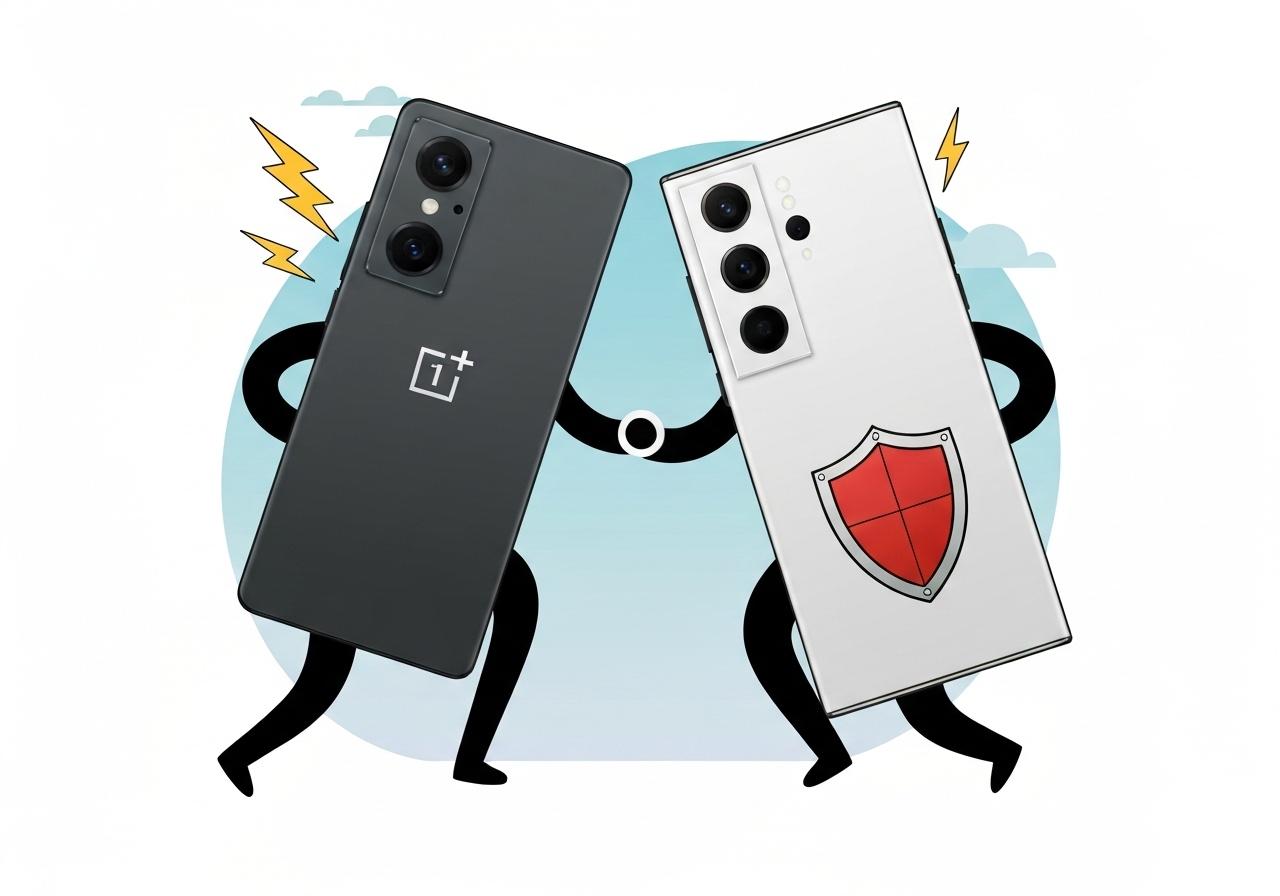
The OnePlus 15 and Samsung Galaxy S25 Ultra arrive as two of 2025’s most talked-about Android flagships, each aiming at demanding users. OnePlus undercuts Samsung on price while packing a very large 7,300mAh battery, IP69-rated durability claims and the Snapdragon 8 Elite Gen 5. Samsung’s S25 Ultra, priced at launch around $1,299, leans on an industry-leading display, S Pen support and a longer seven-year software update promise. After a week of side-by-side use, real-world endurance, screen behavior in wet conditions and software longevity are the clearest differentiators.
Key takeaways
- Price gap: OnePlus 15 starts at $899 versus the Galaxy S25 Ultra’s $1,299 launch price, a roughly $400 difference at release.
- Battery & charging: OnePlus packs a 7,300mAh cell with 80W wired charging (plus 50W wireless); Samsung uses a 5,000mAh battery with 45W wired and 15W wireless charging.
- Durability ratings: OnePlus advertises IP68 plus IP69 for water-jet resistance; Samsung lists IP68 for submersion resistance.
- Performance: OnePlus ships Qualcomm Snapdragon 8 Elite Gen 5; Samsung uses the Snapdragon 8 Elite for Galaxy variant — both flagship-class chipsets with different tuning.
- Display experience: Samsung’s S25 Ultra offers a 6.9″ QHD AMOLED with superior anti-reflective treatment and up to 2,600 nits peak brightness; OnePlus uses a 6.78″ 1.5K 165Hz AMOLED (claimed 1,800 nits peak).
- Camera trade-offs: OnePlus relies on three 50MP modules (wide/ultra/tele 3.5x) plus a 32MP front shooter; Samsung includes a 200MP wide sensor and multiple telephoto options (5x and 3x) with a 12MP front camera.
- Software support: OnePlus promises four OS upgrades and five years of security updates; Samsung guarantees seven years of OS and security updates for the S25 Ultra.
Background
OnePlus launched the OnePlus 15 earlier than many expected, positioning it as a value-focused flagship that borrows from premium hardware trends while keeping the base price below $1,000. The company emphasized battery capacity, durability, and fast wired charging as central selling points. Samsung’s Galaxy S25 Ultra continues the firm’s long-running Ultra lineage, prioritizing best-in-class display tech, camera versatility and the S Pen niche that differentiates it from most rivals.
Flagship smartphone competition in 2024–25 has increasingly split along two axes: raw hardware value versus polished ecosystem experiences. Vendors such as OnePlus push aggressive pricing and large batteries, while Samsung leans on display expertise, software longevity and accessory ecosystems like the S Pen. That divergence shapes buyer choices: some prioritize day-and-a-half battery life and fast charging; others prioritize screen fidelity, camera reach and multi-year updates.
Main event
In hands-on testing, the OnePlus 15’s 7,300mAh battery consistently outlasted the S25 Ultra over heavy-use days. A typical conference day with navigation, social apps, photo capture and streaming left the OnePlus at roughly 40% battery by evening, delivering around nine hours of screen-on time in my tests. The S25 Ultra, with its 5,000mAh cell, did not sustain that level of heavy use into late evening without a top-up.
Display behavior diverged notably in wet conditions. The OnePlus 15’s touch stack and AquaTouch-style handling allowed reliable input with water droplets present, while the Galaxy S25 Ultra’s screen occasionally registered false touches in a drizzle, requiring a wipe for accuracy. Conversely, Samsung’s anti-reflective coating and higher peak brightness made outdoor reading and content consumption more comfortable and color-accurate than the OnePlus panel.
On build and finish, the OnePlus Sand Storm variant incorporates what the company calls a MAO-treated middle frame intended to increase wear resistance; combined with IP69 lab rating, OnePlus pitches stronger real-world durability. Samsung maintains a premium metal/glass construction with IP68 submersion protection and long-standing water-resistance engineering, but lacks the IP69 designation for high-temperature water jets.
Performance in apps and games was broadly excellent on both devices thanks to their top-tier Snapdragon silicon. The OnePlus 15’s vapor chamber cooling and higher refresh-rate 165Hz panel gave a snappier feel in many games, while Samsung’s GPU and OS tuning on the S25 Ultra remained competitive and optimized for sustained workloads. Thermal and frame-rate differences were marginal for everyday use, but sustained gaming sessions favored OnePlus’ thermal headroom in my profile.
Analysis & implications
Battery strategy is now a major marketing axis in flagship phones. OnePlus’ move to a 7,300mAh cell (with a claimed increase to 15% silicon content in the anode for energy density) addresses a persistent consumer pain point: daily charging. If sustained in long-term use, the larger cell plus 80W charging shifts expectations for endurance in premium devices and reduces reliance on power banks for frequent travelers or heavy users.
Samsung’s strength remains the display and ecosystem. The S25 Ultra’s anti-reflective coating and higher peak brightness materially improve legibility in bright sunlight and give content an edge in perceived clarity and color fidelity. For buyers who watch a lot of HDR video, edit photos on-device or prioritize the best visual canvas, Samsung still leads. The S Pen remains a small but meaningful wedge for productivity-oriented customers who want handwriting and quick note capture on a flagship phone.
Software support is a long-term ownership consideration. OnePlus’ four major OS upgrades and five years of security coverage is competitive for the Android market, but Samsung’s seven-year promise extends usable device life by roughly three additional years of OS-level features and patches. That gap matters for users who keep hardware for multiple upgrade cycles and value sustained feature additions and security fixes.
Price-performance dynamics favor OnePlus in the short term: the company undercuts Samsung by a substantial margin while offering standout battery capacity and fast charging. For market share, that combination may pressure Samsung at the sub-$1,000 segment, but Samsung’s advantages in display quality, camera versatility (notably the 200MP main sensor and multiple telephoto options) and ecosystem services still justify premium pricing for many buyers.
| Specification | OnePlus 15 | Samsung Galaxy S25 Ultra |
|---|---|---|
| Display | 6.78″ AMOLED, 1.5K, 165Hz, ~1,800 nits peak | 6.9″ QHD AMOLED, 120Hz, 2,600 nits peak |
| Battery | 7,300mAh, 80W wired, 50W wireless | 5,000mAh, 45W wired, 15W wireless |
| Processor | Snapdragon 8 Elite Gen 5 | Snapdragon 8 Elite for Galaxy |
| Cameras | 50MP wide / 50MP ultra / 50MP tele (3.5x) / 32MP front | 200MP wide / 50MP tele (5x) / 10MP tele (3x) / 50MP ultrawide / 12MP front |
| Launch price | $899 (base) | $1,299 (launch) |
The table highlights the trade-offs buyers face: OnePlus emphasizes battery and value, Samsung concentrates on peak display luminance and camera reach. Those distinctions align with different use profiles rather than strictly better-or-worse comparisons.
Reactions & quotes
Early reviewer impressions and official messaging underline divergent priorities: OnePlus pushes durability and endurance, Samsung points to display and ecosystem advantages. Below are representative short-form comments with context.
“I consistently got nine hours of screen time on the OnePlus 15 during heavy days.”
ZDNET reviewer (hands-on testing)
This remark summarizes a week-long usage profile where the OnePlus 15’s large battery and efficient charge cycle delivered extended runtime compared with the S25 Ultra under similar conditions.
“The S25 Ultra remains our best display on a smartphone so far.”
Independent display testing summary (industry reviewers)
Multiple display analysts and reviewers have repeatedly singled out Samsung’s display tuning and anti-reflective work as class-leading — an advantage that shows up in outdoor legibility and color accuracy for media consumption.
“OnePlus’ Sand Storm frame uses MAO treatment for added wear resistance.”
OnePlus product description (official)
OnePlus frames its Sand Storm finish and IP69 lab rating as durability differentiators; those are manufacturer claims that matter to buyers who prioritize ruggedness.
Unconfirmed
- OnePlus’ claim that 15% silicon content in the anode meaningfully extends long-term battery life versus the industry 10% standard is a manufacturer assertion; independent long-term cycle tests are not yet public.
- Real-world advantages of IP69 versus IP68 for most consumers (pools, rain, splashes) are plausible but not independently quantified in consumer usage studies yet.
- Comparative camera output under identical pro-level scenes (e.g., 200MP vs computational 50MP pipelines) requires side-by-side RAW captures and lab analysis to draw conclusive results; current impressions are based on everyday shooting.
Bottom line
If your priority is endurance, rapid charging and getting flagship performance without a $1,300 price tag, the OnePlus 15 is the stronger value proposition. Its 7,300mAh battery, 80W wired charging and competitive Snapdragon 8 Elite Gen 5 configuration deliver real, measurable advantages for heavy users and gamers who want long single-charge life.
By contrast, choose the Galaxy S25 Ultra if you value the absolute best display, tighter ecosystem integration (including S Pen workflows) and the longest manufacturer software support window. Samsung’s screen and seven-year update policy make the S25 Ultra a safer bet for buyers who keep devices for many years and prioritize content consumption and camera versatility.
Ultimately, the two phones address different priorities: OnePlus aims to democratize high-end endurance and performance at a lower entry price, while Samsung doubles down on premium screen experience, camera depth and extended software maintenance. Your decision should hinge on which of those priorities you expect to feel most in daily use.