
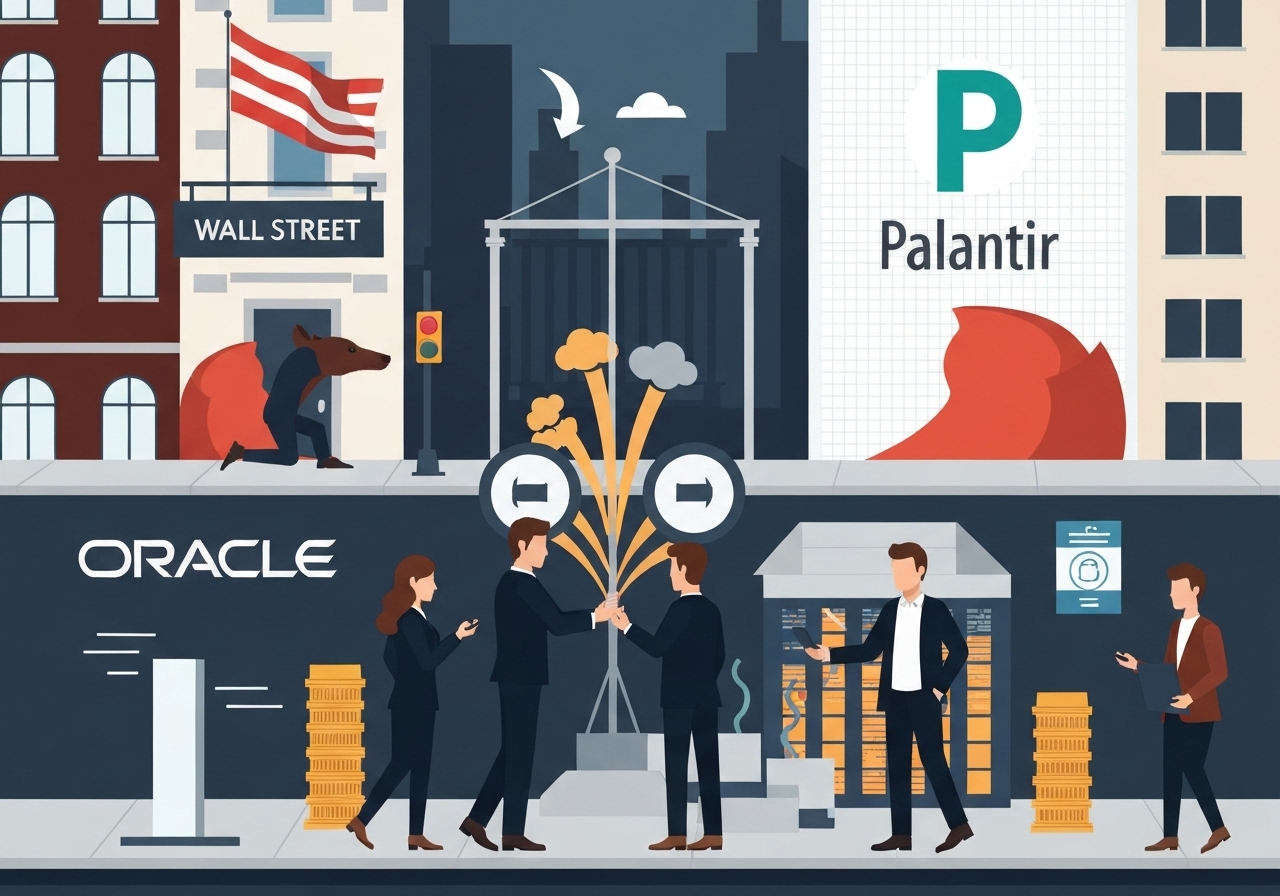
In early January 2026, Wall Street analysts are divided between two headline AI names: Palantir Technologies and Oracle. Palantir has delivered enormous returns since its October 2020 IPO but now trades at a very rich multiple, prompting many analysts to adopt neutral stances. Oracle stunned markets with massive remaining performance obligations tied to AI data-center demand, then faced scrutiny over financing and margin pressure. Analysts remain broadly optimistic on Oracle’s long-term position in AI infrastructure while treating Palantir’s near-term valuation with caution.
Key takeaways
- Palantir’s share price is up roughly 147% over the past year and about 1,920% since its October 2020 IPO, reflecting strong investor enthusiasm for its AI-driven analytics platform.
- Palantir trades near 256 times forward earnings, a valuation level that has led many institutional investors and analysts to call the stock expensive.
- Of 16 analysts reporting on Palantir in the last three months, 3 rated buy, 11 rated hold, and 2 rated sell, according to TipRanks’ aggregated data.
- Oracle reported $455 billion in remaining performance obligations (RPOs) in its first quarter of fiscal 2026, a figure the company tied largely to hyperscaler AI data-center demand.
- About $300 billion of Oracle’s disclosed RPOs were reported to stem from a multiyear arrangement with OpenAI, raising questions about concentration and funding.
- Oracle’s stock has risen close to 18% over the past year; in the last three months TipRanks logs 34 analyst reports with 24 buys and 10 holds, and an average 12‑month target implying roughly 60% upside.
- Mizuho analyst Siti Panigrahi named Oracle a top enterprise-software pick for 2026 with a $400 price target, implying more than 100% upside if realized.
Background
The AI theme dominated capital markets through 2025, driving sharp re-ratings across cloud, infrastructure and software vendors. Hyperscalers and large enterprises rushed to secure capacity for generative AI workloads, prompting software and hardware suppliers to announce multiyear deals and long-term capacity commitments. Those commitments often show up on vendor balance sheets as remaining performance obligations — contract value not yet recognized as revenue — which investors read as both revenue visibility and potential execution risk.
Palantir built its reputation on government contracts and enterprise analytics that layer AI and proprietary data tools to surface insights for complex operations. The company has shown strong customer retention and growing commercial traction, but the rapid stock appreciation has outpaced traditional valuation metrics. Oracle pivoted in public perception: after a strong earnings print tied to AI demand it became an AI darling, but concerns about how it will finance large data-center builds and maintain margins reintroduced caution among some market participants.
Main event
Palantir’s recent price action underscores the tension between growth and valuation. The stock’s multi-year outperformance—about 1,920% since IPO—is anchored in its platform’s ability to ingest diverse data sources and deliver actionable, AI‑assisted recommendations. Yet the forward multiple (circa 256x) has prompted a majority of recent analysts to recommend holding rather than buying, signaling doubts about near-term upside for risk‑averse institutions.
Oracle’s headline was its fiscal 2026 first-quarter disclosure of $455 billion in RPOs, which the market initially translated into a surge in the stock. A significant portion — roughly $300 billion — was reported to be tied to OpenAI contracts, a concentration investors scrutinized given OpenAI’s broad vendor arrangements. The stock spiked, then pared gains as attention turned to the capital required to build and operate new AI data centers and to the company’s most recent negative free cash flow figure.
Investor concern intensified when credit indicators showed stress: credit-default-swap yields tied to Oracle’s debt rose, suggesting bond-market participants were pricing higher perceived credit risk. Questions about whether Oracle would need incremental debt issuance — and how such financing would affect its investment‑grade ambition — tempered some analysts’ enthusiasm despite bullish revenue narratives tied to AI adoption.
Analysis & implications
The contrast between Palantir and Oracle highlights two distinct investor theses in the AI cycle. Palantir is valued as a high-growth, software-driven AI decision platform with a loyal client base, but the valuation makes it sensitive to any deceleration in growth or execution hiccups. For long-term investors, the central question is whether Palantir’s revenue growth and margin expansion can justify its current multiple over the next several years.
Oracle’s opportunity is different: it sells the backbone for AI operations — databases, cloud infrastructure and now large-scale data-center capacity. If the massive RPO backlog converts to revenue and cash flow, Oracle could materially benefit from AI-driven enterprise spend. The countervailing risk is the near-term pressure on free cash flow and the need to finance physical builds at scale, which could compress margins or increase leverage temporarily.
OpenAI’s role complicates both stories. Large, concentrated contracts with a single AI customer raise dependency and execution risk for vendors. Moreover, reports that OpenAI has roughly $1.4 trillion in obligations across infrastructure partners invite questions about how quickly and reliably those obligations translate into spend with any single vendor. For investors, that uncertainty increases the premium placed on balance-sheet strength and contract diversity.
Comparison & data
| Metric | Palantir (PLTR) | Oracle (ORCL) |
|---|---|---|
| 1‑year return | ~+147% | ~+18% |
| Since IPO (Oct 2020) | ~+1,920% | — |
| Forward P/E | ~256x | — |
| Analyst coverage (last 3 months) | 16 reports (3 buy / 11 hold / 2 sell) | 34 reports (24 buy / 10 hold) |
| Key contract / liability note | — | $455B RPOs; ~$300B reportedly from OpenAI |
The table frames why market participants are treating the two firms differently: Palantir’s valuation is extreme relative to conventional earnings metrics, while Oracle’s headline RPOs create both a revenue narrative and a financing question. Investors should weigh conversion risk — how much of the RPOs become recognized revenue and over what timeline — against balance‑sheet flexibility and margin trajectories.
Reactions & quotes
Market reactions have been mixed: some analysts emphasize Oracle’s strategic placement in AI infrastructure, while others highlight the company’s near-term financing and margin questions. Palantir’s supporters point to customer traction and platform stickiness, whereas skeptics flag the stretched valuation as the primary risk to new buyers.
“Oracle remains a top enterprise‑software pick for 2026 given its tech stack exposure to AI,”
Mizuho / Siti Panigrahi (analyst)
Panigrahi’s call — including a $400 price target — reflects a bullish scenario where Oracle converts large contract backlogs into profitable growth. That view assumes Oracle can finance data‑center expansion without permanently harming its credit profile.
“The valuation on Palantir makes it a tough fit for many institutional mandates,”
Wall Street analyst consensus (aggregated)
That sentiment captures why most recent analyst notes rate Palantir as hold: strong operational case but constrained by an earnings multiple that leaves little room for disappointment.
Unconfirmed
- The exact portion of OpenAI’s $1.4 trillion reported obligations that will be paid to or realized by Oracle remains unverified and may change as contracts are executed or renegotiated.
- The $300 billion figure attributed to the OpenAI‑Oracle multiyear arrangement is reported but not independently audited in public filings; final recognized revenue could differ materially.
- The timing, ultimate cost and financing terms for Oracle’s planned data‑center builds have not been fully disclosed and therefore remain subject to future updates.
Bottom line
Palantir and Oracle occupy different positions in the AI ecosystem: Palantir as a software and analytics growth story, Oracle as a critical infrastructure and cloud vendor with potentially massive contract backlogs. Wall Street’s current posture — cautious on Palantir’s valuation but largely optimistic about Oracle’s AI exposure — reflects those structural differences and the specific near‑term risks each company faces.
For investors, the tradeoff is between growth priced at a premium (Palantir) and a balance‑sheet/ execution trade (Oracle). Monitoring RPO conversion rates, cash‑flow trends, debt metrics and OpenAI’s funding trajectory will be essential in 2026 to separate enduring winners from short‑term market narratives.