
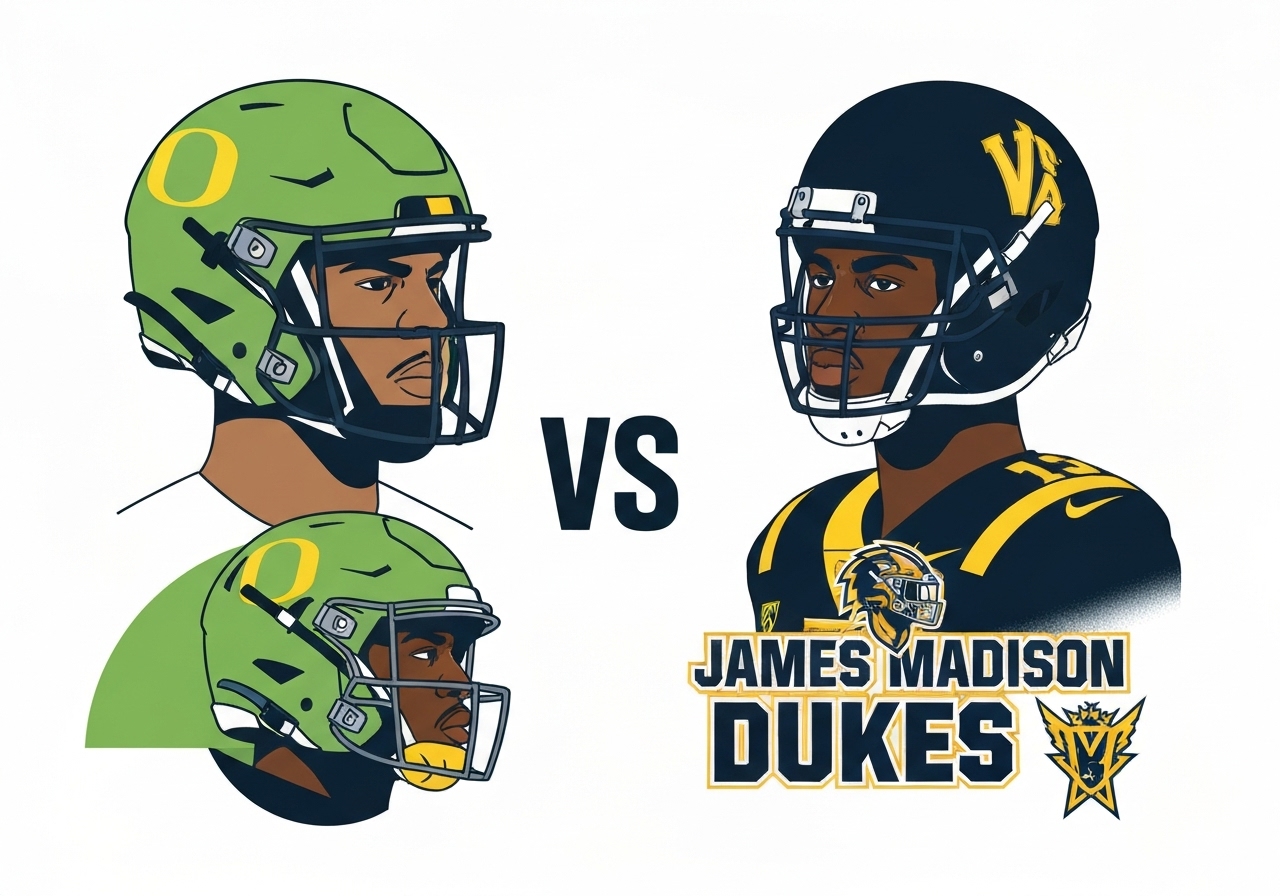
Saturday night in Eugene, No. 5 Oregon (11-1) hosts No. 12 James Madison (11-1) in the final College Football Playoff first-round game, a meeting between two teams with no prior head-to-head history and no shared regular-season opponents. Oregon arrives ranked fifth after an 11-1 regular season, led by redshirt sophomore quarterback Dante Moore and an offense that balances a prolific passing group with a top-15 rushing attack. James Madison punched the final CFP ticket after dominating the Sun Belt, leaning on a run-heavy attack led by tailback Wayne Knight and a dual-threat quarterback in Alonza Barnett III. The winner advances in the playoff bracket; both teams must adapt quickly to each other’s strengths and to the Autzen Stadium environment to move on.
Key Takeaways
- Oregon finished 11-1 and No. 5 in the final CFP poll, with its lone loss to No. 1 Indiana in Week 7 and key wins including a double-overtime victory over then-No. 3 Penn State.
- Dante Moore has thrown 24 touchdowns against six interceptions this season and will helm an Oregon offense that also averages over 218 rushing yards per game (14th nationally).
- Oregon’s top receiving corps has been banged up: Dakorien Moore missed four games and transfer Evan Stewart missed the season; both are listed as questionable but were seen practicing.
- Tight end Kenton Sadiq leads Oregon with eight touchdowns and is a major red-zone matchup problem for any secondary or linebacker group.
- James Madison also enters 11-1 and averages nearly 450 total yards per game, with roughly 245 rushing yards per game (fifth nationally), anchored by Wayne Knight’s 1,263 rushing yards and 6.65 yards per carry.
- Alonza Barnett III has accounted for 21 passing touchdowns and 14 rushing scores; his mobility is central to JMU’s scoring ceiling against Oregon’s stout defense (Oregon has allowed fewer than 15 points per game).
- JMU faced only one Power Four opponent in the regular season (28-14 loss at Louisville, Week 2), leaving questions about how the Dukes’ attack will translate against a Pac-12-caliber defense.
Background
Oregon’s 2025 campaign under Dan Lanning combined explosive offensive outputs with a defense that limited opponents consistently, producing an 11-1 ledger and a top-five CFP finish. The Ducks’ schedule produced several signature moments — a double-overtime win over Penn State and a close two-point victory at Iowa — along with mostly comfortable margins in other victories. Health has been a storyline: the wide receiver room has missed time from key pieces, yet the offense remained productive because of balance and depth.
James Madison rose through the Sun Belt with dominant statistical totals and an 11-1 record that earned the program the final CFP berth. The Dukes’ identity is built on a powerful rushing attack and a versatile quarterback in Alonza Barnett III, who contributes heavily on the ground and through the air. However, JMU’s schedule included limited Power Four competition, which invites debate about how the team’s production will hold up against a top-tier defensive unit in a hostile road environment.
Main Event
The matchup at Autzen Stadium pits Oregon’s multi-faceted offense against a JMU defense that will face the season’s stiffest test. Expect Oregon to mix tempo and personnel frequently: Dante Moore’s ability to pass efficiently pairs with a deep running game that averages more than 218 rushing yards per outing. If Dakorien Moore and Evan Stewart are available, the Ducks’ receiving options grow significantly; otherwise Kenton Sadiq remains the primary seam and red-zone target.
James Madison will lean on Wayne Knight and a ground-first identity to control tempo, sustain drives and limit Oregon possessions. Knight’s 1,263 rushing yards and 6.65 yards per carry make him the central weapon; opening lanes and finishing runs will be essential against Oregon’s front. Alonza Barnett III’s dual-threat skills give the Dukes a second dimension — scramble conversions and designed runs that keep Oregon’s defenders honest.
Special teams and turnovers will be amplified in a playoff night game at Autzen, where crowd noise and field position can swing momentum. For JMU, third-down conversions and red-zone efficiency will determine whether they can compete for four quarters. For Oregon, containing the run without giving up explosive plays will be the defensive priority; their ability to create negative-run plays and generate field-flipping punts could decide the margin.
Analysis & Implications
Matchup-wise, Oregon’s strength is a balanced offense with high-end receiving talent (when healthy) and a potent running game; JMU’s strength is a downhill rushing attack supported by a quarterback who can score in multiple ways. If Oregon’s receivers are fully available, the Ducks can stretch the field and force JMU into more obvious passing situations, where Oregon’s defensive scheme can try to capitalize. Conversely, if JMU can sustain long, run-heavy drives it reduces the number of possessions and increases variance — a classic underdog strategy in neutralizing a more talented opponent.
From a program perspective, a JMU win would mark a seismic result: a Group of Five program beating a top-five Power Five team in the CFP would reshape narratives about access and parity. For Oregon, an early exit would raise questions about peaking and depth under playoff pressure. Either outcome has recruiting and financial implications: playoff success boosts exposure, donor engagement and future scheduling leverage for both programs.
Strategically, the key tactical battles will be Oregon’s ability to neutralize Knight in the box and JMU’s pass protection versus Oregon’s pass rush. Line play and in-game adjustments will matter more than schematic novelty; both staffs will need to win the chess match in play-calling, clock management and fourth-down decisions. Penalties, turnovers and special-teams execution are small-sample-game determiners that often decide one-off postseason matchups.
Comparison & Data
| Metric | Oregon | James Madison |
|---|---|---|
| Record (regular season) | 11-1 | 11-1 |
| Total offense (approx.) | Balanced (top passing & rushing) | ~450 yards/game |
| Rushing yards/game | 218+ (14th nationally) | ~245 (5th nationally) |
| Leading rusher | Multiple contributors | Wayne Knight — 1,263 yards (6.65 ypc) |
| QB scoring | Dante Moore — 24 pass TDs, 6 INTs | Alonza Barnett III — 21 pass TDs, 14 rush TDs |
| Scoring defense | Fewer than 15 points allowed/game | Data varies by opponent strength |
The table above synthesizes the most relevant season-long metrics for the matchup: Oregon’s defensive stinginess and balanced offense versus JMU’s top-five rushing output and heavy total-yardage profile. Numbers reflect trends rather than predictive odds; matchup context, injuries and in-game variance will heavily influence the actual statistical outcome.
Reactions & Quotes
Selection and team communications framed the matchup’s significance heading into the weekend. Below are succinct excerpts and their context.
“James Madison received the final 2025 College Football Playoff spot after its dominant Sun Belt run.”
College Football Playoff selection committee (official release)
The CFP committee’s announcement confirmed JMU’s inclusion and set the narrative of a Group of Five team entering the national bracket, prompting discussion across media and fan bases about competitive balance.
“We know it’s a tough task, but we’re focused on executing and preparing for a hostile environment.”
Oregon head coach Dan Lanning (press availability)
Oregon’s staff emphasized preparation and game planning rather than headlines; that posture is typical for a top-five program managing expectations and minimizing distractions before a playoff game.
“This is the biggest stage for our program in recent history — we’ll treat it like any other game but with full respect for the challenge.”
James Madison athletics communications (team statement)
JMU framed the game as both opportunity and responsibility, underscoring the program-level significance of a CFP appearance and the need for execution against a higher-ranked opponent.
Unconfirmed
- Whether Dakorien Moore and Evan Stewart will be cleared and active for the game — both were listed as questionable and were seen practicing, but final statuses will be on the gameday report.
- How JMU’s offense will fare against a top-15 rushing defense and a front that has yielded fewer than 15 points per game — season stats favor the Ducks defensively, but single-game results can differ.
- The scale of an upset: a JMU win would be historic within CFP context, but labeling it the largest upset in CFP history depends on comparative seeding and odds from multiple seasons.
Bottom Line
This matchup is a classic underdog-versus-favorite playoff test: Oregon brings top-five ranking, a balanced offense, and a stingy defense to Autzen Stadium; James Madison counters with a high-volume rushing attack and a playmaking, dual-threat quarterback. Health for Oregon’s receiving corps and JMU’s ability to control the line of scrimmage will be decisive. Expect a physical game with field-position battles, where turnovers and special teams could tilt the result more than raw season metrics suggest.
For Oregon, advancing validates a top-five seed and keeps CFP aspirations alive; for James Madison, a win would reframe Group of Five narratives and elevate the program’s national standing. Fans should watch early-down efficiency, third-down defense, and how each coaching staff adjusts after halftime — those factors are likelier to predict the winner than pregame reputations alone.