
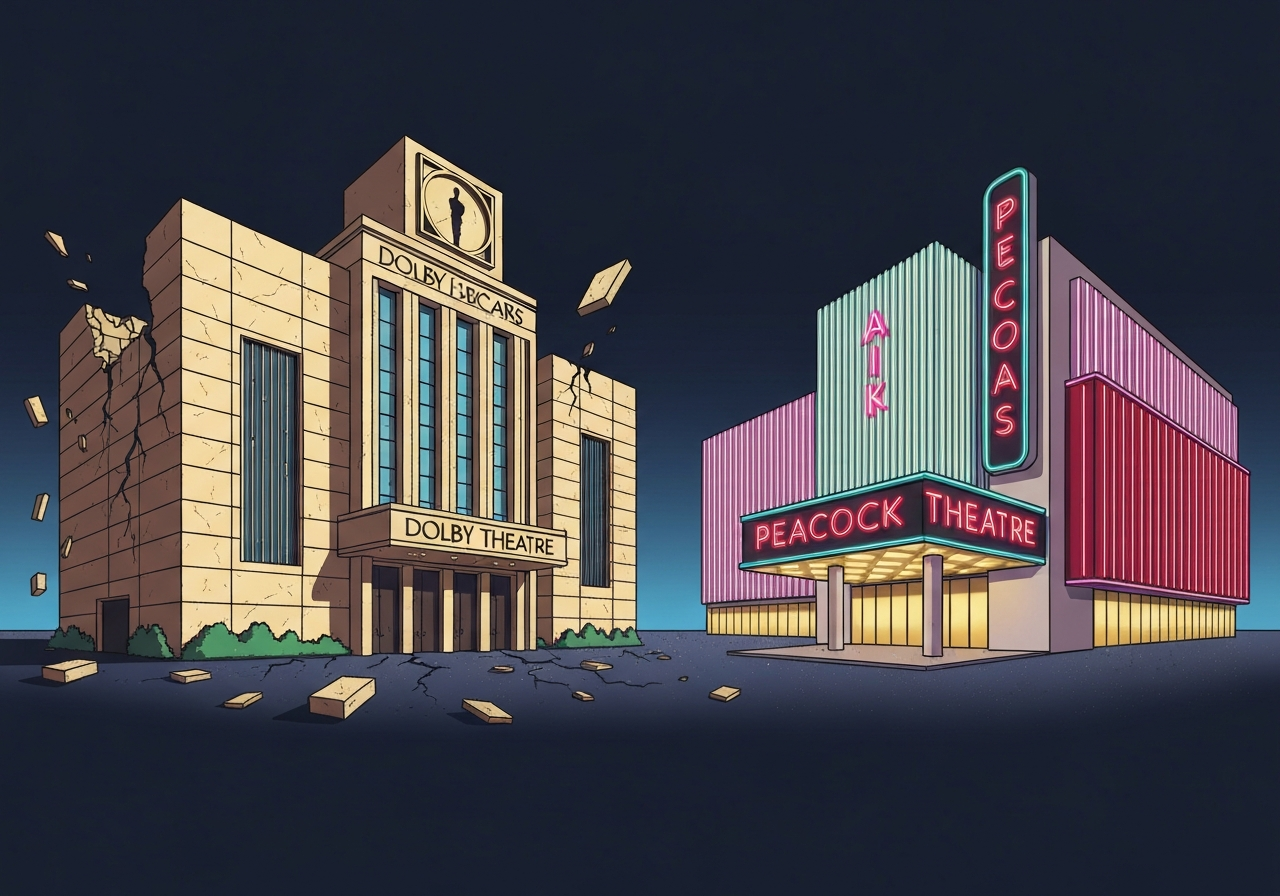
The Academy of Motion Picture Arts and Sciences has announced that the Academy Awards ceremony will move from the Dolby Theatre to the Peacock Theater at L.A. Live beginning in 2029, with the arrangement extending through 2039. The first ceremony at the new site will coincide with the telecast’s migration to YouTube and mark the 101st Academy Awards. Dolby Theatre has been the Oscars’ regular home since 2002, aside from a COVID-era shift to Union Station in 2021. AEG, which owns L.A. Live, will partner with the Academy on upgrades to accommodate the ceremony.
Key Takeaways
- The Oscars will relocate to Peacock Theater starting in 2029 and remain there through 2039, a planned 11-year run.
- The 2029 ceremony will be the 101st Oscars and will air on YouTube after a long history on ABC.
- Dolby Theatre hosted the Oscars continuously from 2002 until the move; the only exception was the 2021 ceremony at Union Station due to COVID-19 restrictions.
- AEG will fund and execute comprehensive enhancements to Peacock Theater including stage, sound, lighting, lobby and backstage upgrades tailored for the Oscars.
- L.A. Live’s expanded plaza will serve as the red carpet zone for arrivals and broadcast staging.
- The agreement is described by the Academy and AEG as a partnership combining the Academy’s production needs with AEG’s venue management and technical capabilities.
Background
Since 2002, the Dolby Theatre has functioned as the Oscars’ flagship venue, hosting ceremonies, rehearsals and many of the ancillary events that define award season. The Dolby run produced a stable, broadcast-ready environment that networks, producers and studios came to rely on for staging a complex live telecast. The 2021 ceremony was a notable exception: organizers moved to Union Station in response to pandemic-era health guidance and logistical constraints.
In recent years the Academy has explored ways to modernize the show and expand its global reach, including new production partnerships and distribution strategies. The announced shift to YouTube for broadcast — departing from ABC after decades — is part of that broader reconfiguration of platform and audience strategy. L.A. Live, a 23-acre entertainment district whose owner-operator is AEG, has developed into a concentrated hub for concerts, film premieres and live events, making it a logical candidate for a large-scale awards production.
Main Event
The Academy confirmed a formal partnership with AEG under which AEG will carry out significant, ceremony-specific upgrades to Peacock Theater. Planned improvements include revamped stage infrastructure, upgraded sound and lighting systems, remodeled lobby and public spaces, and expanded backstage production areas. Academy leaders said they will work closely with AEG to incorporate bespoke design elements needed for the Oscars’ unique staging demands.
AEG framed the move as an opportunity to reimagine the live and televised experience of the Oscars. Company executives emphasized L.A. Live’s purpose-built plaza and recent expansion as advantages for red carpet flow and broadcast footprint. Artist renderings released with the announcement illustrate a retooled interior and a plaza configured for arrivals and fan viewing, though those visuals are conceptual rather than final designs.
The timing aligns with two major transitions: the centennial-plus milestone of the Academy (the 101st ceremony) and the telecast’s platform migration to YouTube. Academy officials framed both changes as part of a long-term plan to modernize presentation and reach new global audiences while preserving the ceremony’s prestige and theatrical scale.
Analysis & Implications
The move signals a strategic pivot by the Academy toward venue flexibility and platform diversification. Shifting to L.A. Live places the ceremony in a mixed-use entertainment district that can offer integrated broadcast staging, hospitality, and ticketing advantages not always available in single-purpose theaters. For producers, the promise of infrastructure upgrades means fewer temporary builds and potentially more sophisticated production values.
Relocating also has economic implications for surrounding businesses and for venues that have hosted ancillary events. The extended residency at Peacock Theater could concentrate Oscar-week economic activity—hotels, restaurants, vendors—around L.A. Live and downtown Los Angeles. That concentration may benefit local commerce but could also disrupt the broader ecosystem of venues and suppliers that serviced Dolby Theatre productions.
On distribution, the switch to YouTube represents a major recalibration of rights and audience strategy. YouTube’s global platform could broaden live viewership but may change advertising, sponsorship and rights-revenue models that have historically relied on linear broadcast partners. The Academy and rights holders will need to translate production economics to a digital-first delivery model while protecting long-standing studio and advertiser relationships.
Comparison & Data
| Venue | Oscar Hosting Window | Notable Points |
|---|---|---|
| Dolby Theatre | 2002–2028 (regular host) | Longstanding technical setup and central Hollywood location; 2021 exception at Union Station |
| Peacock Theater (L.A. Live) | Planned 2029–2039 | Owned by AEG; site of planned upgrades and expanded plaza for red carpet |
The table highlights the uninterrupted Dolby tenure since 2002 and the Academy’s decision to designate Peacock Theater for an 11-year appointment. The announced scope of AEG’s work focuses on permanent and production-critical upgrades that should reduce the need for temporary infrastructure during Oscar weeks. That may lower some logistical costs over time but will require upfront capital investment tied to AEG’s renovation schedule.
Reactions & Quotes
Academy leadership framed the partnership as a technical and creative collaboration aimed at serving both live attendees and a global broadcast audience. They emphasized AEG’s operational experience with high-profile venues and the need to tailor Peacock Theater to the Academy’s staging requirements.
“We are thrilled to partner with a global powerhouse like AEG,”
Academy CEO Bill Kramer and President Lynette Howell Taylor
The Academy’s statement paired the move with its broader goals for the 101st ceremony and beyond, stressing close collaboration with AEG on design and production elements. AEG’s senior executives highlighted L.A. Live’s capacity to host cultural moments and expressed a commitment to reimagining the Oscars’ live footprint.
“L.A. Live was built to host the moments that define culture…we’re proud to partner with the Academy,”
Todd Goldstein, Chief Revenue Officer, AEG
Industry observers noted that a long-term venue agreement provides scheduling certainty for production teams but also raises questions about how the show’s creative direction will adapt to a new physical stage and a digital-first broadcast partner.
Unconfirmed
- Details about final seating configuration and exact technical specifications at Peacock Theater remain unconfirmed pending design completion and permitting.
- Specifics of the financial terms between the Academy and AEG, including who covers renovation costs and revenue-sharing arrangements, have not been publicly disclosed.
- The full commercial and advertising model tied to the YouTube telecast—how sponsorship inventory or revenue will be divided—has not been confirmed.
Bottom Line
The Academy’s move to Peacock Theater represents a deliberate, multi-year strategy to refresh the Oscars’ physical and broadcast presence. Anchoring the ceremony at L.A. Live offers production and audience advantages, while the YouTube partnership signals a further push toward global digital reach. Both shifts will require careful execution to preserve the ceremony’s prestige while adapting revenue and production models.
For stakeholders—studios, advertisers, local businesses and viewers—the transition means new operational patterns and potential commercial opportunities concentrated around L.A. Live. Observers should watch confirmations of renovation timelines, broadcast commercial terms, and any creative adjustments producers make to leverage the new stage and platform.