
Lead
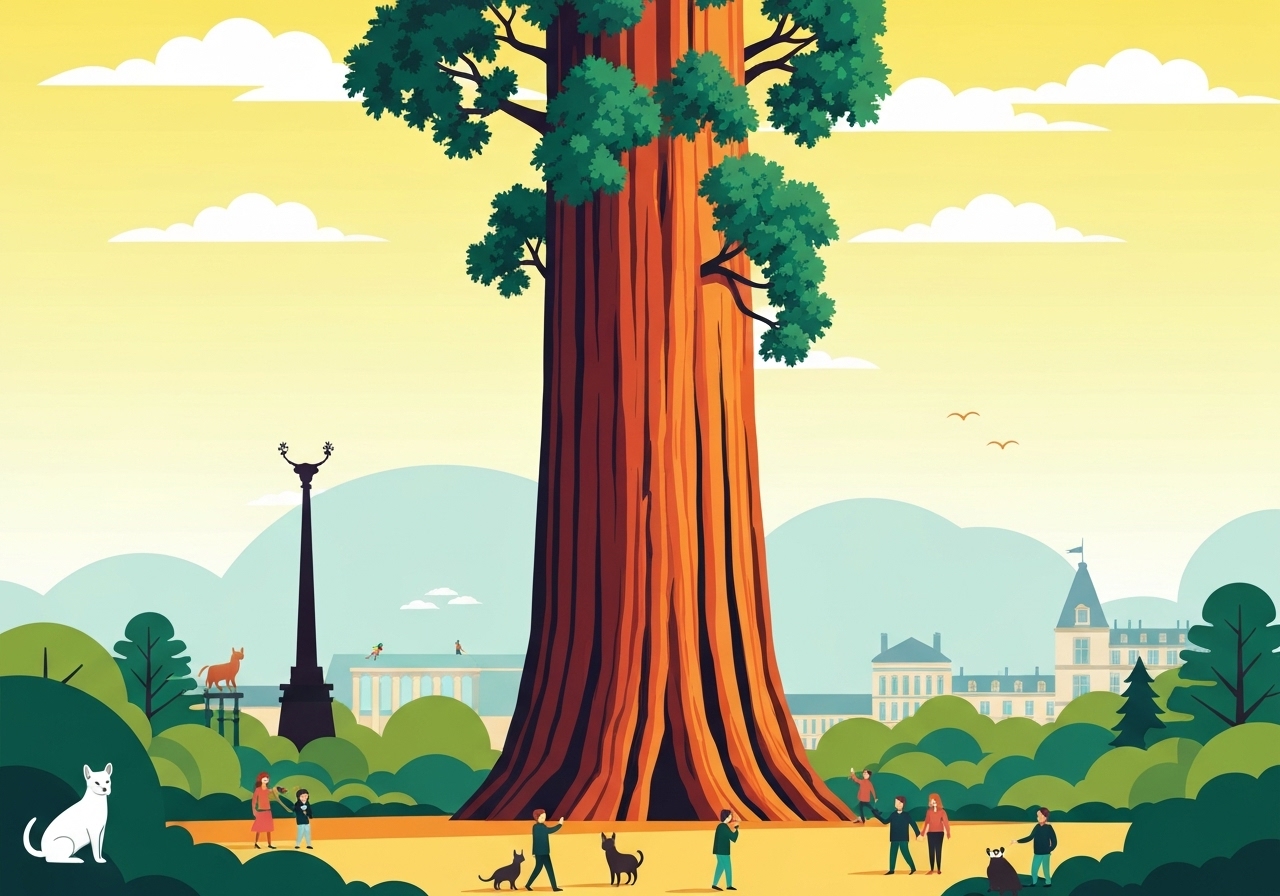
On a late-summer afternoon in August, a visitor in Parc des Buttes-Chaumont was shown an unexpected sight: a single California sequoia rising among Parisian greenery. The tree, planted around the park’s opening in 1867, now tops 100 feet and may be the tallest tree in the city. Parc des Buttes-Chaumont was transformed from a former landfill into a landscaped public park under Napoleon III, and this specimen is a surviving trace of 19th-century planting experiments. Its presence links Paris’s urban design history to a distant Californian landscape.
Key Takeaways
- The sequoia stands in the park’s northeast corner and was first planted around 1867, the year Parc des Buttes-Chaumont opened.
- Measured at just over 100 feet, the tree may be the tallest in Paris though it remains small compared with giant sequoias back home.
- The planting likely dates to work overseen by Adolphe Alphand or by chief gardener Jean-Pierre Barillet-Deschamps during the Haussmann era.
- Parc des Buttes-Chaumont was converted from a landfill into a major green space under Napoleon III and opened to the public in the late 1860s.
- The General Sherman Tree in California is roughly 275 feet tall and is estimated at about 2,000 years old, underscoring how young the Paris specimen still is.
- A friend first pointed out the Paris sequoia during a Sunday in August, highlighting how easily an extraordinary tree can blend into an urban park landscape.
Background
Parc des Buttes-Chaumont occupies a northeast slice of Paris and was deliberately reshaped in the 1860s as part of the city’s broad transformations under Napoleon III and Georges-Eugène Haussmann. Designers turned a disused and unsanitary dump into steep lawns, cliffs, artificially arranged rockwork and winding paths, aiming to create a picturesque urban escape. That program included planting exotic and unusual trees, a fashionable practice for European cities eager to demonstrate horticultural reach and scientific curiosity.
Two figures are central to the park’s early plantings: Adolphe Alphand, an engineer who managed the park’s construction, and Jean-Pierre Barillet-Deschamps, Paris’s chief gardener at the time. Both played roles in selecting species and shaping the planted landscape, though record-keeping for individual specimens from that period is often incomplete. The arrival of species such as the California sequoia into European gardens reflected 19th-century botanical exchange: seeds and saplings were carried across oceans and trialed in metropolitan collections.
Main Event
The sequoia’s presence came into sharper focus for a visitor in August when a friend gestured toward a towering trunk that contrasted with surrounding plane and lime trees. From the park lawn, the tree’s reddish bark and conical form make it stand out in the site’s northeastern sector, where Haussmannian apartment blocks rise beyond the treeline. Although not ancient by sequoia standards, the tree now measures just over 100 feet, a notable height within Paris’s typically lower urban canopy.
Documentation suggests the tree was planted around the park’s inauguration in 1867, but no definitive planting record names the individual who placed it. Contemporary city gardeners typically attribute the specimen either to Alphand’s planting program or to Barillet-Deschamps’s curatorial choices. Visitors and local walkers now treat the tree as a point of curiosity, often photographing the incongruous silhouette of a western giant against Parisian rooftops.
Unlike its Californian kin, the Paris sequoia faces different climatic, soil and pollution conditions that shape its growth trajectory. Park staff maintain the grounds as part of metropolitan green-space management, but the level of targeted arboricultural attention this specimen receives varies with municipal priorities. Its survival for more than a century testifies to both the tree’s hardiness and to long-running efforts to preserve specimens planted during Paris’s major 19th-century makeover.
Analysis & Implications
The tree is both a botanical curiosity and a small record of global plant exchange driven by 19th-century urban ambition. Planting exotic trees in Paris was partly aesthetic, partly scientific; a single sequoia placed in a public park signaled municipal modernity and horticultural reach. Today, the tree serves as a living link to that era while raising questions about how nonnative specimens adapt to different climates and pollution loads.
From an urban forestry perspective, a 100-foot sequoia in Paris represents a management challenge and an asset. Its size requires inspection and, occasionally, pruning or support to mitigate public-safety risks in a busy park. Municipal budgets and priorities determine whether such legacy specimens receive specialist care or only routine maintenance, and that choice shapes their long-term survival.
The tree also has cultural and tourist value: visitors encountering a sequoia in a Parisian landscape experience a striking contrast that can boost local interest in the park. That attention may encourage conservation measures, but it can also bring increased foot traffic and potential soil compaction—factors arborists must weigh. Finally, the specimen’s future growth will offer real-world data on how a famously Californian species performs in a temperate European capital, information that could inform future planting decisions.
Comparison & Data
| Specimen | Approx. Height | Estimated Age |
|---|---|---|
| Paris sequoia (Parc des Buttes-Chaumont) | Just over 100 ft | Planted c.1867 (approx. 150 years) |
| General Sherman (Sequoia National Park) | ~275 ft | ~2,000 years |
The table highlights scale: the Paris tree, though large for the city, remains a fraction of the age and height of the largest living giant sequoias in California. Measurements in urban settings can vary by method and timing, so reported heights are approximate; however, the contrast is clear and underscores different growth conditions. The Paris sequoia’s roughly 150-year lifespan so far sits well within the species’ potential, but its long-term trajectory will depend on urban pressures and care.
Reactions & Quotes
Locals treat the tree as a charming anomaly; casual encounters often begin with surprise and end with a photograph. Park visitors emphasize the visual dissonance of a west-coast giant framed by Parisian architecture, and some call it a hidden city treasure.
“I had lived near the park for years and only noticed it when a friend pointed it out one perfect Sunday,”
Local visitor
An arborist who reviewed the tree’s situation stressed its resilience and the need for ongoing monitoring. Municipal botanists and urban foresters view such specimens as both historically valuable and requiring targeted maintenance to remain safe and healthy within dense public spaces.
“This sequoia is doing well here, but trees of this size need regular inspections and soil care to thrive amid city conditions,”
City arborist (paraphrased)
Unconfirmed
- No definitive archival record naming the individual who planted the Parc des Buttes-Chaumont sequoia has been found; attribution to Alphand or Barillet-Deschamps is plausible but not proven.
- Height measurements are approximate; exact trunk dimensions and precise age estimates for the Paris specimen have not been published in a peer-reviewed tree inventory.
Bottom Line
The Parc des Buttes-Chaumont sequoia is a striking example of 19th-century botanical exchange and of how urban design decisions leave living legacies. Standing at just over 100 feet and planted around 1867, it remains modest beside California giants but notable within Paris’s landscape. Its survival highlights both the adaptability of the species and the role of municipal stewardship in preserving historical plantings for public benefit.
For locals and visitors, the tree offers a moment of surprise and connection across continents; for urban foresters, it is a specimen worth monitoring as cities balance heritage, public safety and ecological resilience. Further measurement and archival research could clarify its exact age, planting provenance and conservation needs.