
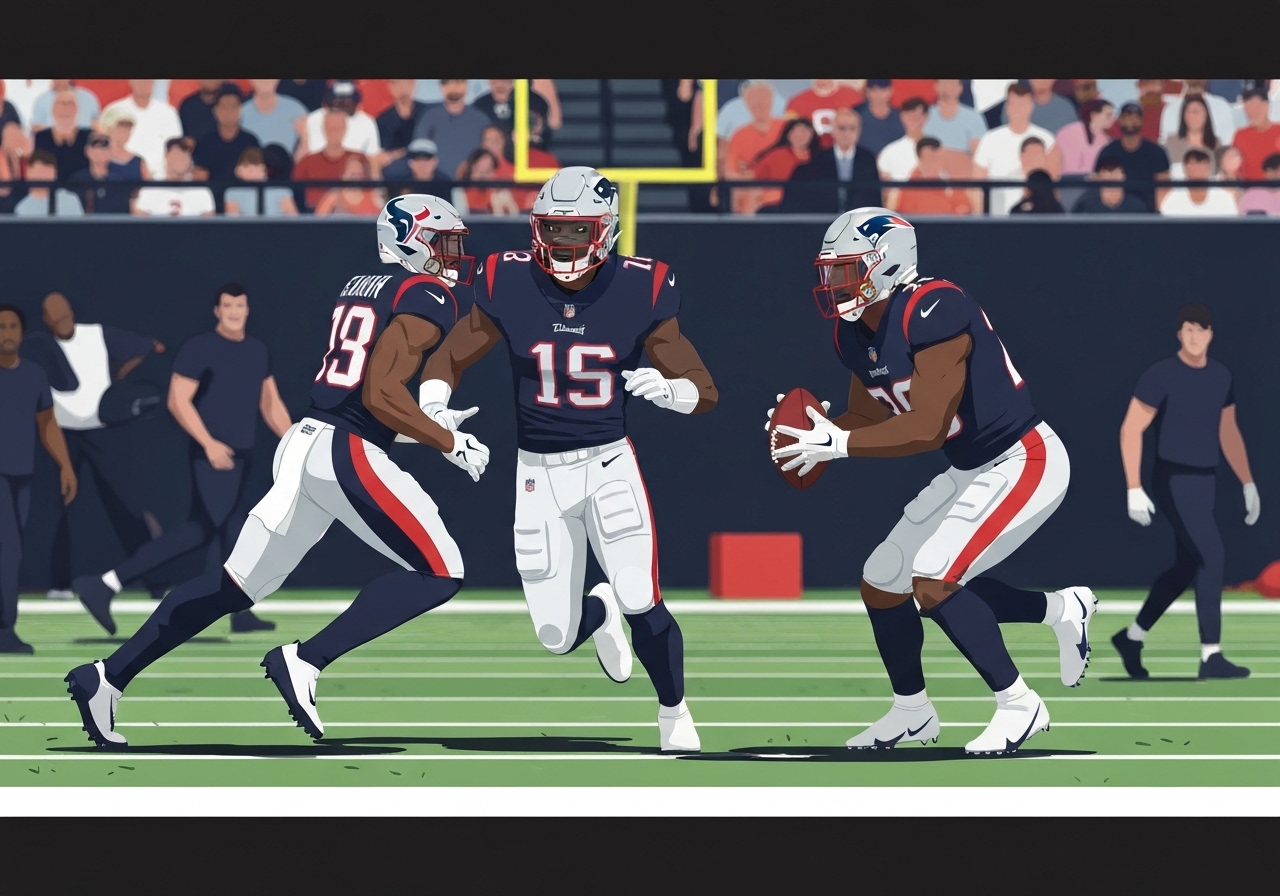
In Sunday’s divisional-round matchup, the New England Patriots’ defense forced four interceptions off Houston quarterback C.J. Stroud in the first half, powering a 21-10 lead at intermission. The turnovers came in multiple forms, including a 26-yard pick-six returned by Marcus Jones early in the second quarter. Stroud completed 10 of 26 passes for 124 yards with one touchdown and four interceptions through 30 minutes. New England’s offense produced just enough to convert those takeaways into points while Houston managed nine first downs and 132 total yards at halftime.
Key Takeaways
- Patriots recorded four interceptions off C.J. Stroud in the first half, including a 26-yard pick-six by Marcus Jones.
- C.J. Stroud was 10-of-26 for 124 yards, 1 TD and 4 INTs at halftime.
- Carlton Davis accounted for two of the interceptions and Craig Woodson added one.
- Houston totaled nine first downs and 132 yards, going 4-of-9 on third down; they committed four turnovers in the half.
- New England had six first downs, 134 yards, and was 1-of-8 on third down despite leading 21-10.
- Drake Maye finished the half 10-of-19 for 117 yards with two touchdowns and one interception; he also had three fumbles, two of which were recovered by the Patriots.
- Marcus Jones’ 26-yard pick-six came early in the second quarter and was a decisive swing in the scoring margin.
Background
The Patriots entered the divisional matchup with a defense known for aggressive coverage and turnover creation, particularly late in the regular season and into the playoffs. The Texans, led by rookie C.J. Stroud, relied on a potent passing attack to offset struggles in the ground game; the matchup promised a test of New England’s secondary against a quick-developing offense. Special teams and field position were expected to play a role, as both clubs had previously shown vulnerability on third down at different stretches during the year. Coaching staffs on both sides emphasized ball security and limiting explosive plays in the buildup to this game.
Past encounters between these franchises have been competitive, with turnovers often deciding the outcome when defenses rise to the occasion. For New England, creating takeaways has been a key pathway to playoff wins under their recent defensive schemes. Houston’s season featured growing pains for a young roster and a rookie quarterback adjusting to the speed of playoff competition. Stakeholders included coaches focusing on halftime adjustments, defensive backs aiming to maintain discipline, and an offense attempting to sustain drives against a turnover-hungry unit.
Main Event
The first half unfolded as a defensive battle punctuated by opportunistic plays. New England’s secondary capitalized on several errant throws by Stroud; the second-quarter interception returned for a touchdown by Marcus Jones was the clearest example, a 26-yard return that shifted momentum. Carlton Davis contributed two interceptions, and Craig Woodson added another, collectively ending multiple Houston possessions inside New England territory. Each turnover forced the Texans into shorter fields and limited their ability to build offensive rhythm.
Houston’s lone first-half touchdown came when Stroud connected with Christian Kirk on a 10-yard pass earlier in the period, briefly giving Houston a 10-7 advantage. After the Jones pick-six, New England extended the lead through complementary offense and special teams positioning. Despite the turnovers, neither offense produced large cumulative yardage totals: the Patriots had 134 yards and six first downs, while Houston tallied 132 yards and nine first downs. Third-down efficiency was poor for New England (1-of-8) and modest for Houston (4-of-9).
Drake Maye’s first-half line included two touchdowns and an interception; he completed 10 of 19 throws for 117 yards. Maye also lost three fumbles in the half, with two recovered by New England. The loose-ball recoveries were recorded in quick succession after strip-sack situations, and they prevented what might otherwise have been longer Houston scoring opportunities. The first half ended with a Hail Mary attempt resulting in an interception, sealing the short-term statistical edge for the Patriots.
Analysis & Implications
The four interceptions fundamentally changed the game’s balance despite neither offense dominating the stat sheet. Turnovers that lead directly to points — especially a defensive touchdown — create outsized value in playoff football because they swing expected points and field position simultaneously. New England’s ability to convert takeaways into points, rather than simply stalling after turnovers, is a hallmark of efficient postseason teams and explains the 21-10 lead regardless of third-down struggles.
For Houston and Stroud, the box score raises questions about decision-making and deep-shot accuracy under playoff pressure. A 10-of-26 line with four interceptions suggests either mistimed reads, tight coverage, or both. Coaches will likely examine whether schematic adjustments, protection calls, or a possible quarterback change could reduce the turnover rate in the second half. The NBC preview noted it would not be shocking if Davis Mills replaced Stroud, and that possibility hangs over Houston’s halftime discussion.
New England’s offense, while not prolific in the first half, succeeded where it mattered: turning takeaways into scoreboard advantage. The Patriots still face a challenge sustaining drives given a 1-of-8 third-down conversion rate; if Houston’s defense adjusts and limits short fields, the lead could shrink quickly. Conversely, the Texans must prioritize ball security and cleaner quarterback play to engineer a comeback — playoff margins are typically unforgiving of repeated turnovers.
Comparison & Data
| Metric | Patriots (1H) | Texans (1H) |
|---|---|---|
| Score | 21 | 10 |
| Interceptions (forced) | 4 | 0 |
| Turnovers | 0 | 4 |
| First downs | 6 | 9 |
| Total yards | 134 | 132 |
| Third down | 1-of-8 | 4-of-9 |
| Stroud (1H) | 10-of-26, 124 yds, 1 TD, 4 INT | |
| Maye (1H) | 10-of-19, 117 yds, 2 TD, 1 INT, 3 fumbles | |
The table highlights how turnovers drove the halftime score more than yardage totals or first-down advantages. New England’s defense produced a scoring play off a turnover, which often appears as the decisive factor in low-yardage playoff halves. Contextually, teams that force multiple turnovers in a half convert at a significantly higher rate into wins, especially when one of those turnovers is returned for a touchdown.
Reactions & Quotes
Coaches and analysts framed the first half around ball security and opportunistic defense. Both teams were expected to make strategic halftime adjustments focused on quarterback play and protection schemes.
“We turned what we could into points and that was the difference in the half,”
Patriots coach (paraphrased)
The Patriots’ coach emphasized converting takeaways into points rather than boasting about raw defensive stats. That focus on situational football underlines the team’s approach to playoff preparation and in-game decision-making.
“We need cleaner execution and to eliminate turnovers quickly,”
Texans coaching staff (paraphrased)
Houston’s staff stressed ball security and quicker reads for the quarterback at halftime, signaling that schematic or personnel changes were under consideration to reduce mistakes and regain offensive momentum.
“A multi-interception half forces urgent adjustments; halftime will determine whether the game tightens or slips away,”
NFL analyst (paraphrased)
Independent analysts pointed to the halftime period as decisive, noting how teams typically respond to turnover-heavy halves — either by tightening fundamentals or by making personnel shifts to change the game flow.
Unconfirmed
- Whether Houston will replace C.J. Stroud with Davis Mills in the second half is unconfirmed and remains a coaching decision.
- Full injury statuses for any participants at halftime have not been confirmed by team medical updates.
Bottom Line
New England led 21-10 at halftime because its defense converted four Stroud interceptions into points, including a pick-six by Marcus Jones. The box score shows striking parity in yards and first downs, but turnovers produced a decisive scoring gap. For Houston, the path back requires cleaner quarterback play and fewer miscues; small margins in the second half will determine whether the Texans can erase a two-possession deficit.
Expect both sidelines to adjust: Houston may change quarterback approach or personnel to protect the ball, while New England must find ways to sustain drives given a 1-of-8 third-down showing. The halftime adjustments will likely dictate whether the Patriots’ turnover-fueled edge holds or if the Texans stage a comeback.