
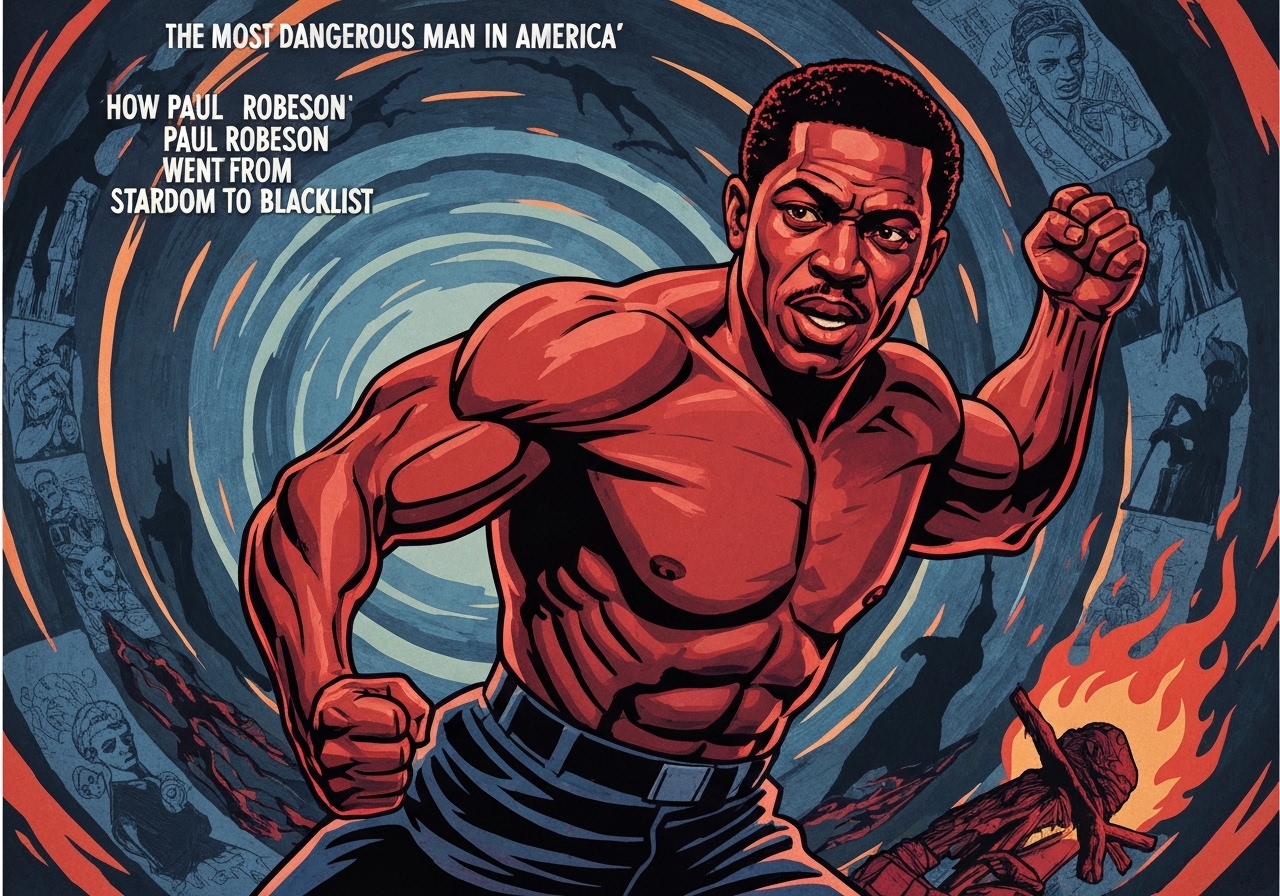
Fifty years after Paul Robeson’s death, his life reads like two very different American stories: a meteoric rise from Rutgers football standout and Columbia Law graduate to global stage and screen star, and a political exile stripped of passports, recordings and mainstream recognition during the Cold War. Once celebrated as one of the most famous Black Americans of his era, Robeson’s refusal to repudiate the Soviet Union and his outspoken left-wing politics triggered a sustained campaign of isolation by government authorities, mainstream white institutions and many respected Black organizations. That campaign—marked by hearings, violent protests and official travel bans—effectively removed him from the public lineage for decades. The result is an uneven cultural memory: extraordinary artistic achievement overshadowed by political censure and partial erasure.
Key Takeaways
- Paul Robeson died in January 1976; January 2026 marks roughly 50 years since his death and renewed calls for reassessment.
- Robeson’s 1943 Broadway Othello ran for 296 performances, a record run for a Shakespeare production on Broadway.
- He was a two-time All-American at Rutgers, a Columbia Law graduate and briefly an NFL defensive end early in his career.
- In 1949–1950 Robeson’s political stance led to public clashes: Jackie Robinson testified to HUAC in 1949 and hostile crowds produced riots at Peekskill, New York.
- The U.S. government denied Robeson a passport for nearly a decade; legal challenges culminated in Supreme Court rulings in the 1950s that limited ideological denial of travel.
- Institutional distancing—by the NAACP, Urban League and some Black cultural leaders—helped accelerate Robeson’s marginalization in mainstream histories.
- Despite later admiration from artists and activists, Robeson’s name was reduced or omitted in some institutional records, including references at Rutgers.
Background
Born in 1898, Paul Robeson combined prodigious athletic, intellectual and artistic gifts. At Rutgers he earned All-American honors twice as a football player; he went on to graduate from Columbia Law School, yet he chose performance as his public vocation and quickly gained global renown as a concert singer, stage and film actor. His 1943 portrayal of Othello was historically significant: he was the first Black actor to play the role on an American Broadway stage, and the production’s 296-performance run set a Broadway record for Shakespeare.
Robeson’s public profile in midcentury America extended beyond the arts. He spoke widely on race, colonialism and labor rights, and he welcomed international engagement that many in the United States associated with left-wing movements. Those positions increasingly collided with Cold War anxieties and the institutional pressures of the Red Scare. Government bodies such as the House Committee on Un-American Activities (HUAC), and a broader cultural campaign to police loyalty during the early Cold War, set the stage for an escalating confrontation between Robeson and establishment actors.
Main Event
The rupture accelerated in 1949, when Robeson addressed international peace conferences and openly criticized U.S. foreign policy while expressing admiration for aspects of the Soviet Union. His posture alarmed political authorities and many American institutions. Prominent Black organizations and figures, anxious about their own vulnerability to accusations of subversion, distanced themselves; that distancing intensified Robeson’s isolation from both white America and parts of the Black establishment.
That same year, Jackie Robinson—already a national symbol after breaking Major League Baseball’s color barrier in 1947—testified to HUAC and refused to defend Robeson’s views. Robinson later described how the episode weighed on him, but his 1949 testimony contributed to the delegitimizing of Robeson in mainstream opinion at a critical moment. Protest and violence followed: concerts, notably in Peekskill, New York, prompted hostile, sometimes violent, reactions that both endangered performers and signaled to national audiences that Robeson had become a lightning rod.
Federal restrictions compounded the damage. The State Department’s refusal to issue or renew Robeson’s passport effectively barred much international travel for nearly a decade, a sanction that curtailed his concert career and his ability to work abroad. Legal challenges and shifting jurisprudence on travel and political belief would later restrict authorities’ ability to use passports as ideological punishment, but the intervening years took a heavy toll on Robeson’s visibility and livelihood.
Analysis & Implications
Robeson’s fate in midcentury America shows how political policing can erase a figure from institutional memory even when their artistic achievements are unmatched. Institutional reactions—governmental sanctions combined with voluntary distancing by cultural and civil-rights organizations—produced an effective blackout: recordings were harder to distribute, press coverage dwindled, and historical references were softened or excised. The long-term consequence was generational forgetting: as archives, curricula and commemorations shifted focus, Robeson’s centrality to twentieth-century Black cultural history diminished.
That marginalization also reveals tensions within movements for racial justice. Leaders and organizations balancing immediate survival and long-term strategy sometimes prioritized institutional acceptance over defending a controversial dissident, a dynamic that can skew public history. The Robeson case thus complicates simple hero/villain narratives: it highlights how pressure from the state and the desire for respectability within marginalized communities intersect to shape who is remembered and how.
Contemporary debates over civic belonging, public memory and curricular content echo Robeson’s era. Efforts today to restrict teaching of certain aspects of Black history and the politicization of cultural institutions can produce effects similar to midcentury blacklisting, though the mechanisms and actors differ. Reappraising Robeson therefore has present-day stakes: recovering suppressed or neglected histories can illuminate how democratic societies police dissent and decide which cultural figures are allowed into the canon.
Comparison & Data
| Year | Event | Effect |
|---|---|---|
| 1943 | Othello on Broadway — 296 performances | Record run for Shakespeare; mainstream artistic acclaim |
| 1949 | Robeson addresses international peace gatherings; Jackie Robinson testifies | Political controversy; public and institutional backlash |
| c.1950s | Passport restrictions imposed, lasting nearly a decade | Restricted travel and overseas work; career disruption |
| 1958 (late) | Supreme Court rulings limit ideological travel bans | Legal protections for travel partially restored |
The table above condenses key milestones and their immediate effects. While Robeson’s 296-performance run in 1943 signals the height of his domestic theatrical success, the years around 1949–1950 mark the start of sustained institutional penalties. The legal environment shifted in the late 1950s after court decisions curtailed the use of passports as instruments of ideological control, but the cultural and archival damage from the intervening decade persisted.
Reactions & Quotes
Contemporaries reacted in divergent ways: some defenders continued to venerate Robeson privately and publicly, while leading organizations chose distance to avoid their own exposure. The fracture within Black public life—between protectionist strategies and outspoken solidarity—remains a critical part of the story.
“I wouldn’t fly the flag on Fourth of July or any other day.”
Jackie Robinson, quoted in The New York Times, 4 July 1969
This remark from Robinson, published two decades after his testimony before HUAC, illustrates how his perspective evolved amid mounting disillusionment with the pace of racial progress and shifting political alliances. Robinson’s later statements complicate how historians assess his 1949 decisions and show the long-term personal and moral consequences of that moment.
“The most dangerous man in America.”
Phrase used in contemporary State Department rhetoric
Officials and some press outlets framed Robeson as a national security risk; that rhetorical construction rationalized travel bans and other penalties. The phrase captures how language of danger was deployed to justify curbs on civil liberties during the Cold War.
“The Tallest Tree in the Forest.”
Howard Bryant, Kings And Pawns (2026)
Scholars and artists have preserved Robeson’s legacy with honorifics like this one; such efforts form the countercurrent to institutional forgetting and underline the case for renewed historical attention.
Unconfirmed
- Precise measurement of how many younger Black Americans are unaware of Robeson’s career lacks recent national survey data and should not be assumed without supporting polls.
- Institutional editing at specific universities (for example, the scale and motives behind edits to Rutgers’ historical materials) requires archival verification and records requests for full confirmation.
- Direct one-to-one equivalence between Robeson-era blacklisting and contemporary policy moves is an analytical comparison that highlights parallels but cannot be taken as an exact historical mirror without additional evidence.
Bottom Line
Paul Robeson’s life was marked by extraordinary achievement and by a punitive political reaction that curtailed his public career and reshaped his legacy. The mechanisms of that erasure combined formal state actions—travel restrictions and surveillance—with cultural and institutional distancing that reduced his visibility in histories and curricula for decades. Recovering Robeson’s full story is both a matter of historical accuracy and a test of how societies reckon with dissenting voices.
As institutions and cultural stewards reconsider the twentieth-century canon, Robeson’s case should prompt careful reflection about which figures are marginalized for their politics, how reputations are policed, and what responsibility present-day institutions have to restore overlooked contributions. Renewed scholarship, archival access and public commemoration can help ensure that Robeson’s multifaceted achievements are visible to future generations.