
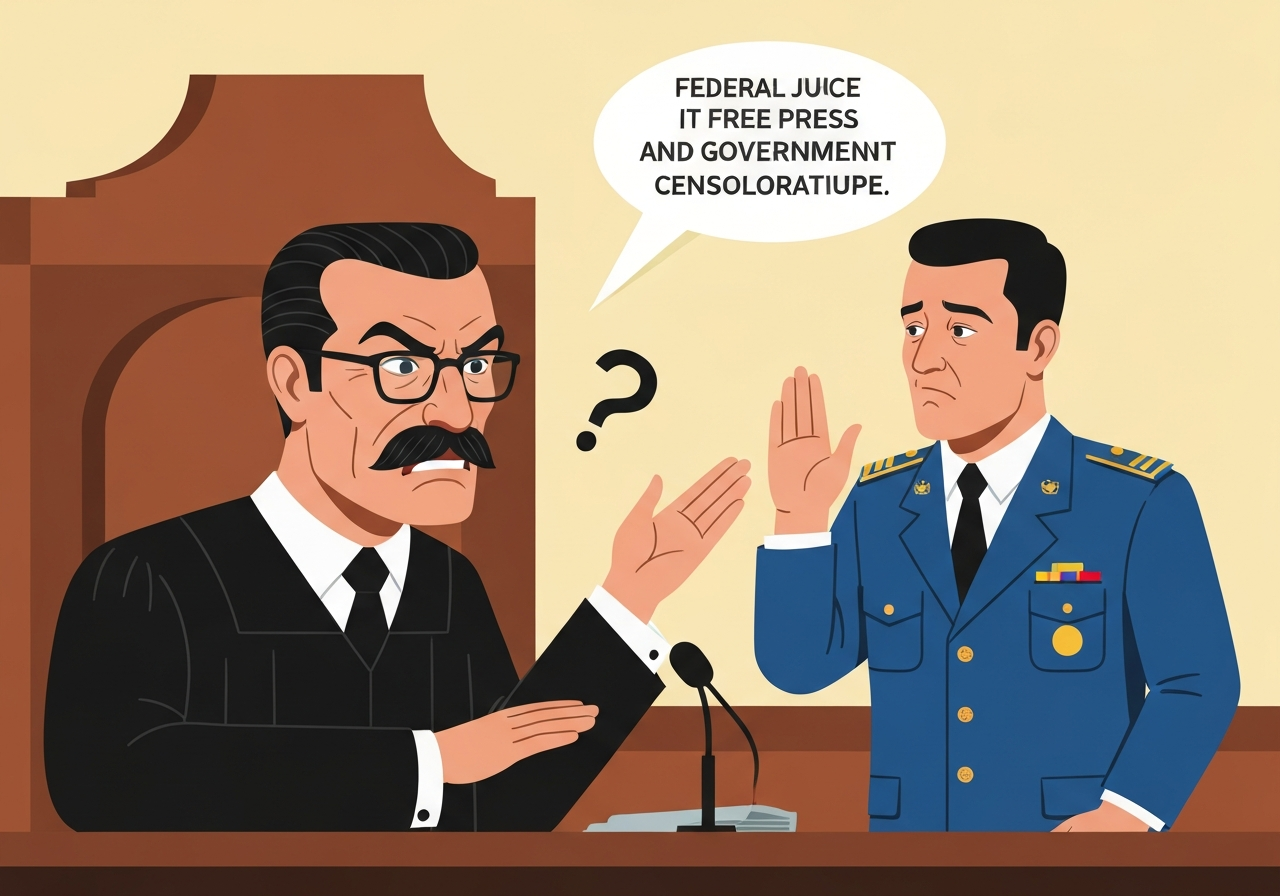
Lead: A federal judge in Washington signaled skepticism on Friday about new Pentagon rules that limit what credentialed journalists may report from inside the Department of Defense. U.S. District Judge Paul Friedman pressed Justice Department lawyers on First Amendment concerns during a hearing about a mid-2025 policy that asks reporters to publish only government‑authorized information or risk losing Pentagon badges. Attorneys for The New York Times and other outlets argue the 21‑page agreement curtails ordinary newsgathering; a decision from Friedman is expected in the coming weeks. Reporters who refused to sign the agreement lost routine Pentagon access and were required to surrender credentials in October.
Key Takeaways
- Judge Paul Friedman heard arguments in Washington on Friday and expressed doubt about the constitutionality of the Pentagon agreement limiting on‑site reporting.
- The contested policy, introduced in mid‑2025, is a 21‑page agreement that forbids reporting of information not authorized by the Department of Defense, including some declassified or off‑the‑record material.
- Major outlets, including five leading broadcast networks and NBC News, declined to sign and subsequently lost their regular Pentagon access.
- The Department of Justice defended the rules as a security measure and described Pentagon entry as “a privilege, not a right” in legal filings.
- The New York Times and other media plaintiffs say the policy was motivated by displeasure at critical coverage and is designed to chill reporting the Department disfavors.
- Members of the press were allowed back into the building this week for briefings by Defense Secretary Pete Hegseth and Chairman of the Joint Chiefs Dan Caine related to the Iran war.
- Former Pentagon public affairs official Pete Williams stated in a sworn declaration that regular in‑person access is essential to trustworthy reporting and that the policy undermines institutional norms.
Background
The Defense Department introduced a formal credentialing agreement in mid‑2025 that it asked credentialed journalists to sign to maintain full access to Pentagon facilities. The 21‑page document, as described in court filings, restricts the gathering and publication of information not specifically authorized by the Department, extending even to some material obtained off Pentagon grounds. Department officials framed the change as a national security safeguard to prevent those deemed a security risk from gaining broad access to military headquarters.
Many news organizations resisted. Dozens of outlets, including the five major broadcasters, declined to sign; those organizations then lost their routine access and were required to turn in Pentagon badges in October. The New York Times and others filed suit challenging the policy, arguing it imperils the press’s capacity to ask questions and gather information independently of official lines. The dispute follows prior litigation over media access to government spaces, such as last year’s Associated Press lawsuit over White House event restrictions that remains under appeal.
Main Event
At Friday’s hearing, Judge Paul Friedman repeatedly questioned Department of Justice attorneys about how the policy squares with First Amendment protections for newsgathering. Friedman stressed that routine journalistic practices—posing questions and following up when officials decline to answer—are central to the public’s ability to learn about government actions. During exchanges with DOJ lawyer Michael Bruns, the judge observed that asking questions cannot itself be treated as wrongful conduct.
Attorneys for The New York Times, represented by Theodore J. Boutrous Jr., told the court the policy was not neutral. Boutrous argued the Department adopted the agreement in response to sustained coverage it found unfavorable and that the rules are designed to exclude outlets whose reporting the Pentagon disfavors. The Times’ filings warn that the policy would chill journalists from pursuing stories that go beyond official pronouncements.
The Department and Justice Department lawyers countered that the measure is a reasonable security calibration. In filings, DOJ described Pentagon entry as a privilege that the Department controls and said the policy still permits reporters to attend briefings and use certain Pentagon spaces while claiming the rules are aimed at protecting sensitive information. Bruns also emphasized that journalists can gather information outside the building through other lawful means.
The practical fallout has been tangible: reporters removed belongings from Pentagon offices after returning badges in October, and some organizations say losing in‑building access has already complicated coverage. This week, credentialed journalists were allowed back into the Pentagon to attend briefings by Defense Secretary Pete Hegseth and Chairman Dan Caine on the Iran war, a temporary accommodation that plaintiffs say does not address the broader constraints of the agreement.
Analysis & Implications
The dispute raises core constitutional questions about how far the government can condition physical access to public institutions without running afoul of the First Amendment. Courts have long recognized that the Constitution constrains government actions that effectively block the press from gathering news, but judges also give weight to legitimate national security needs. This case will test where that balance lies when access is limited through contract‑style agreements rather than formal regulations.
If the court enjoins the policy, it could reaffirm strong protections for on‑site reporting and set limits on administrative rules that restrict what journalists may publish based on Department approval. Such an outcome would preserve traditional newsgathering practices inside military headquarters and could discourage similar policies at other federal agencies. Conversely, an adverse ruling for plaintiffs could embolden agencies to adopt comparable terms for access, shifting the practical terrain of federal reporting toward negotiated permissions.
The timing matters: the hearing occurred while U.S. forces are engaged in operations related to the Iran war, a period when public demand for detailed, independent reporting is heightened. Restricting in‑person access during active military operations could reduce independent oversight and narrow the range of perspectives available to the public. International observers and allied militaries follow U.S. transparency norms; a sustained curtailment could influence how other democracies balance press access and security.
Comparison & Data
| Feature | New Pentagon Agreement (mid‑2025) | Prior Practice |
|---|---|---|
| Scope of reportable material | Limited to Department‑authorized information; bans some off‑the‑record/declassified reporting | Journalists could report independently, including some declassified or off‑the‑record material |
| Access mechanism | Conditional on signing a 21‑page agreement | Credentialing based on newsroom verification and longstanding DoD practices |
| Consequences for refusal | Suspension/loss of Pentagon badge | Routine access retained; temporary revocations rare |
The table captures how the 2025 agreement formalizes restrictions that previously were governed by convention and internal guidance. Reporters and former Pentagon public affairs officials say the shift marks a substantive tightening, converting informal norms into written conditions enforceable by badge revocation. That procedural change has immediate ramifications for beat reporting and for how sources inside the Department engage with the press.
Reactions & Quotes
Advocates for the press framed the policy as antithetical to democratic accountability, saying it risks turning a public institution into a space where only approved narratives circulate. The Pentagon’s defenders characterize the measure as a narrowly tailored step to protect sensitive information while still allowing press engagement under controlled conditions.
“Asking a question is not a crime,” Judge Paul Friedman said as he challenged the government’s emphasis on restrictions during the hearing.
U.S. District Judge Paul Friedman
“It may be how authoritarian governments stay in power; it’s not how democracy works,” David Schulz of the Pentagon Press Association told the court, criticizing the new approach.
Pentagon Press Association (David Schulz)
“The Policy was not promulgated in a vacuum,” Theodore J. Boutrous Jr. wrote in filings, arguing the Department reacted to unfavorable press by adopting rules that could chill critical reporting.
Counsel for The New York Times (Theodore J. Boutrous Jr.)
Unconfirmed
- Whether the Department applied the new agreement selectively against particular outlets or reporters remains unproven in public filings.
- It is not yet established how consistently the policy will be enforced across different Pentagon offices and briefings going forward.
- No public record has confirmed that the policy has prevented any specific national security breach attributable to in‑building reporting.
Bottom Line
The case will clarify how far the Department of Defense may condition physical access to its headquarters without violating press freedoms. A ruling for the media would reinforce longstanding norms of independent newsgathering inside government institutions; a ruling for the Pentagon could authorize tighter administrative control over who may report from federal facilities.
In practical terms, the dispute affects the public’s ability to receive diverse, on‑the‑ground reporting about U.S. military actions—especially during active operations related to the Iran war. Readers should watch for Friedman’s forthcoming ruling and any appellate review, which could set a nationwide precedent for agency‑level press access policies.
Sources
- NBC News — news organization report summarizing the court hearing, filings, and statements from parties involved.