
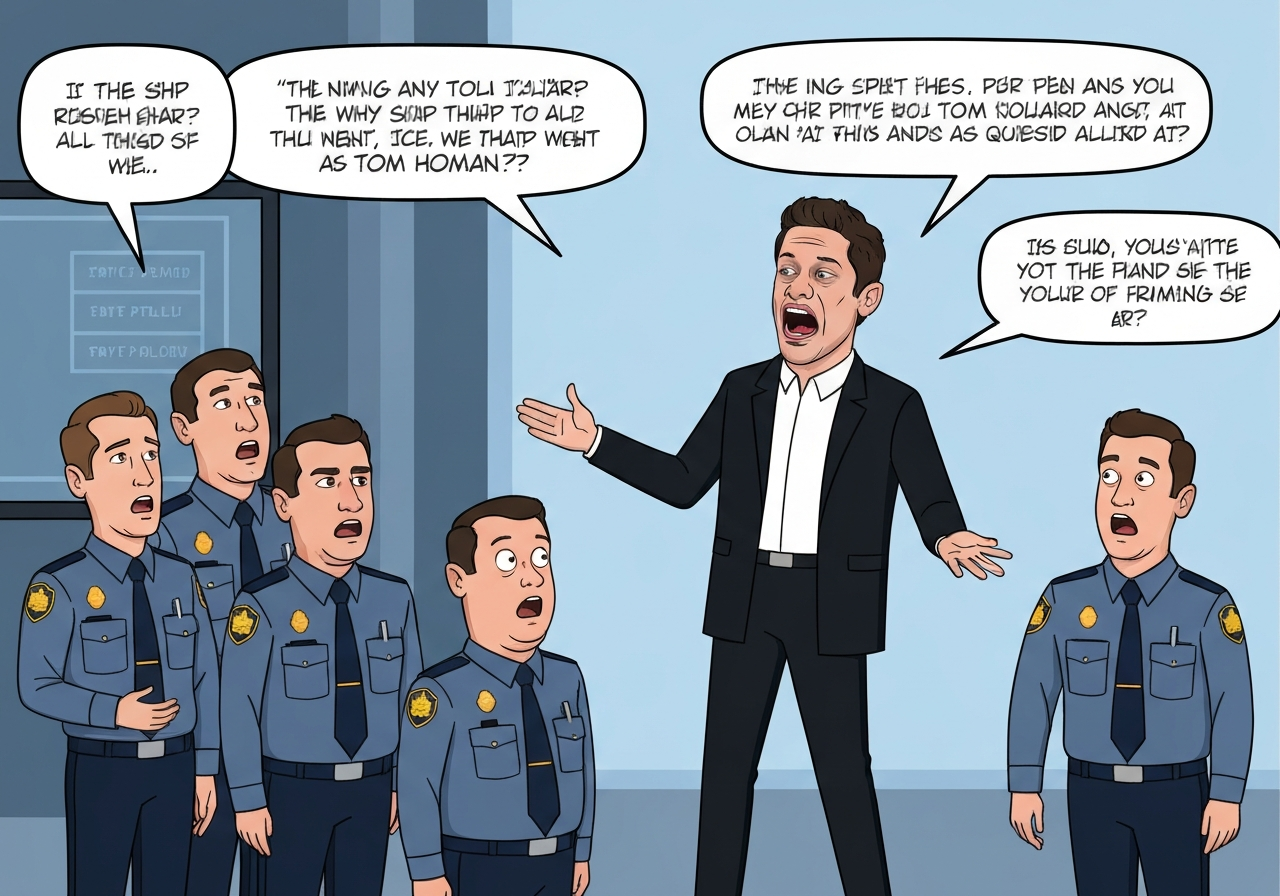
Pete Davidson made a surprise return to Saturday Night Live’s cold open for the show’s 1,000th episode, appearing in Minneapolis as Tom Homan, the Trump-era border official. In the sketch, Davidson’s Homan addresses a baffled group of ICE agents after recent Minnesota violence and urges them to “lower the temperature” while trying to reframe what their mission should be. The scene referenced the dismissal of Border Patrol Commander Greg Bovino and name-checked a recent Don Lemon arrest reported on Friday, folding real-world headlines into the satire. The sketch ended with Homan pleading for restraint and warning agents to avoid doing things that would get filmed.
- Pete Davidson returned for SNL’s 1,000th episode cold open, performing as former federal official Tom Homan in Minneapolis.
- The sketch cites the recent dismissal of Border Patrol Commander Greg Bovino and references a Don Lemon arrest that occurred on Friday.
- Actors portraying ICE agents repeatedly misstate their mission; one jokes about “Epstein files,” which the sketch treats as a distraction tactic.
- James Austin Johnson appears as an ICE agent in the scene and supplies a key, awkward exchange that underlines the sketch’s critique of enforcement tactics.
- The fictional Homan character describes past controversies—separating families and an on-camera bribe claim—and implores agents to show restraint, though the agents respond that they will not.
- The sketch frames public accountability and the risk of recorded misconduct as central to current debates about immigration enforcement.
- SNL used topical references and local setting (Minneapolis) to anchor the satire in recent headlines and public controversies.
Background
Saturday Night Live has a long history of using cold opens to lampoon political and cultural figures; placing a mock Border Czar at the center of its 1,000th episode continues that tradition. Tom Homan served in immigration enforcement roles under the Trump administration and has been a frequent subject of late-night satire. The Minneapolis staging tied the sketch to recent unrest there and to national debates over policing and immigration enforcement.
The sketch name‑checks specific controversies that have shaped public perceptions: the firing of Border Patrol Commander Greg Bovino, widely reported arrests such as Don Lemon’s reported Friday incident, and broader allegations tied to immigration enforcement tactics including family separations. SNL’s writers folded these elements into a short scene that blends factual references with exaggerated, comedic beats to critique both policy and personnel decisions.
Main Event
The cold open opens with Davidson’s Homan explaining why he’s suddenly in Minneapolis, joking that his predecessor was dismissed not for lying or for controversial behavior but because those actions were caught on camera. He then attempts to test the assembled ICE agents about their mission; they supply absurd or headline-driven answers, such as searching for “Epstein files,” a line played for ironic effect in the sketch.
When Homan tries to coach the group on when to use force, the agents suggest “right away” or “preemptively,” prompting a frustrated correction that the window for force is narrower than their instincts suggest. The sketch repeatedly leans on the idea that agents were hired angry and given weapons without adequate training, a critique voiced in-character by one agent that the sketch uses to implicate policy choices rather than only individual failures.
At several beats the Davidson character lists damning shorthand descriptions—“separating families,” “taking a $50,000 bribe”—as part of the satire, then laments being cast as the most reasonable person in the room. The scene closes with Homan asking his team to show restraint and respect rights; an agent immediately replies “No,” and Homan, deflated, concedes he had to ask.
Analysis & Implications
The cold open uses satire to compress complex public-policy criticisms into a single, accessible vignette. By turning real headlines and named figures into punchlines, the sketch aims both to entertain and to underscore public anxieties about accountability in enforcement agencies. The invocation of filmed misconduct highlights the media-era logic that visibility can spur institutional consequences—an argument SNL dramatizes by making the filmable act the reason for a dismissal.
Politically, the sketch reflects and amplifies friction between calls for tougher enforcement and demands for oversight and restraint. It suggests that recruitment and training—hiring “angry, aggressive” staff without adequate supervision—are policy levers as consequential as written directives. That framing invites viewers to consider institutional design, not only individual culpability, when assessing episodes of violence or misconduct.
For Minneapolis and other localities experiencing unrest, the sketch’s local staging matters: it signals that national-level enforcement choices play out in municipal settings. The comedy does not offer solutions, but its critique points to two policy implications: clearer rules of engagement and stronger accountability mechanisms, both of which are likely to be part of ensuing public discussions and political responses.
| Item | Detail |
|---|---|
| SNL episode | 1,000th episode cold open |
| Location (sketch) | Minneapolis |
| Main character | Tom Homan (Pete Davidson) |
| Notable references | Greg Bovino dismissal; Don Lemon arrest (Friday); “Epstein files” mention |
The table above summarizes the sketch’s public anchors: the milestone episode number, city setting, central performer and the headlines the cold open invoked. These touchpoints helped the writers ensure topical resonance for viewers following national news about immigration enforcement and local unrest.
Reactions & Quotes
Immediately after the sketch aired, social conversation emphasized both the boldness of the satire and the ease with which current headlines were woven into jokes. Below are representative lines from the sketch that were used for comic and rhetorical effect.
“So we need to tighten up… and lower the temperature.”
SNL cold open (Pete Davidson as Tom Homan)
Context: The line frames the sketch’s nominal aim—call for restraint—while the sketch repeatedly undercuts that message by showing agents who appear unprepared to follow it.
“You hired a bunch of angry, aggressive guys, gave us guns and didn’t train us.”
Actor James Austin Johnson (portraying an ICE agent)
Context: This in-character observation functions as the sketch’s explicit policy critique, suggesting institutional responsibility for misconduct rather than singling out only individuals.
“Maybe just try not to get filmed.”
SNL cold open (Pete Davidson as Tom Homan)
Context: The closing gag points to a media-era accountability dynamic: visibility can drive consequences, even when internal reforms do not.
Unconfirmed
- The sketch implies certain individuals accepted bribes or committed specific crimes; those claims were presented as satire within the sketch and remain unverified in court records or independent reporting here.
- The line suggesting the “Epstein files” were released to distract from enforcement misconduct is a fictionalized device in the sketch and is not corroborated by independent evidence in this report.
Bottom Line
SNL’s 1,000th‑episode cold open used Pete Davidson’s portrayal of Tom Homan to stitch together topical controversies about immigration enforcement, media visibility and local unrest in Minneapolis. The sketch trades in sharp shorthand—naming dismissals, arrests and policy scandals—to make a broader point about institutional responsibility and the role of public scrutiny.
As satire, the sketch simplifies complex realities but also surfaces policy questions that merit public attention: recruitment standards, training, oversight and how footage of enforcement actions shapes accountability. Viewers and policymakers alike are likely to continue debating those issues as investigations, local responses and national political conversations unfold.
Sources