
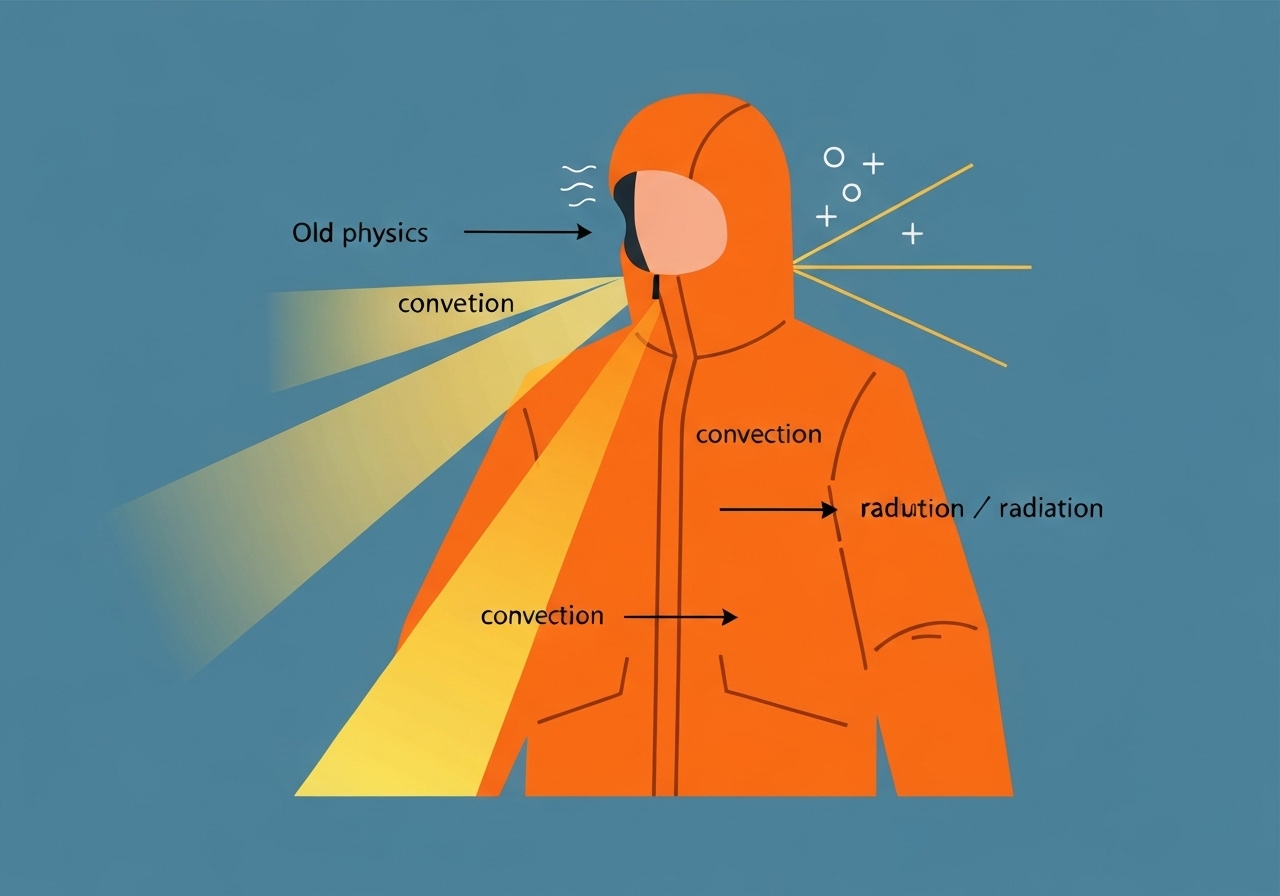
As temperatures drop this winter, millions reach for insulated outerwear that marries centuries-old thermal science with modern materials engineering. At its core, a winter jacket controls heat flow through conduction, convection and radiation while allowing moisture to escape; recent advances in ultralight fibers, breathable membranes and reflective linings have let designers boost warmth without bulk. The result: jackets that feel warmer, dry faster and weigh far less than earlier garments, even as they rely on principles described by Newton, Fourier, Stefan, Boltzmann and Planck.
Key takeaways
- Winter jackets manage heat via three classical modes—conduction, convection and radiation—each addressed by different layers or treatments.
- Insulation slows conductive heat loss by trapping still air; high-loft down and aerogel-infused fabrics increase trapped air per unit thickness.
- Outer shells block convective heat loss from wind and water; many use laminated, microporous membranes that are waterproof yet vapor-permeable.
- Reflective liners or patterned metallic dots reduce radiative losses by bouncing body infrared back toward the wearer without completely blocking breathability.
- Moisture control is critical: wet insulation collapses and loses loft, so vapor-permeable membranes and moisture-wicking layers preserve insulation performance.
- New textiles (ultrafine fibers, aerogels, phase-change coatings) let manufacturers tune warmth, weight and breathability more precisely than before.
- Adaptive or active textiles (research stage) aim to vary permeability or insulation on demand, but broad commercial adoption is still limited.
Background
The physical laws describing heat movement are long-established. In the early 18th century, Isaac Newton characterized convective cooling driven by fluid motion; Joseph Fourier formalized conduction in 1822; and late-19th- and early-20th-century work by Josef Stefan, Ludwig Boltzmann and Max Planck made thermal radiation a quantitative field. Those frameworks remain the basis for designing clothing that retains warmth.
What has changed is materials science. Over the past two decades engineers developed ultrafine synthetic fibers, water-repellent treatments for natural down, microporous membranes and thin reflective coatings. These innovations do not alter the governing equations, but they give designers far greater control over how a garment responds to wind, moisture and body heat.
Main event: how modern jackets manage heat
Conduction is the direct transfer of heat through contact. Insulation combats conduction by trapping pockets of still air in a matrix of fibers or feathers; still air has low thermal conductivity, forcing heat to travel a longer, more tortuous path. High-loft down creates voluminous clusters that immobilize air, while synthetics and aerogel-enhanced fabrics pack comparable insulation into thinner layers.
Convection is the loss of heat when moving air replaces the warm boundary layer that forms next to the body. A tightly woven outer shell or laminated membrane blocks wind-driven pumping, preserving that thin insulating bubble. Many shells also add sealed hems, drawcords and design details that minimize leaks at cuffs, collars and zippers—places where convective losses are concentrated.
Radiation carries heat as infrared waves emitted by the body. Some modern jackets use thin reflective liners or patterned metallic dots to bounce a portion of that radiation back toward the wearer. The patterning is deliberate: continuous metallic films reflect well but trap moisture, whereas micro-dot or patterned coatings strike a balance between reflectivity and breathability.
Moisture management ties these strategies together. When insulation gets wet—whether from rain or trapped sweat—down collapses and synthetic loft is reduced, greatly lowering thermal resistance. That’s why high-performance systems combine moisture-wicking inner layers, venting options and waterproof-breathable membranes to keep insulation dry while letting vapor escape.
Analysis & implications
Pairing classical thermal physics with engineered textiles has shifted design from trade-offs toward targeted solutions. Rather than choosing between warmth and breathability, manufacturers now specify layered systems where each element addresses one failure mode: inner wicking, mid-layer loft, outer-shell wind and water resistance, and liners that modulate radiative losses. This modularity improves comfort across varied activities and conditions.
Economics and consumer expectations drive rapid iteration. Ultralight down and aerogel composites command higher prices, but they enable the same thermal performance at a fraction of the weight. That has implications for outdoor recreation, military gear and any application where carried weight matters. At the same time, widespread adoption raises supply-chain and sustainability questions, such as sourcing ethical down and managing synthetic microfibers.
Looking ahead, adaptive textiles—materials that change permeability or insulation in response to temperature or humidity—could blur the line between passive garments and active systems. Academic groups report prototypes that open microscopic vents as humidity rises or alter reflectivity with illumination, but scaling these to durable, affordable consumer products remains a technical and manufacturing challenge.
Comparison & data
| Heat-transfer mode | How it removes heat | Design response |
|---|---|---|
| Conduction | Direct contact transfers molecular energy | Trap still air: down, synthetic loft, aerogels |
| Convection | Moving air strips warm boundary layer | Windproof shells, sealed seams, adjustable hems |
| Radiation | Infrared emitted by body into surroundings | Reflective liners or patterned coatings to return IR |
Those responses are often combined in multilayer systems: an inner wicking layer, insulating midlayer and protective outer shell. Quantitative performance depends on loft (measured in grams per cubic centimeter and fill power for down), membrane porosity (grams of water vapor per square meter per 24 hours) and fabric wind-resistance ratings; brand tests report wide variation across products and conditions.
Reactions & quotes
“Modern textiles let us tailor warmth into thin packages—it’s the materials, not new physics, that changed the game.”
materials researcher, university lab
This succinctly captures the consensus among engineers: the governing laws of heat are unchanged, but new fibers and coatings amplify desired effects.
“A waterproof-breathable membrane preserves insulation performance in wet weather—without it, down can lose most of its thermal value.”
outdoor gear product manager
Industry spokespeople emphasize system design: shell, insulation and liners must work together to keep users comfortable during activity and exposure to precipitation.
“I was surprised how much lighter my jacket felt while staying warmer—and it dried faster after a wet hike.”
recreational backcountry hiker
Consumer experience often reflects how well a garment balances warmth, weight and moisture control in real-world use.
Unconfirmed
- Adaptive textiles that fully self-regulate insulation and breathability for everyday jackets exist in prototypes, but a clear timeline for mass-market deployment is not established.
- The precise heat-savings percentage from patterned reflective dots versus continuous films varies by material and context; manufacturer claims are not uniformly verified across independent lab tests.
Bottom line
Winter jackets work because designers apply time-tested heat-transfer physics through increasingly sophisticated materials. Insulation traps still air to limit conduction, shells reduce convective stripping, and reflective layers lower radiative losses; moisture management ties the system together. Innovations such as aerogel composites and patterned reflective liners enable warmer, lighter and drier garments than were possible a decade ago.
For consumers, the practical takeaways are simple: choose systems matched to your activity—ventilation for high exertion, higher loft for still conditions, and reliable waterproof-breathable shells for wet weather. Keep an eye on adaptive-textile research: it promises garments that respond dynamically to conditions, but broad, affordable adoption remains a future prospect.