
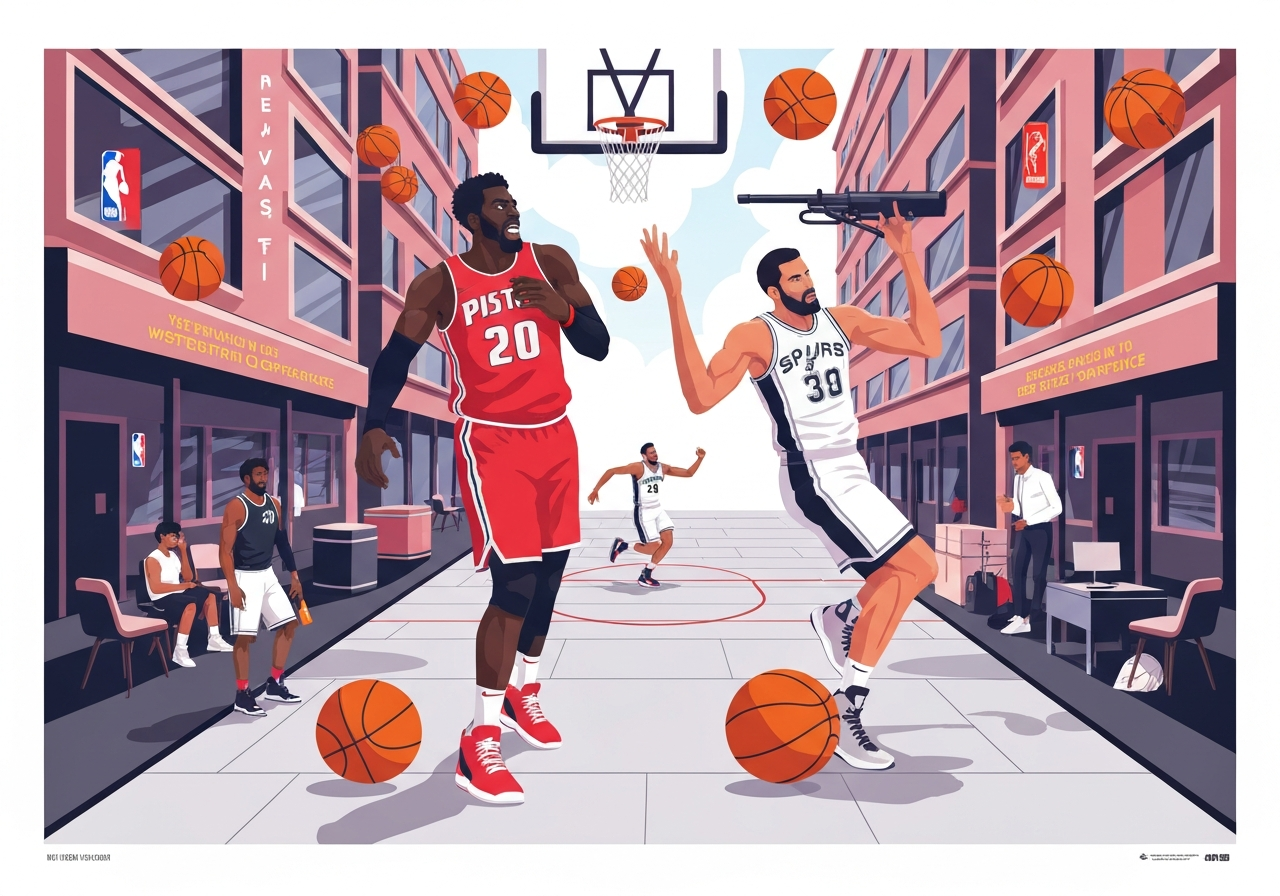
Lead: The San Antonio Spurs beat the Detroit Pistons 114-103 on Saturday at Little Caesars Arena, exposing roster gaps for Detroit even as Cade Cunningham struggled. San Antonio’s supporting cast of shooters and ball handlers overcame Victor Wembanyama’s limited shooting night and powered a second-half defensive push. The loss highlighted Detroit’s shortage of reliable outside shooting and secondary playmaking on a night when its primary stars were contained. The game left a dejected home crowd and fresh questions about how the Pistons will win playoff-style matchups.
Key takeaways
- Final score: Spurs 114, Pistons 103 at Little Caesars Arena; Spurs improved behind a balanced attack.
- Three-point differential decided the game: San Antonio hit 18-of-40 (45.0%) from deep, Detroit went 7-of-36 (19.4%).
- Victor Wembanyama finished 6-of-16 from the field but produced 21 points, 17 rebounds and six blocks.
- Cade Cunningham struggled offensively, shooting 5-of-26 and facing heavy pressure and foul trouble.
- Devin Vassell paced the Spurs with 28 points and seven made threes; Julian Champagnie added 17 points with significant perimeter accuracy.
- Jalen Duren led Detroit with 25 points and 14 rebounds; Ron Holland added 15 points and 11 boards.
- Tobias Harris was ineffective offensively (1-of-6, four points); Ausar Thompson was removed at the 8:14 mark of the third quarter (Spurs up 63-62) and did not return.
- The result underscored Detroit’s lack of shooting and secondary creators around Cunningham—key issues for postseason-style games.
Background
The Pistons entered the matchup as a developing team built around Cade Cunningham and several high-upside youngsters; their coaching staff has emphasized defense and toughness while the roster’s perimeter shooting remains a work in progress. San Antonio arrived as one of the season’s most intriguing title contenders, led by Victor Wembanyama but balanced by role players who can shoot and handle the ball. Both teams historically rank poorly in three-point percentage among NBA clubs, so outside accuracy is often a determining factor when matchups tighten.
Detroit’s regular-season résumé includes an unusually strong record against the league’s top teams, a point noted by observers and the club itself; that resilience has masked some persistent construction problems, chiefly the scarcity of reliable catch-and-shoot threats and playmakers beyond Cunningham. The Spurs, by contrast, have prioritized surrounding Wembanyama with spacing and ball movement, a blueprint that turns single-star nights into team wins. Saturday’s game presented a fairly pure test of those divergent roster philosophies.
Main event
The game flowed as a contest of styles: Detroit tried to use activity, defense and athleticism to disrupt San Antonio’s spacing, while the Spurs looked to generate open looks for their shooters. Early on both defenses had moments of control, but the turning factor emerged when San Antonio began to find rhythm from deep. The Spurs made several consecutive contested rotations and kickouts that produced open triples.
Cunningham endured an off night—limited to 5-for-26 from the floor and hampered by fouls and persistent ball pressure—which reduced Detroit’s ability to initiate offense through its primary creator. Wembanyama, though held to 6-of-16 shooting, still influenced the game with 17 rebounds and six blocks and remained a defensive anchor in the paint, particularly in the second half when San Antonio tightened interior protection.
San Antonio’s role players answered repeatedly. Devin Vassell scored 28 points and drained seven threes; Julian Champagnie shot effectively from distance and finished with 17 points; and Steph Castle contributed 16 points and 11 assists, orchestrating ball movement that yielded the Spurs’ 18 made triples. Detroit managed to stay close through three quarters on the strength of Jalen Duren (25 points, 14 rebounds) and hustle plays from Ron Holland, but the Pistons were limited to 20 third-quarter points as San Antonio’s defense asserted itself.
A critical lineup decision came when Ausar Thompson was removed with 8:14 left in the third quarter with the Spurs leading 63-62; he did not return, and the Pistons’ offense failed to find consistent secondary scoring thereafter. Tobias Harris provided minimal offensive impact (1-of-6 for four points), and the bench lacked a dependable shot-creator to relieve Cunningham’s burden. Those absences widened the gap late and allowed the Spurs to close the game on a run fueled by threes and defensive stops.
Analysis & implications
San Antonio’s win reinforced the modern NBA template: elite defensive rim impact plus plentiful, accurate perimeter shooting. Wembanyama’s presence requires extra attention inside, but the Spurs’ supporting cast—ball handlers who can kick and shooters who can convert—turned his floor impact into a full-team advantage. When role players shoot the percentage the Spurs did (18-for-40), opponents with weak spacing suffer, regardless of superstar matchups.
For Detroit, Saturday exposed structural weaknesses: inadequate catch-and-shoot options, limited off-ball creators, and an overreliance on Cunningham to generate a majority of offense. Cunningham’s off night magnified those weaknesses; without trusted secondary scorers or consistent screening/spacing schemes, the Pistons’ offense stagnated against elite defenses. That spells trouble in playoff settings where teams can amplify half-court defensive pressure.
Coaching and personnel adjustments will be scrutinized. The decision to bench Ausar Thompson for much of the second half—whether tactical or disciplinary—left Detroit without a rotation piece capable of creating mismatches or spacing the floor. Unless Detroit adds reliable shooters or develops current wings into consistent threats, opponents that prioritize perimeter defense and rim protection will regularly exploit the Pistons’ construction.
Longer-term, Detroit still has time to refine its identity: the club has 26 games remaining to address offensive spacing and to find lineups that balance Cunningham’s creation with floor spacing. The front office must weigh short-term lineup tuning versus roster upgrades to supply the missing ingredients that become essential in postseason basketball.
Comparison & data
| Team | 3PA | 3P Made | 3P % |
|---|---|---|---|
| San Antonio Spurs | 40 | 18 | 45.0% |
| Detroit Pistons | 36 | 7 | 19.4% |
Context: Both clubs entered the night among the NBA’s lower-ranked teams in three-point percentage, so San Antonio’s 18-of-40 performance represents an outlier of efficiency that determined the game. Detroit’s 7-for-36 night is the kind of off-night that neutralizes a defense-first approach; with limited spacing, interior defenders can clog lanes and force contested looks.
Reactions & quotes
“The Spurs hit 18 three-pointers on the night compared to just seven for the Pistons.”
Detroit Bad Boys (game recap)
This factual line summarizes the core statistical story: San Antonio’s perimeter accuracy overwhelmed Detroit’s defense and offset a middling offensive night for Wembanyama.
“Victor Wembanyama finished with 21 points, 17 rebounds and six blocks.”
Detroit Bad Boys (box summary)
The numbers illustrate Wembanyama’s dual influence—his scoring was modest for the efficiency watchers, but his rebound and block totals show how he impacted both ends.
“Cade Cunningham was limited to 5-of-26 in a game where Detroit lacked reliable secondary scoring.”
Detroit Bad Boys (game analysis)
That observation captures why Detroit’s offense stalled: Cunningham’s struggles coincided with the absence of dependable complementary scorers.
Unconfirmed
- The precise reason Ausar Thompson was removed at 8:14 of the third quarter and did not return has not been officially confirmed by the coaching staff; available reports do not specify whether it was tactical, disciplinary or injury-related.
- Any internal locker-room discussions about lineup changes or trade considerations following the loss have not been publicly disclosed and remain speculative.
Bottom line
San Antonio’s 114-103 victory at Little Caesars Arena was less about one superstar’s scoring and more about surrounding talent executing a spacing-and-passing game plan. The Spurs’ shooters and ball handlers made open shots and controlled the tempo, converting a modest Wembanyama scoring night into a comfortable team win.
For Detroit, the game served as a clear diagnosis: without reliable outside shooting and secondary creation, the Pistons are vulnerable against elite defenses. With 26 games left in the regular season, Detroit must either develop its current wings into consistent shooters or seek roster tweaks to supply the missing ingredients required for playoff-style success.
Sources
- Detroit Bad Boys — local sports site / game recap and box-summary.