
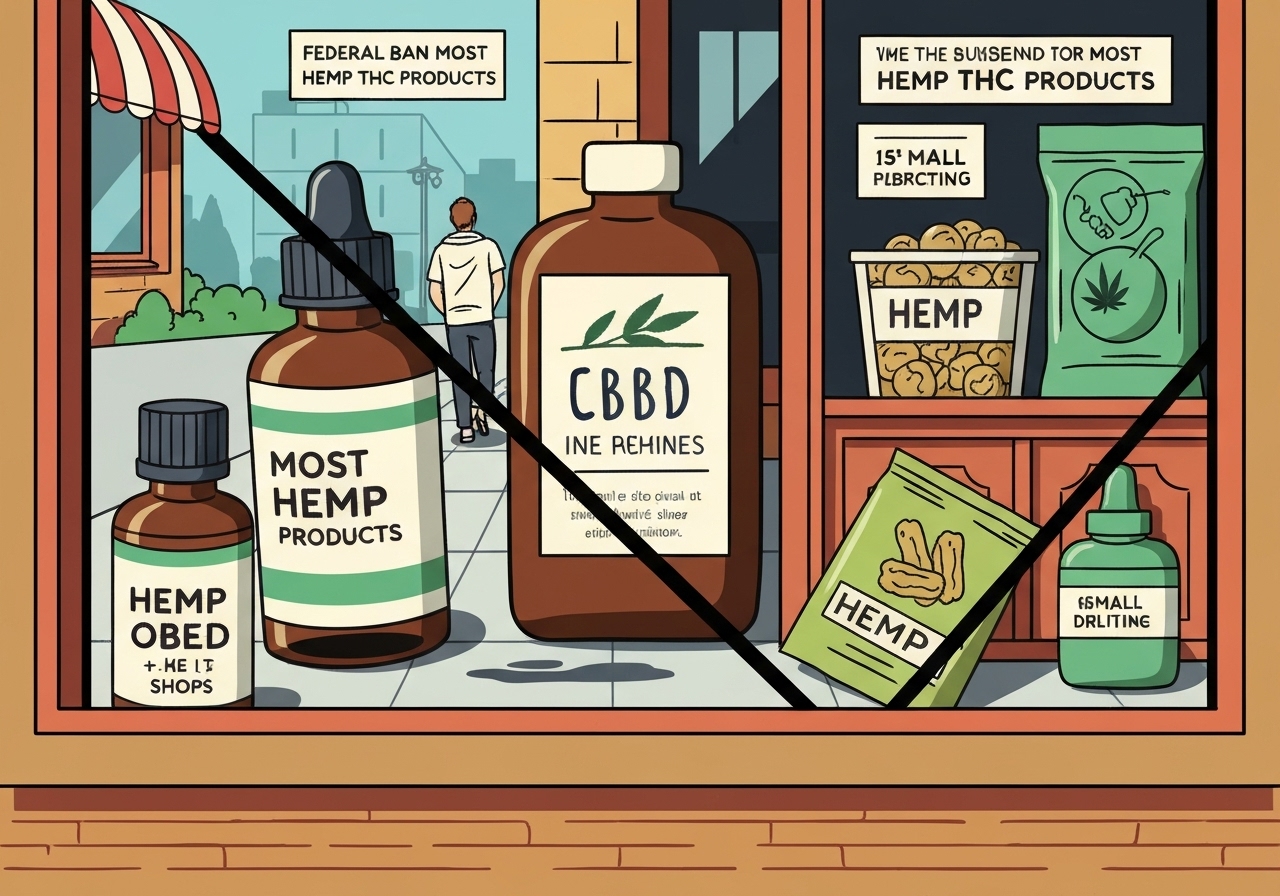
Lead: On Nov. 13, 2025, as Congress approved legislation to end a brief government shutdown, lawmakers inserted a provision that bans many intoxicating hemp products containing THC. The change closes a loophole from the 2018 Farm Bill and will directly affect retailers and patients in the Pittsburgh region. Small businesses such as Lawrenceville Hemp Co., which opened on Butler Street in April 2024, say the rule threatens their ability to sell products that customers use for chronic pain and other conditions. Owners and advocates warn the move could force most hemp-product retailers to change operations or close within a year.
Key Takeaways
- The new federal provision, adopted on Nov. 13, 2025, prohibits many intoxicating hemp products with THC above 0.4 milligrams, closing a 2018 Farm Bill loophole.
- Lawrenceville Hemp Co., opened April 2024 on Butler Street, and owner Carter Utz—who has Type 1 diabetes and rheumatoid arthritis—says these products have been essential for her daily life and business.
- Patrick Nightingale, president of Pittsburgh NORML, says the change moves intoxicating hemp products into the sphere of state regulation and removes them from general retail shelves.
- A 2023 Whitney Economics report estimates the restriction could wipe out roughly 95% of current hemp-related businesses and cost about $1.5 billion in tax revenue nationally.
- Absent new Pennsylvania legislation to license adult-use hemp-derived THC, affected products would only be available through state-regulated medical or adult-use frameworks.
- Retailers, patients and some legal observers predict an enforcement and regulatory transition period of months to a year, creating legal and commercial uncertainty.
Background
The 2018 Farm Bill federally legalized hemp by defining it as cannabis with no more than 0.3% delta-9 THC by dry weight. That definition left room for manufacturers to produce highly concentrated hemp-derived THC extracts and synthetic isomers that were not explicitly prohibited, and those products entered mainstream retail channels—gas stations, convenience stores and online marketplaces. Bright packaging and novelty forms broadened appeal, drawing attention from regulators and public-health advocates concerned about youth access and product safety.
Over the past several years more states and federal actors have grappled with how to treat hemp-derived intoxicants such as certain delta-8 and high-potency delta-9 formulations. Regulators have cited inconsistent testing, inconsistent labeling and limited oversight of manufacturing practices. Industry stakeholders argue many consumers rely on hemp-derived THC for symptom relief where medical marijuana is restricted or expensive; public-health groups emphasize potential risks from untested products and attractive packaging that may appeal to minors.
Main Event
On the evening of Nov. 13, 2025, congressional negotiators finalized a package to reopen the federal government and included language that effectively bans the sale of many intoxicating hemp products containing THC above 0.4 milligrams. That clause closes the pathway that allowed potent hemp-derived products to be sold broadly after the Farm Bill. The measure does not criminalize hemp per se, but it restricts commercial distribution of items the statute characterizes as intoxicating.
In Pittsburgh, small retailers immediately reacted. Carter Utz, owner of Lawrenceville Hemp Co., showed staff inventory on Butler Street and described opening the shop in April 2024 after receiving a legal settlement; she said the store served customers seeking relief from chronic pain, inflammation, anxiety and depression. Utz said the new federal language leaves her uncertain whether she can legally sell many of the products she stocks or obtain THC-containing hemp for personal use if limits are enforced.
Local legal observers emphasize the change shifts primary authority to states. Patrick Nightingale, a criminal-defense lawyer and president of the Pittsburgh chapter of the National Organization for the Reform of Marijuana Laws (NORML), said the federal move removes many hemp products from interstate retail channels and makes them subject to state licensing regimes if states adopt them. In Pennsylvania, that would require state lawmakers to write a new adult-use licensing framework or expand existing medical programs to cover these products.
Industry trade groups and some analysts predict a period of rapid market contraction as retailers scramble to reclassify inventory and adjust to enforcement priorities. Customers who use these products for medical reasons express concern about access if state-level pathways are not enacted quickly; some say travel for purchases or transitioning to medical cannabis programs would impose time and cost burdens.
Analysis & Implications
The federal change has three immediate policy effects: it narrows the federally permitted hemp market, it signals renewed federal engagement in cannabis-product boundaries, and it forces state legislatures to decide whether to create regulatory pathways. For states with established medical or adult-use markets, the shift may simply redirect sales into licensed dispensaries. For states without such frameworks, patients and small retailers could face extended interruptions in lawful access and revenue.
Economically, the Whitney Economics projection that up to 95% of businesses could be affected and $1.5 billion in tax revenues threatened frames the scale of potential disruption, though the precise local impact will depend on Pennsylvania’s legislative response and enforcement timelines. Smaller retailers that specialized in hemp-derived products—often with slim margins and limited capital—are at elevated risk of closure during a regulatory transition.
Public-health advocates view the ban as an opportunity to reduce youth exposure to brightly packaged intoxicants and to impose manufacturing and testing standards. Industry advocates counter that abrupt restrictions can push consumers toward unregulated black-market sources or to noncompliant vendors operating in legal gray areas. The net public-health outcome will hinge on implementation: if states adopt robust licensing, testing and age-verification requirements, harm reduction could be achieved with less disruption.
Comparison & Data
| Policy | Measure | Practical effect |
|---|---|---|
| 2018 Farm Bill | ≤0.3% delta-9 THC (dry weight) | Opened market for hemp derivatives; left potency and product forms largely unregulated |
| 2025 shutdown-package provision | Ban on intoxicating hemp products >0.4 mg THC | Removes many hemp-derived intoxicants from general retail; places them under state regulation |
The simplified table shows the shift from a percentage-of-weight standard to a milligram-per-product threshold; practical enforcement will require clarifying whether the 0.4 mg limit applies per serving, per package, or by another metric. That ambiguity will shape compliance costs and testing needs for producers and retailers.
Reactions & Quotes
Owners and patients in Pittsburgh described immediate fear about access and livelihood. A local shop owner said the products had real therapeutic value for her and her customers, framing the change as a personal and business crisis.
“This is my livelihood that they’re playing with,”
Carter Utz, owner, Lawrenceville Hemp Co.
Legal advocates emphasized the regulatory shift and the need for state solutions to replace the prior federal gap.
“Any intoxicating hemp products that are produced are now subject to state regulation,”
Patrick Nightingale, president, Pittsburgh NORML (criminal-defense attorney)
Independent research cited by industry groups underlines projected economic consequences from a sweeping federal restriction.
“This legislation will destroy 95 percent of businesses and cost $1.5 billion in lost tax revenue,”
Whitney Economics report (2023)
Unconfirmed
- Whether Pennsylvania lawmakers will pass a new adult-use licensing law that explicitly authorizes hemp-derived intoxicants within a state-regulated framework is not yet confirmed.
- The precise enforcement timeline and whether current retail inventory will be eligible for a grace period or buyback program have not been publicly detailed by federal or state officials.
- How the 0.4 milligram threshold will be interpreted (per serving, per package, or another unit) remains unspecified and may vary in guidance or litigation.
Bottom Line
The federal restriction adopted on Nov. 13, 2025, marks a substantial tightening of how intoxicating hemp products are treated in the United States. For Pittsburgh-area retailers, patients and local economies, the provision introduces near-term uncertainty: many small businesses that built models around hemp-derived THC now face difficult choices about inventory, licensing and survival.
How this plays out will depend on state-level action in Pennsylvania and other states, administrative guidance on enforcement and how quickly regulated alternatives are created. Policymakers can reduce disruption by clarifying testing standards, establishing reasonable transition periods, and designing licensing that balances access for patients with protections against youth exposure.
Sources
- CBS Pittsburgh (local news report, Nov. 13, 2025)
- Whitney Economics (industry research consultancy; 2023 report cited for business and tax-impact estimates)
- NORML (advocacy organization; local chapter statements and legal analysis)
- Congress.gov — 2018 Farm Bill (H.R.2) (federal statute text and legislative history)