
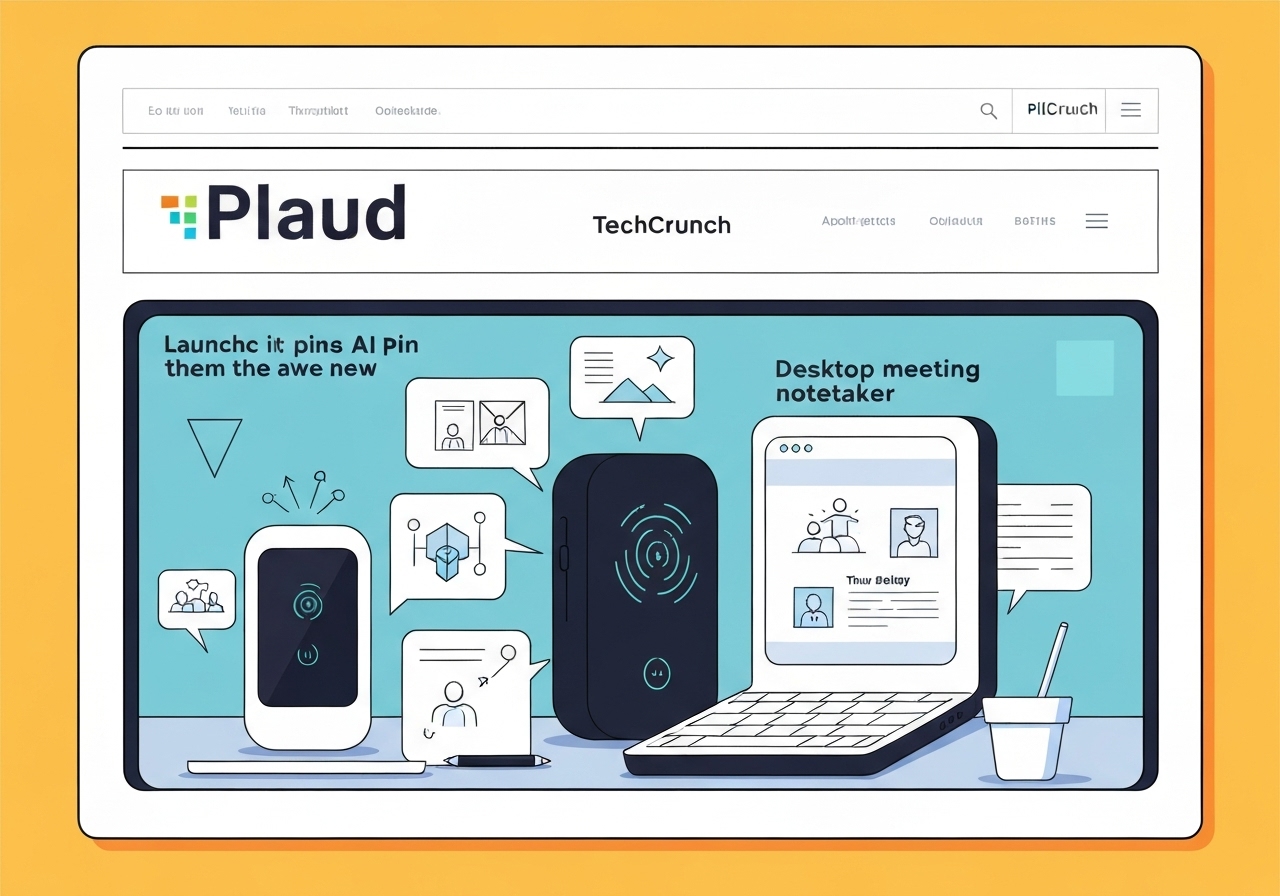
Lead: Plaud unveiled the Plaud NotePin S and a companion desktop meeting-notetaker ahead of CES 2026 in Las Vegas on January 4, 2026. The $179 pocketable AI pin includes a physical record/stop button, Apple Find My support and 64GB of onboard storage, while the Mac client captures system audio and structures meeting transcripts into notes. Plaud said the device offers up to 20 hours of continuous recording, two MEMS microphones with a 9.8‑foot capture range and 300 free transcription minutes per month. The launches expand Plaud’s lineup—its fourth device after selling more than 1.5 million units—to span both in-person and remote meeting workflows.
Key Takeaways
- Plaid introduced the NotePin S on January 4, 2026 ahead of CES 2026 in Las Vegas; retail price is $179.
- Hardware specs: 64GB onboard storage, 20 hours continuous battery life, two MEMS mics with ~9.8 feet effective capture range.
- Packaging includes clip, lanyard, magnetic pin and wristband for multiple wear options; Apple Find My support added.
- Plaud provides 300 minutes of free transcription per month to users of the device and desktop app.
- The new Mac desktop app captures system audio, structures transcripts into notes with AI, and supports multimodal inputs (images and typed notes).
- Plaud positions the NotePin S for people on the move; compared with the Note Pro it is smaller but has shorter range and lower battery life.
- Plaud has sold more than 1.5 million devices to date and is targeting both in-person and digital meeting markets, competing with services such as Granola, Fathom and Fireflies.
Background
Plaud entered the wearable notetaker market in 2024 with a pin-shaped voice recorder that emphasized simple, on-body capture for meetings and interviews. The product line has focused on in-person recording use cases, improving microphone arrays, battery life and on-device transcription to reduce friction for users who prefer hardware-first capture. Sales have scaled quickly: the company reports more than 1.5 million devices sold across its product family.
As hybrid and fully remote meetings have become the norm in many workplaces, software-based meeting notetakers have proliferated. Services such as Granola, Fathom and Fireflies automate remote meeting capture and provide integrations to calendar and collaboration platforms. Plaud’s strategic move to pair a compact hardware pin with a desktop client signals an attempt to bridge on-the-go in-person capture and the established remote-meeting transcription market.
Main Event
Plaud introduced the NotePin S on January 4, 2026, describing the device as a smaller, more portable successor in its pin family. The standout physical change is a tactile button: press to start/stop recording and tap during a session to mark highlights. Packaging emphasizes flexibility with a clip, magnetic pin, lanyard and wristband included, letting users choose how to wear or carry the unit.
Hardware details announced by Plaud include 64GB of internal storage and a battery rated for up to 20 hours of continuous recording. The unit uses two MEMS microphones that Plaud says capture clear audio up to about 9.8 feet. Monthly transcription allowances are built into the platform: users receive 300 minutes of automated transcription at no charge.
Alongside the device, Plaud launched a Mac desktop client that captures system audio to transcribe digital meetings and then reorganizes the output into structured notes. The company carried last year’s multimodal notetaking approach—allowing images and typed annotations alongside audio transcripts—into the desktop app. Plaud said the client can detect when a meeting is active and prompt users to capture the transcript.
Plaud acknowledges trade-offs: compared with the larger Note Pro, the NotePin S has a shorter capture range and lower battery capacity. Plaud framed the trade as intentional, prioritizing portability for “people who are constantly on the go.” Apple Find My support was added to help users locate misplaced units.
Analysis & Implications
Plaud’s combined hardware-plus-software strategy positions it to serve two overlapping markets: people who want reliable in-person capture and teams that need automated remote meeting notes. The NotePin S addresses portability and convenience—important differentiators for journalists, researchers and mobile professionals who prioritize form factor over maximum recording range.
By offering 300 free transcription minutes monthly and a desktop client that pulls system audio, Plaud is directly entering competition with meeting transcription services that rely purely on software. For customers who already own Plaud hardware, the desktop app strengthens platform lock-in by centralizing transcripts and multimodal notes across devices.
Privacy and compliance will be key hurdles. Device-level recording simplifies capture but raises questions about consent, retention policies and where transcripts are stored and processed. Enterprises with strict data governance will probe Plaud’s storage and processing controls before adopting the platform at scale.
On the business side, pricing the NotePin S at $179 makes it a mid-range hardware play; success will depend on convincing buyers that the hardware and bundled transcription quota offer a better total experience than subscription-only rivals. The approach could fuel incremental hardware sales if Plaud’s desktop software proves sticky across meeting platforms.
Comparison & Data
| Model | Price | Storage | Battery (continuous) | Capture range | Monthly transcription |
|---|---|---|---|---|---|
| Plaud NotePin S | $179 | 64GB | 20 hours | ~9.8 ft | 300 minutes (free) |
| Plaud Note Pro (company comparison) | — | — | Longer than NotePin S | Greater than 9.8 ft | — |
The table summarizes available specifications for the NotePin S and Plaud’s comparative statements about the Note Pro. Plaud has been explicit that the Note Pro offers longer range and greater battery life; the company did not publish exact numeric comparisons for the Note Pro in the announcement. The NotePin S’s 300 free minutes and included accessories (clip, lanyard, magnetic pin, wristband) emphasize portability and out-of-the-box readiness.
Reactions & Quotes
“The desktop app can detect when a meeting is active and prompt you to capture the transcript,”
Plaud (company announcement)
“The NotePin S is suited for people who are constantly on the go,”
Plaud (product briefing)
Context: both excerpts reflect Plaud’s product messages at launch, framing the NotePin S as a portability-first device with integrated software that reduces friction when capturing both in-person and digital meetings.
Unconfirmed
- Windows and Linux desktop client availability: Plaud announced a Mac app; cross-platform support was not detailed.
- Exact Note Pro numerical specs relative to NotePin S (battery hours, exact range) were not published in the announcement.
- Full list of supported meeting platforms and native integrations (beyond system audio capture) remains unspecified.
- Data residency, retention periods and whether transcription is processed on-device or in the cloud were not fully detailed.
Bottom Line
Plaud’s NotePin S and desktop meeting client mark a deliberate push to connect on-body capture with remote meeting workflows. The $179 device emphasizes portability and convenience—64GB storage, 20 hours battery and Apple Find My—while the Mac client brings structured AI notes to digital meetings. Together they create a more complete capture ecosystem for users who move between in-person and virtual settings.
Adoption will hinge on platform compatibility and clarity around privacy and enterprise controls. If Plaud can demonstrate secure handling of transcripts and expand desktop support, the product pair could be a credible alternative to subscription-only meeting notetakers; otherwise, organizations with strict data policies may remain cautious.