
Lead
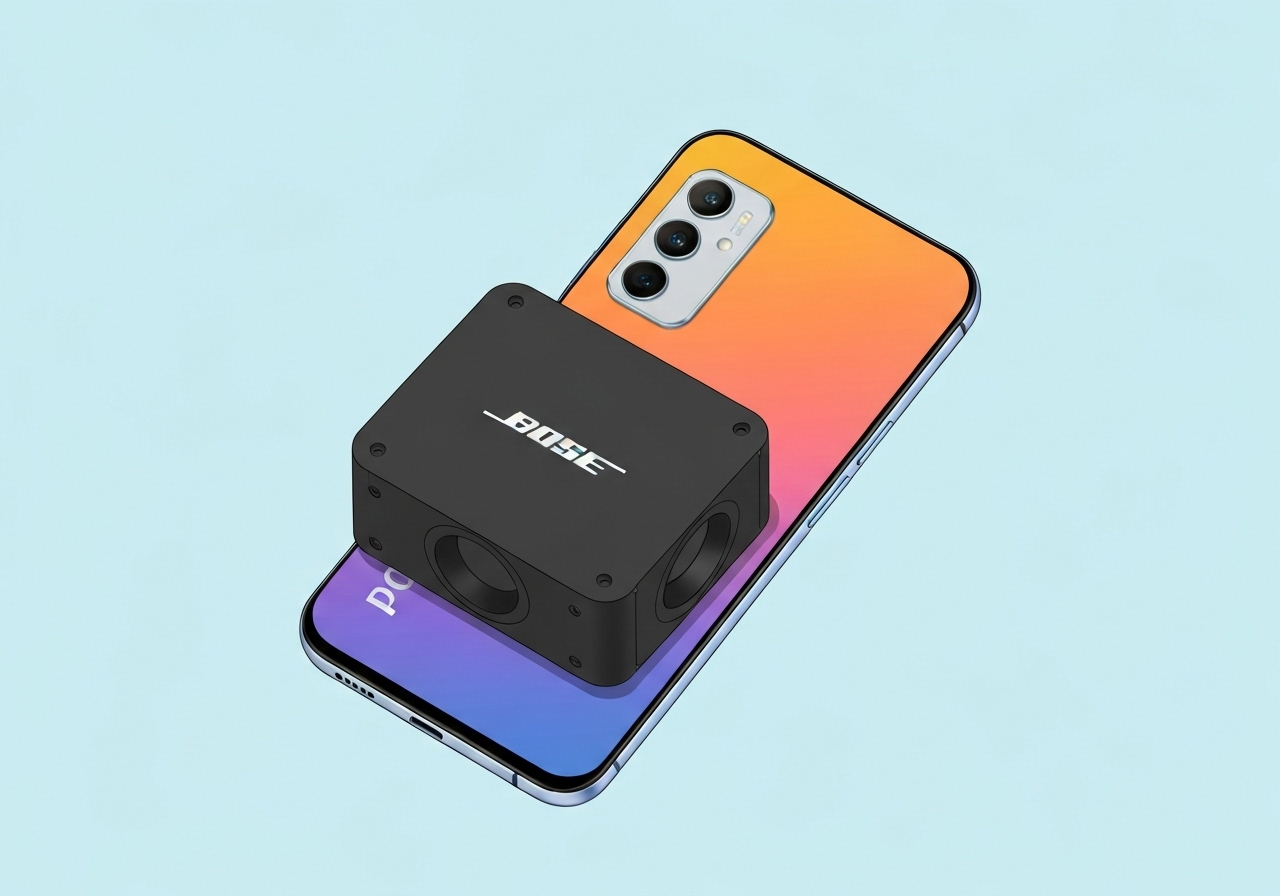
Xiaomi spin-off Poco has teamed up with audio specialist Bose to give its new F8 series a stronger audio identity: both the F8 Pro and F8 Ultra use stereo speakers tuned with Bose, while the F8 Ultra adds a built-in subwoofer intended to deliver deeper bass. The phones were revealed alongside two value tablets and keep Poco’s focus on high-spec hardware at accessible prices. Early positioning highlights audio as a differentiator in an increasingly crowded affordable-flagship segment. Poco and Bose say the collaboration aims to improve clarity and low-frequency impact without changing the phones’ mainstream feature sets.
Key Takeaways
- The Poco F8 Ultra includes a dedicated subwoofer in addition to Bose-tuned dual stereo speakers, while the F8 Pro shares the dual stereo setup without the subwoofer.
- Bose provided tuning and two sound profiles — Dynamic (extra bass) and Balanced (vocal-forward) — for both models, per company statements.
- Hardware: the F8 Ultra uses a Snapdragon 8 Elite Gen 5, 6.9-inch OLED panel, triple 50MP rear cameras and wireless charging; the F8 Pro uses last year’s Snapdragon 8 Elite and a 6.59-inch screen.
- Both phones carry IP68 dust/water resistance and batteries above 6,000mAh, which Poco expects will deliver long endurance.
- Pricing starts at $579 for the F8 Pro and $729 for the F8 Ultra, with a $50 early-bird launch discount on the Ultra.
- Poco also announced two sub-$400 tablets, the Pad X1 and Pad M1, both emphasizing high-resolution displays and Dolby Atmos speakers for media consumption.
Background
Smartphone makers have increasingly pushed audio quality as a selling point, pairing hardware tweaks with software tuning to stand out as display, camera, and chipset advances become incremental. Historically, premium audio features—multiple drivers, tuned chambers, and branded partnerships—have been a differentiator for a handful of models from major brands. Poco, positioned as a value-focused offshoot of Xiaomi, has built traction by delivering flagship-class specs for lower price points and now appears to be extending that playbook into perceived experiential benefits like sound.
Bose brings decades of acoustic engineering experience and a consumer-facing brand that signals audio credibility. For an OEM like Poco, collaborating with an established audio name helps communicate a tangible upgrade without radically altering industrial design or cost structure. At the same time, integrating components such as a subwoofer into a slim phone requires trade-offs in internal layout, thermal design, and power draw—areas where Poco will need to balance marketing claims with real-world performance.
Main Event
Poco announced two new F8-branded phones. Both models include dual stereo speakers that Bose helped tune, and the F8 Ultra adds a dedicated subwoofer unit. Poco states the subwoofer produces “deeper, more impactful bass,” positioning it as the key audio differentiator for buyers who prioritize low-frequency performance in mobile listening and gaming.
The F8 Ultra is fitted with the Snapdragon 8 Elite Gen 5 chipset, a 6.9-inch OLED display, triple 50-megapixel rear cameras, wireless charging capability, and an IP68 rating. The F8 Pro is equipped with the previous-generation Snapdragon 8 Elite, a smaller 6.59-inch screen, and slightly downgraded camera optics compared with the Ultra, while retaining IP68 protection and similarly large battery capacity above 6,000mAh.
Poco set the F8 Pro starting price at $579 and the F8 Ultra at $729, with an initial $50 early-bird discount on the Ultra. The company also introduced two tablets below $400, the Pad X1 and Pad M1, which emphasize high-resolution panels and Dolby Atmos-tuned speakers as budget-friendly entertainment devices. Poco’s announcement frames the Bose partnership as a way to elevate perceived audio quality across its new product range.
Analysis & Implications
Partnering with a brand like Bose gives Poco a marketing edge: it converts an otherwise technical spec into a recognizable consumer benefit. For price-conscious buyers, a familiar audio name can simplify comparisons against competitors that claim better sound without third-party validation. However, brand partnerships do not automatically guarantee superior listening experiences; real-world gains depend on how the components are integrated and tuned within the phone’s physical constraints.
From an engineering perspective, adding a subwoofer to a phone is unusual and challenging. Producing meaningful low-frequency output requires moving more air or using specialized acoustic chambers—both of which compete for internal space. Poco’s decision suggests the company accepted some internal-design trade-offs to deliver bass performance that could appeal to gamers and media-focused users, but the net impact on thermals or component placement remains to be independently measured.
Commercially, the price positioning keeps both phones in the affordable-flagship bracket. At $729 for the Ultra, including the subwoofer may reassure some buyers that they are getting additional hardware value; others may prefer to compare battery life, display peak brightness, and camera performance against rivals. If Bose-tuned audio proves differentiating in reviews, other OEMs could accelerate similar collaborations, further raising the prominence of branded audio in mid‑range and upper-mid smartphone tiers.
Comparison & Data
| Spec | Poco F8 Pro | Poco F8 Ultra |
|---|---|---|
| SoC | Snapdragon 8 Elite (previous-gen) | Snapdragon 8 Elite Gen 5 |
| Display | 6.59-inch OLED | 6.9-inch OLED |
| Cameras | Triple rear lenses (downgraded vs Ultra) | Triple 50MP rear cameras |
| Audio | Bose-tuned dual stereo speakers | Bose-tuned dual stereo + built-in subwoofer |
| Battery | >6,000mAh | >6,000mAh |
| IP rating | IP68 | IP68 |
| Price (base) | $579 | $729 ($50 early discount) |
The table highlights the two models’ shared platform decisions—large batteries and IP68 protection—while showing the Ultra’s higher-end chipset, larger screen, camera emphasis, and unique audio hardware. These differences clarify why Poco prices the Ultra roughly $150 above the Pro and positions it as the premium choice within the series.
Reactions & Quotes
“By combining Bose’s expertise in acoustic engineering with Poco’s innovation in design and technology, Poco F8 Series achieves a level of clarity and depth that redefines what’s possible in mobile sound,”
Nick Smith, Bose (company statement)
This statement frames the partnership as mutually reinforcing: Bose brings tuning and engineering heritage, while Poco provides the hardware platform and market reach.
“The subwoofer delivers deeper, more impactful bass,”
Poco product announcement
Poco highlighted the subwoofer as the headline benefit of the Ultra, emphasizing bass as a reason consumers might choose the higher-priced model.
Unconfirmed
- Exact subwoofer power rating and acoustic specifications have not been published by Poco; objective measurements are pending independent reviews.
- The real-world effect of the subwoofer on battery life under heavy audio or gaming workloads has not been disclosed.
- Market availability and launch timelines for all regions, including pricing and promotions beyond the $50 early-bird discount, remain subject to Poco’s regional rollout plans.
Bottom Line
Poco’s collaboration with Bose and the addition of a subwoofer to the F8 Ultra are clear attempts to turn audio into a headline feature that justifies a premium over the Pro. The approach aligns with Poco’s value-first strategy while attempting to tap a recognizable brand to signal quality. Whether the subwoofer meaningfully changes user experience will depend on independent listening tests and measurements of trade-offs such as internal space loss or battery impact.
For shoppers, the F8 Pro remains the cost-effective choice with Bose-tuned stereo sound, while the F8 Ultra targets buyers who prioritize bass and higher-end internal specs. Reviewers and consumers should look for side-by-side audio tests and battery-life results when evaluating whether the subwoofer is a practical advantage or primarily a marketing differentiator.
Sources
- The Verge (technology journalism)
- Poco official site (company announcement / product pages)
- Bose (company / corporate statements)