
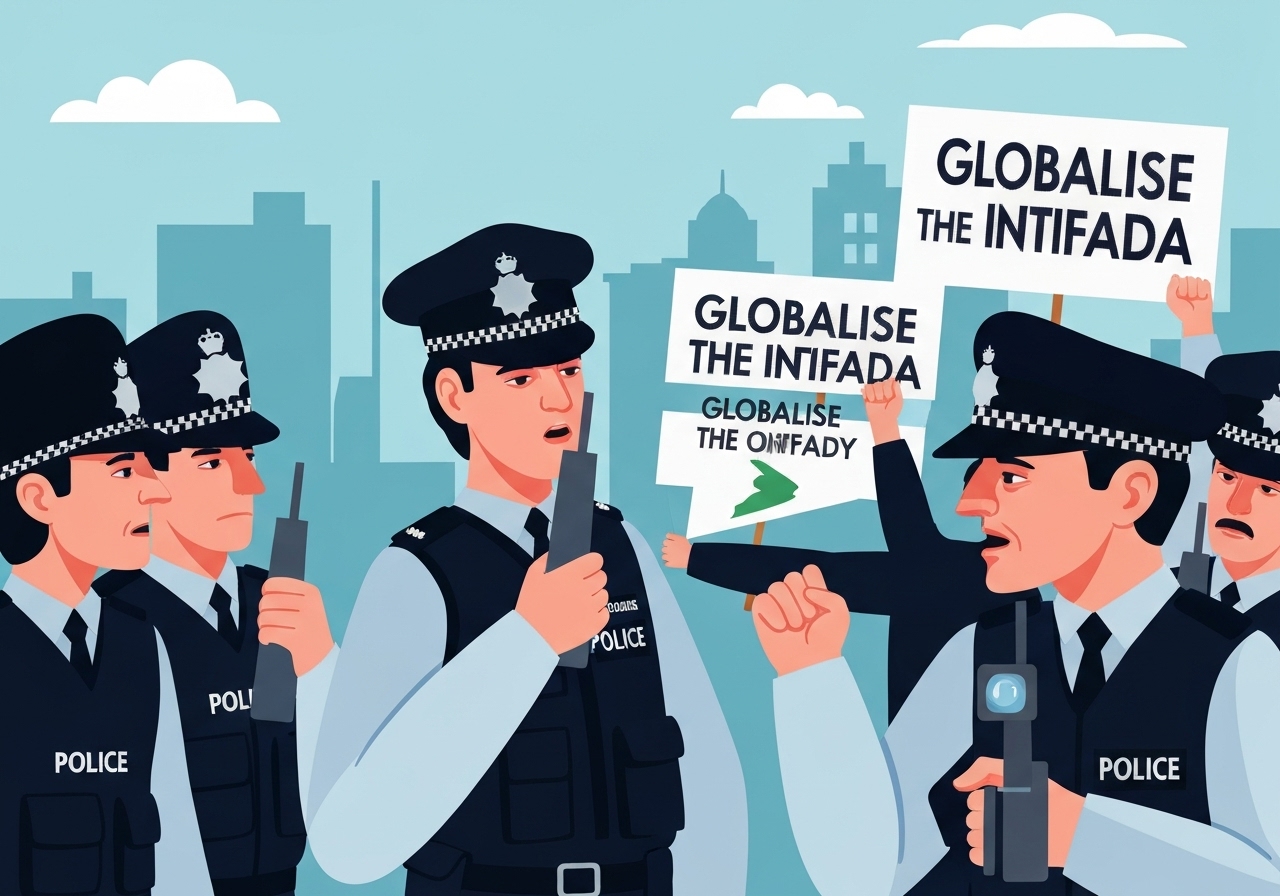
Metropolitan and Greater Manchester police announced they will arrest people who hold placards or chant the slogan “globalise the intifada” at protests, saying the phrase can have violent consequences. The move followed a mass shooting at Bondi Beach that killed 15 people and a UK synagogue knife attack on 2 October that killed two, incidents police cited as changing context. Officials said frontline officers will be briefed on an enhanced approach, including use of powers under the Public Order Act and tighter conditions around synagogue services. Community leaders and ministers have welcomed stepped-up security and a government review of protest and hate-crime laws.
Key takeaways
- The Metropolitan Police and Greater Manchester Police said they will arrest people using the chant or carrying related placards at future protests, describing the language as potentially inciting violence.
- Authorities referenced the Bondi Beach shooting that killed 15 people and the Heaton Park synagogue knife attack on 2 October in Manchester that killed two, saying those events altered policing priorities.
- Police said frontline officers will be briefed on the approach and that they will apply powers under the Public Order Act, including specific conditions around services at London synagogues.
- Visible patrols and protective security measures around synagogues, schools and community venues have been increased in London and Greater Manchester.
- The Board of Deputies of British Jews publicly welcomed the police intervention, saying robust enforcement of the slogan had been urged for some time.
- Prime Minister Keir Starmer announced an uplift in funding for Jewish security to £28m and ordered a review of protest and hate-crime legislation.
Background
In recent months, protests related to the Israel–Gaza conflict have included chants and placards using the Arabic word “intifada,” historically tied to Palestinian uprisings. The word’s use at demonstrations has divided opinion: some interpret it as a call for armed struggle, others as a slogan for resistance that can be non-violent. Police forces stress that the legal threshold for criminal action is whether speech amounts to criminal incitement or a breach of the peace under the Public Order Act.
The decision to treat the slogan as actionable reflects broader anxiety after two high-profile attacks: a mass shooting at Bondi Beach that killed 15 people at a Hanukkah event and the 2 October knife attack at Heaton Park Hebrew Congregation that killed two. Community groups, Jewish institutions and some political leaders have pressed for clearer enforcement to protect congregations and community venues. At the same time, civil liberties groups caution that enforcement must be carefully targeted to avoid unlawful restrictions on lawful protest and debate.
Main event
On the day of the announcement, the two police forces issued a joint statement saying that violent acts had changed the context for policing rhetoric at protests. They said officers will be briefed on an “enhanced approach” and that the forces will not hesitate to make arrests where placards or chants cross into criminal behaviour. The statement explicitly named the slogan “globalise the intifada” as one such phrase that will trigger enforcement.
Police also flagged use of statutory powers under the Public Order Act, which allows conditions to be placed on protests and gatherings and gives officers powers to disperse or arrest where offences occur. Forces said they would apply conditions around synagogue services in particular, aiming to reduce risk at times of communal worship. Local commanders said visible patrols and protective security measures have been increased at synagogues, schools and community venues in London and Greater Manchester.
Community leaders responded quickly. The Board of Deputies of British Jews described the intervention as necessary and said it had long raised concerns about the chant. Ministers in Westminster supported stepped-up security: Prime Minister Keir Starmer confirmed a rise in Jewish-community security funding to £28m while announcing a review of protest and hate-crime laws to ensure enforcement is effective and proportionate.
Analysis & implications
Legally, the move leans on provisions in the Public Order Act and other criminal legislation that criminalise incitement to violence and disorder. Police must demonstrate that specific speech or behaviour meets the statutory threshold for unlawful conduct rather than merely expressing a political view. That legal boundary will be central to how cases are handled in court and to any subsequent judicial review of policing decisions.
Operationally, briefing frontline officers and imposing conditions around places of worship increases immediate protection for vulnerable venues but also raises operational challenges. Officers will need clear guidance to distinguish between protected political speech and unlawful incitement. Misapplication could lead to legal challenges or accusations of disproportionate interference with freedom of expression, especially in a politically charged environment.
Politically, the policy responds to pressure from Jewish community organisations and some political leaders seeking urgent action after the Bondi and Manchester attacks. It may reduce acute security risks in the short term, but community leaders and civil liberties advocates will monitor whether enforcement is consistent and evidence-based. The government’s announcement of additional security funding aims to buffer venues against near-term threats but does not remove longer-term drivers of communal tension.
Comparison & data
| Incident | Date | Deaths | Location |
|---|---|---|---|
| Bondi Beach mass shooting | Sunday (recent) | 15 | Sydney, Australia |
| Heaton Park synagogue knife attack | 2 October | 2 | Manchester, UK |
| UK Jewish security funding announced | This week | £28m (allocated) | United Kingdom |
The table summarises the attacks and the announced security funding. Police cite the two attacks to justify a change in enforcement posture; the funding uplift to £28m is intended to support immediate protective measures around community sites. Statistical trends in antisemitic incidents will be an important metric to track the policy’s effect, but those data typically lag and require aggregation from multiple reporting bodies.
Reactions & quotes
Officials and community groups framed the new policy as a necessary response to a changed security environment. Police emphasised duty to protect and to act where language amounts to criminal conduct.
“Violent acts have taken place, the context has changed – words have meaning and consequence. We will act decisively and make arrests.”
Metropolitan Police / Greater Manchester Police (joint statement)
The Board of Deputies expressed relief at visible action while urging continued robust enforcement and support for affected communities.
“We strongly welcome this necessary intervention.”
Board of Deputies of British Jews (community organisation)
Political leaders have signalled legislative and funding responses; Prime Minister Keir Starmer announced additional security funding and a review of relevant laws to ensure enforcement is effective and proportionate.
Unconfirmed
- That chanting “globalise the intifada” directly caused either the Bondi or Manchester attacks is asserted by some leaders but has not been legally or forensically established.
- Specific numbers of arrests that will result from the new policing approach have not been published and remain unspecified.
- Whether the policy will be applied consistently across different protests and phrases with similar political content has not been clarified by police.
Bottom line
Police in London and Greater Manchester have signalled a more interventionist approach to a specific protest slogan, citing recent attacks that targeted Jewish communities. The announcement combines operational measures—briefing officers and increasing patrols—with legal tools under the Public Order Act and an injection of £28m in security funding for Jewish institutions.
Short-term, the steps are likely to raise visible security and may deter some immediate risks at communal sites. Longer-term effects depend on how narrowly police apply the tests for unlawful incitement, how courts rule on any contested arrests, and whether the government’s review leads to legislative change. Observers should track incident data, policing guidance, and any legal challenges to assess whether the balance between safety and free expression is maintained.
Sources
- BBC News (media report summarising police statements and community reactions)