
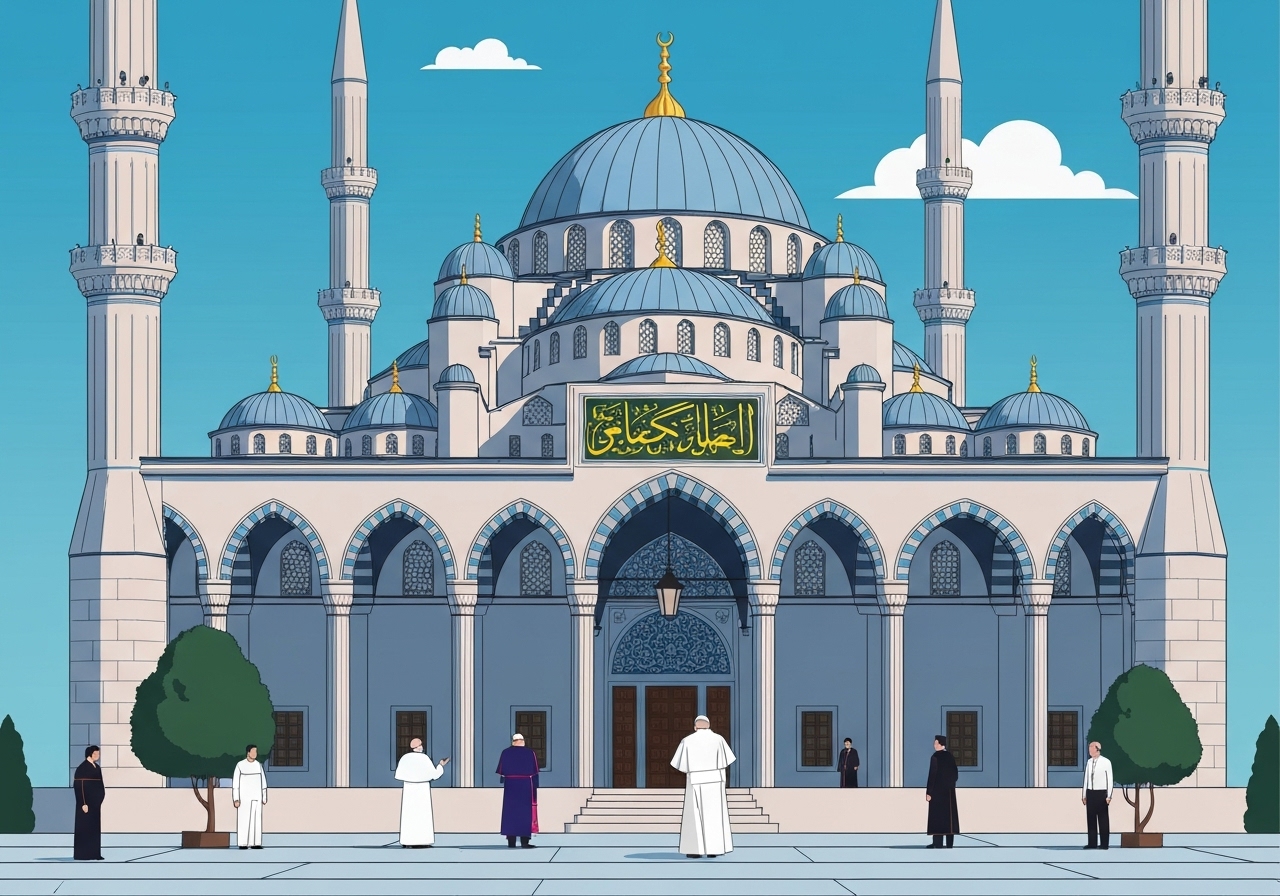
Lead: Pope Leo XIV visited Istanbul’s Sultan Ahmed Mosque — commonly called the Blue Mosque — during a four-day trip to Turkey, marking his first public visit to a Muslim place of worship since assuming the papacy in May. The Pontiff was seen bowing upon entry but reportedly did not perform a prayer inside, a departure from actions by some recent predecessors. The Vatican described the visit as one of “reflection and listening,” stressing respect for the site and for worshippers. The trip continues with meetings in Turkey and a scheduled visit to Lebanon, where he will mark the 2020 Beirut port blast site.
Key Takeaways
- Pope Leo XIV visited the Sultan Ahmed (Blue) Mosque in Istanbul during a four-day Turkish trip; he assumed the papacy in May.
- Photographs show the Pope bowing on entry; multiple reports say he did not pray inside, unlike Pope Francis in 2014 and Pope Benedict XVI in 2006.
- The Vatican framed the visit as “in a spirit of reflection and listening,” emphasizing respect for the mosque and those who gather there.
- After the mosque visit, the Pope was welcomed at St George’s Cathedral by Ecumenical Patriarch Bartholomew, signalling interfaith outreach.
- The broader trip includes a stop in Lebanon and a planned Mass at the Beirut waterfront, at the 2020 port explosion site where 200+ people died and around 7,000 were injured.
- The journey’s theme — building bridges between faiths — was a plan initiated under the late Pope Francis and adopted publicly by Pope Leo XIV since his May inauguration.
Background
The Sultan Ahmed Mosque, built under Ottoman Sultan Ahmed I between 1609 and 1617, is one of Istanbul’s most visited religious sites. Known as the Blue Mosque for its blue and turquoise İznik tiles, it routinely draws millions of visitors annually and is both an active mosque and a major tourist landmark. Papal visits to Muslim places of worship have been rare but symbolically significant: John Paul II entered the Umayyad Mosque in Damascus in 2001, Pope Benedict XVI visited the Blue Mosque in 2006, and Pope Francis prayed there in 2014. Each of those visits was widely reported as gestures toward interfaith dialogue between the Vatican and Muslim communities.
Pope Leo XIV’s trip to Turkey is part of a short regional journey that will include Lebanon; the itinerary was reported to have been arranged under late Pope Francis and retains the earlier emphasis on bridge-building. Diplomatic and religious leaders typically view papal visits to Muslim worship sites as gestures with both spiritual and geopolitical overtones, offering a rare platform for interreligious conversation. The context for this trip includes persistent regional tensions and a global concern, as the Pope himself warned, about a rising level of conflict that could threaten broader stability.
Main Event
On arrival at the Blue Mosque, Pope Leo XIV entered the courtyard and bowed before stepping inside the prayer hall; photographers captured the gesture but there were no signs of him performing a public prayer. Vatican officials said the visit was undertaken “in a spirit of reflection and listening,” framing the action as respectful observation rather than liturgical participation. Local authorities and mosque officials allowed the brief visit within regular operating procedures for dignitaries, and the Pontiff’s movement inside the mosque was measured and quiet, consistent with precedent for high-profile visitors.
After the mosque visit, the Pope traveled to St George’s Cathedral in Istanbul where he met Ecumenical Patriarch Bartholomew, the spiritual leader of the Eastern Orthodox Church. The encounter continued the trip’s ecumenical and interfaith threads and included private greetings and exchanges consistent with diplomatic and religious protocol. Organizers described the meetings as cordial and intended to reaffirm historic ties between Roman Catholic and Eastern Orthodox communities in the region.
The Pope’s itinerary then turns to Lebanon, a country where Christians make up a significant minority (estimated at roughly one-third of the population) and where he is due to meet a range of faith leaders and youth groups. Among the most notable program items is a Mass planned at the Beirut waterfront near the site of the 2020 port explosion, an event that killed over 200 people and injured about 7,000. That Mass is intended as both a memorial and a pastoral act for survivors and bereaved families.
Analysis & Implications
Pope Leo XIV’s visit to the Blue Mosque is symbolically important: it signals continuity with recent popes’ efforts to sustain interfaith dialogue while calibrating the Vatican’s public posture. By bowing and refraining from public prayer, the Pontiff balanced respect for Muslim worship practices with the boundaries of Catholic liturgical norms. That choice will be read differently across audiences — some will see it as prudent diplomacy, others as less overtly conciliatory than predecessors who prayed inside.
Geopolitically, the trip affords the Vatican an opportunity to assert soft power in a region facing deep social and political challenges. Meetings with Orthodox and Muslim leaders, and the planned Lebanese Mass, allow the Pope to address humanitarian concerns and advocate for peace without direct political intervention. The visit also provides a platform to call attention to regional crises and to the needs of vulnerable populations in both Turkey and Lebanon.
Domestically within Catholic constituencies, the visit may shape perceptions of Pope Leo XIV’s approach to interreligious engagement. He has publicly embraced the theme of bridge-building since his first appearance on the St Peter’s balcony in May, and this visit reiterates that priority. Longer-term implications depend on follow-up actions: whether the Vatican deepens institutional engagement with Muslim and Orthodox counterparts, supports joint initiatives, or limits the contact to symbolic gestures will determine the visit’s lasting impact.
Comparison & Data
| Pope | Site | Year |
|---|---|---|
| John Paul II | Umayyad Mosque, Damascus | 2001 |
| Benedict XVI | Blue Mosque, Istanbul | 2006 |
| Francis | Blue Mosque, Istanbul | 2014 |
| Pope Leo XIV | Blue Mosque, Istanbul | 2025 (current trip) |
The table highlights how papal visits to prominent Muslim places of worship have occurred intermittently over the past quarter-century, often coinciding with broader diplomatic outreach. Visits in 2001, 2006 and 2014 were explicit gestures toward interfaith dialogue; the current visit continues that pattern. Quantitatively, the Beirut Mass will mark one of the most publicly visible acts of the tour, taking place at the 2020 blast site where official tallies put fatalities at over 200 and injuries near 7,000.
Reactions & Quotes
“He undertook the tour in a spirit of reflection and listening, with deep respect for the place and for the faith of those who gather there in prayer.”
Vatican statement (official)
This statement from the Vatican framed the visit as reflective and respectful rather than liturgical, providing the institution’s official explanation for the nature of the Pontiff’s actions inside the mosque.
“The future of humanity is at stake,”
Pope Leo XIV (public remark, start of trip)
The Pope’s warning about global conflict, given at the outset of the trip, underscores the diplomatic tone of his itinerary and his intent to link pastoral visits with broader appeals for peace and restraint internationally.
Unconfirmed
- Whether the Pope conducted any private prayer inside the mosque remains unreported beyond official summaries and press images; the Vatican’s statement emphasized reflection rather than prayer.
- Reports that the trip’s detailed itinerary was fully planned by the late Pope Francis have been reported, but internal Vatican planning documents have not been publicly released to confirm the extent of those arrangements.
Bottom Line
Pope Leo XIV’s Blue Mosque visit is a careful, symbolic act of interfaith outreach: visible enough to register with international audiences, restrained enough to respect both Catholic practice and the mosque’s sanctity. The choice to bow and not to pray in public follows a measured diplomatic script intended to avoid theological confusion while signalling respect.
How the trip is interpreted will depend on subsequent gestures and institutional follow-up. If the Vatican pursues concrete joint projects with Muslim and Orthodox partners, the visit could be an important step toward sustained cooperation; if it remains primarily symbolic, its long-term impact will be limited to diplomatic signaling and public relations.
Sources
- BBC News (media report of the papal visit and Vatican statement)