
Lead
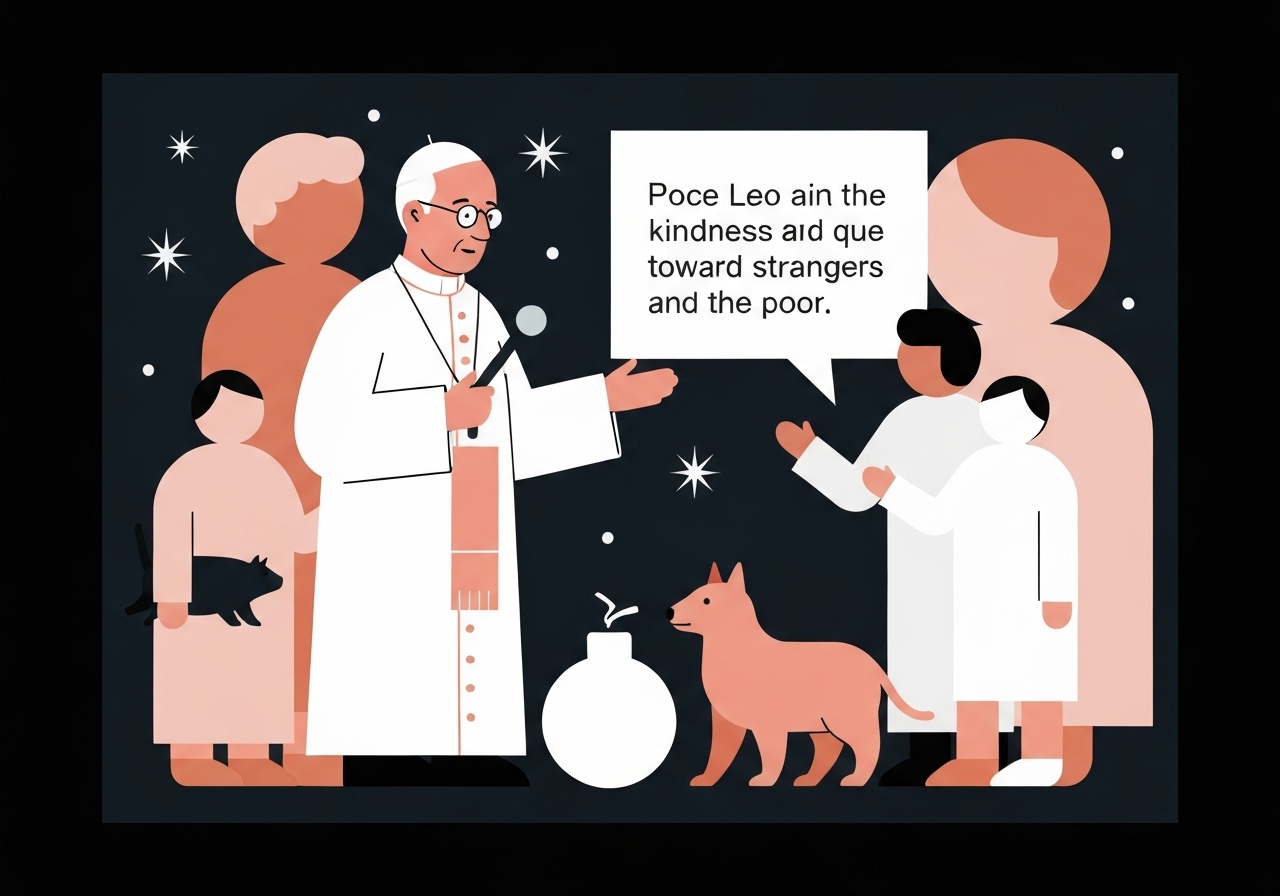
Pope Leo used his Christmas Eve sermon at St Peter’s Basilica to tell the world’s 1.4 billion Catholics that the nativity story is a call to welcome and assist strangers and the poor. Speaking on 24 December, the 70-year-old pope framed the image of Jesus born in a stable — because there was no room at the inn — as evidence that refusing to help people is tantamount to rejecting God. About 6,000 people attended the solemn mass inside the basilica, while roughly 5,000 watched on large screens in St Peter’s Square in heavy rain. The pope said hospitality to migrants and vulnerable people should be central to Christian life, reiterating themes he has emphasised since his election in May.
Key Takeaways
- Pope Leo delivered his Christmas Eve sermon at St Peter’s Basilica on 24 December, attended by about 6,000 people inside the building.
- Approximately 5,000 people gathered in St Peter’s Square and watched the service on screens despite heavy rain.
- The pope linked the nativity’s stable scene to a moral duty: “To refuse one is to refuse the other,” he said of refusing God by refusing people.
- Leo, 70, the first US-born pope, was elected by cardinals in May to succeed Pope Francis and marked his first Christmas as pope.
- He reiterated care for immigrants and the poor as central themes of his early papacy and quoted Pope Benedict XVI on the world’s treatment of children, the poor and foreigners.
- Before the mass he greeted those in the square, thanking them for enduring the rain and braving the weather to attend.
- The pope will celebrate a Christmas Day mass and deliver the biannual Urbi et Orbi blessing on Thursday.
Background
The nativity narrative has long been invoked by popes as a moral mirror for society, used to highlight how religious teaching intersects with public policy on poverty and migration. In recent years the Vatican has placed recurring emphasis on migration, economic inequality and human dignity; those themes have become more prominent amid global migration flows and polarized debates in many countries. Pope Leo’s emphasis on hospitality follows a pattern set by his predecessors in making social care and the treatment of migrants a visible liturgical and rhetorical priority.
Leo’s election in May came during a period of intense attention on the Vatican’s stance toward humanitarian issues and international politics. As the first US-born pope, his comments carry particular attention from both US and global media, and his prior public criticisms of hardline immigration measures have already drawn commentary from political leaders and advocacy groups. The Christmas liturgy, attended by thousands inside and observed by many more outside, remains one of the highest-profile moments each year for the pope to state the Church’s moral priorities.
Main Event
During the solemn Christmas Eve mass on 24 December, Pope Leo described the stable where Jesus was born as a theological and ethical image: it demonstrates God’s presence among the least advantaged and the moral obligation to make room for others. He told worshippers that treating human beings as commodities is a distortion of economic life and contrasted that with God becoming “like us,” a phrase he used to underline the dignity of every person. The pope explicitly linked hospitality to the divine, urging that denying care to a person is equivalent to denying God.
The service inside St Peter’s Basilica was attended by roughly 6,000 people, according to organizers, while an estimated 5,000 stood under umbrellas and ponchos in St Peter’s Square watching on large screens. Leo stepped outside briefly before the mass to acknowledge those standing in the rain, thanking them for their perseverance and presence. He told the crowd he admired their courage for remaining in difficult weather to mark the liturgy.
Leo referenced a line from Pope Benedict XVI lamenting society’s failure to care for children, the poor and foreigners, folding that citation into a broader critique of economic systems that commodify people. He also reiterated pastoral priorities that have marked his early papacy: welcoming migrants, defending human dignity and calling for tangible acts of charity. The mass set the stage for the upcoming Christmas Day liturgy and the Urbi et Orbi blessing the pope is scheduled to deliver on Thursday.
Analysis & Implications
Pope Leo’s Christmas message reinforces continuity in Vatican rhetoric on migration and social inequality while shaping expectations about his pastoral priorities. By tying the nativity scene to concrete duties toward migrants and the poor, the pope signals that his theological framing will continue to inform Vatican engagement with humanitarian crises and public policy debates. For Catholic communities and charitable organisations, such statements often translate into renewed calls for relief efforts and local initiatives aimed at people on society’s margins.
Politically, the sermon arrives amid heated debates in several countries over immigration controls and asylum policy. Leo’s prior public criticisms of hardline immigration measures—mentioned during his early months as pope—suggest he will remain a vocal advocate for more humane approaches. While papal appeals do not translate directly into immediate policy change, they can sway public opinion, mobilise faith-based actors and shape the language used by policymakers and advocates.
Economically, the pope’s critique of systems that treat people as commodities highlights tensions between market pressures and social protection norms. This message could influence Catholic institutions’ investment and procurement policies, charitable grantmaking, and partnerships with secular organisations addressing poverty. Internationally, reaffirming hospitality and dignity as central values may bolster Vatican engagement with international bodies focused on migration and human rights.
Comparison & Data
| Location | Approximate Attendance |
|---|---|
| St Peter’s Basilica (inside) | 6,000 |
| St Peter’s Square (outside, watching screens) | 5,000 |
The posted figures reflect organisers’ estimates for the Christmas Eve mass and the square viewing. Attendance for papal liturgies can vary year to year depending on security measures, weather and the scale of public interest; this year’s numbers show a substantial in-person turnout despite heavy rain.
Reactions & Quotes
“To refuse one is to refuse the other.”
Pope Leo, Christmas Eve homily
The pope used this concise formulation to summarise his moral argument that denying hospitality to people is equivalent to denying God’s presence.
“I admire and respect and thank you for your courage and your wanting to be here this evening, even in this weather.”
Pope Leo, to the crowd in St Peter’s Square
This remark came as he briefly greeted those watching outdoors, acknowledging the rain and the commitment of attendees who braved it to participate.
“A distorted economy leads us to treat human beings as mere merchandise.”
Quoted by Pope Leo from Pope Benedict XVI
The citation of Benedict XVI reinforced Leo’s critique of economic systems that, in his view, devalue human dignity.
Unconfirmed
- Whether specific government leaders will change immigration policy in direct response to the pope’s remarks remains unconfirmed and would depend on domestic political considerations.
- The long-term impact of this Christmas message on Vatican policy direction is not yet confirmed; statements set tone but do not always result in immediate institutional change.
Bottom Line
Pope Leo’s Christmas Eve sermon framed hospitality toward migrants and the poor as a core Christian obligation and a test of whether society makes room for the human person. By using the nativity story and citing previous papal voices, he positioned his appeal within a recognizable Vatican moral tradition while signalling the pastoral priorities of his early papacy.
For congregations, charities and policymakers, the address is likely to renew focus on practical measures for welcoming migrants and combating poverty, even as the degree to which it influences secular policy remains uncertain. Observers should watch for how Church institutions, international partners and national authorities respond in the coming months, particularly around humanitarian initiatives and public messaging on migration.
Sources
- The Guardian — (news)
- Vatican News — (official Vatican communications)