
Lead
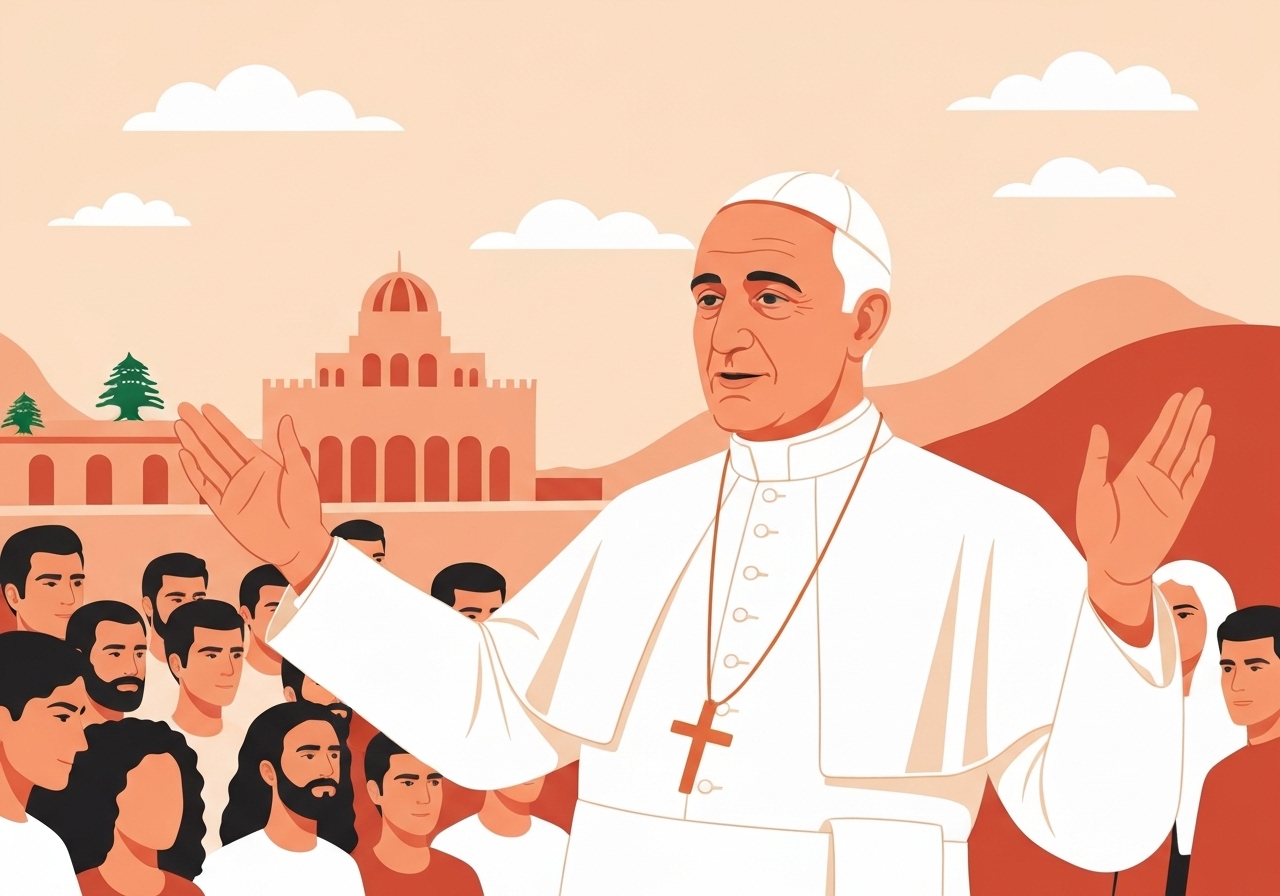
On Dec. 1, 2025, Pope Leo XIV opened his first full day in Lebanon by praying at the tomb of St. Charbel and addressing clergy and pilgrims in Harissa and Annaya. He urged Lebanon’s Christian communities to remain in the country and called on political leaders to work for peace amid economic collapse, sectarian deadlock and fears of renewed war. Arriving in Beirut on Nov. 30 after a three-day stop in Turkey, the pope also repeated support for a two-state solution to the Israeli-Palestinian conflict. His message combined pastoral consolation with a public appeal for political responsibility.
Key Takeaways
- Pope Leo XIV arrived in Beirut on Nov. 30, 2025, and spent Dec. 1 visiting St. Maroun in Annaya and the Our Lady of Lebanon shrine in Harissa.
- He prayed at the tomb of St. Charbel, the first pope to do so, and asked for peace for Lebanon and the wider Levant.
- Leo publicly challenged Lebanon’s political leaders to become “true peacemakers,” urging them to set aside divisions that fuel deadlock and hardship.
- The pope received enthusiastic crowds despite steady rain; thousands lined motorcade routes waving Lebanese and Vatican flags.
- He encouraged priests, nuns and young people to offer hope and to remain in Lebanon amid an ongoing economic crisis and the aftermath of the 2020 Beirut port blast.
- On the trip’s earlier leg in Turkey, Leo told reporters private talks with President Recep Tayyip Erdogan touched on Gaza and Ukraine and praised Turkey’s potential role in mediation.
- Lebanon faces persistent political paralysis under its sectarian power-sharing system and renewed debate over Hezbollah’s weapons following last year’s fighting with Israel.
Background
Lebanon has endured years of compounded crises: a severe economic collapse that accelerated after 2019, a currency crash, rising poverty and political paralysis aggravated by sectarian power-sharing that often produces stalemate. The 2020 Beirut port explosion deepened public mistrust in state institutions and remains a focal point of unresolved investigations and political tension. Christians, once a more numerous group across the Levant, have emigrated in large numbers over recent decades—estimates run into the hundreds of thousands—driven by war, insecurity and limited economic prospects.
The Maronite Church and other Christian communities are politically and socially prominent in Lebanon’s confessional system but have seen their influence diminish as populations shift and parties such as Hezbollah have gained armed and political clout. International actors—including the Vatican, regional states and Western donors—have long framed Lebanon as a test case for pluralism in the Middle East. Pope Francis had planned to visit previously but was unable to do so; Leo XIV’s trip fulfills that long-delayed papal outreach at a fragile moment.
Main Event
On Monday, Dec. 1, Leo traveled to the hilltop Monastery of Saint Maroun in Annaya to pray at the tomb of St. Charbel Makhlouf, a 19th-century Maronite hermit revered across Christian and Muslim communities. Bells tolled as thousands of pilgrims braved rain to greet him; worshippers waved flags and showered the pope’s route with flowers and rice. The visit to St. Charbel was presented as the first papal pilgrimage to that tomb, symbolically linking Lebanon’s religious heritage to Leo’s broader call for coexistence.
Later the pope met with Catholic bishops, priests, consecrated persons and pastoral workers at the Our Lady of Lebanon sanctuary in Harissa. In a lively gathering marked by applause and ululation, he urged clergy and religious sisters to offer practical hope and love to communities beset by hardship, saying pastoral care is essential when daily necessities become difficult and when people feel exploited by forces that take advantage of desperation.
Earlier stops on the trip included Ankara and Istanbul, where Leo met President Recep Tayyip Erdogan and took part in ecumenical services. At the presidential palace in Baabda on Nov. 30 he appealed to Lebanese officials to assume their responsibilities; he did not explicitly single out recent hostilities or the disarmament debate in that speech but acknowledged widespread suffering and insecurity.
Analysis & Implications
Leo’s visit combines pastoral outreach with delicate diplomacy. By praying at sites revered by both Christians and Muslims, he underscored the Vatican’s long-term interest in protecting pluralism in the Levant while avoiding direct intervention in Lebanon’s internal security debates. That posture aims to reassure minority communities without escalating tensions with influential armed actors such as Hezbollah.
Politically, the pope’s call for leaders to be peacemakers places moral pressure on Lebanon’s fractured elite, but it is unclear whether moral suasion can overcome structural incentives for patronage and sectarian competition. Lebanon’s power-sharing system routinely produces prolonged government vacancies; without concrete reforms or strong external incentives, political paralysis is likely to persist.
Economically, encouraging Christians to remain addresses the demographic dimension of Lebanon’s decline: continued emigration drains technical skills, capital and social cohesion. However, retention will depend on tangible improvements—stability, jobs, basic services—not only pastoral appeals. International donors and regional state actors could amplify the pope’s message only if they pair solidarity with realistic assistance and political leverage.
Comparison & Data
| Metric | Pre-2010 (approx.) | Today (est.) |
|---|---|---|
| Lebanese Christians (population share) | ~35-40% | ~25-30% (declining) |
| Economic contraction (since 2019) | Stable | GDP down >50% in real terms (currency collapse) |
| Notable shocks | Lebanese Civil War (1975-1990) | 2020 Beirut port blast; 2023-25 political/economic crises |
The table provides approximate measures to contextualize the pope’s appeal. Exact population shares are contested; emigration estimates vary by source but point to a substantial Christian exodus over recent decades. The economic figures underscore why calls to remain must be paired with material stabilizers to be effective.
Reactions & Quotes
Clergy and pilgrims greeted the pope’s visit with warmth; some framed it as a sign Lebanon should be preserved. Priest Hanna Rahme, speaking at Harissa, appealed to parishioners to remain steadfast.
“The real martyrdom of Jesus Christ is among us, telling us that Lebanon is very important. We must save it, sacrifice for it, and remain steadfast in it.”
Priest Hanna Rahme
After the pope’s address to clergy, many responded with applause and calls of support; a pilgrim, May Noon, told reporters that staying is a communal decision tied to interfaith coexistence and daily survival.
“We will stay here — no one can uproot us from this country; we must live in it as brothers.”
May Noon, pilgrim
The Vatican framed the trip as both pastoral and diplomatic; Vatican officials said Leo sought to bolster Christians while encouraging dialogue among Lebanon’s leaders. Turkish and Lebanese officials highlighted Erdogan’s and President Joseph Aoun’s meetings with the pope as opportunities to promote regional mediation and unity.
Unconfirmed
- Whether Leo’s visit will produce any immediate policy changes or tangible steps toward disarmament of armed groups in Lebanon remains unconfirmed; no formal agreement or commitment was announced.
- Claims that Turkey’s mediation during the trip will yield rapid breakthroughs in Gaza or Ukraine are not corroborated beyond officials’ statements about discussions and potential roles.
Bottom Line
Pope Leo XIV’s Dec. 1 visits to St. Charbel’s tomb and the Harissa shrine combined pastoral consolation with a pointed appeal to Lebanon’s political class. His call for Christians to remain is meant to shore up a community facing demographic decline, but its practical effect will hinge on political reform and economic stabilization that the pope cannot deliver alone.
The visit amplifies international attention on Lebanon at a fragile moment: moral leadership can inspire, but without concrete domestic reforms and coordinated international support, the structural drivers of emigration and instability are likely to persist. Observers should watch whether the pope’s outreach catalyzes donor pledges, regional mediation or domestic political concessions in the weeks ahead.