
Lead
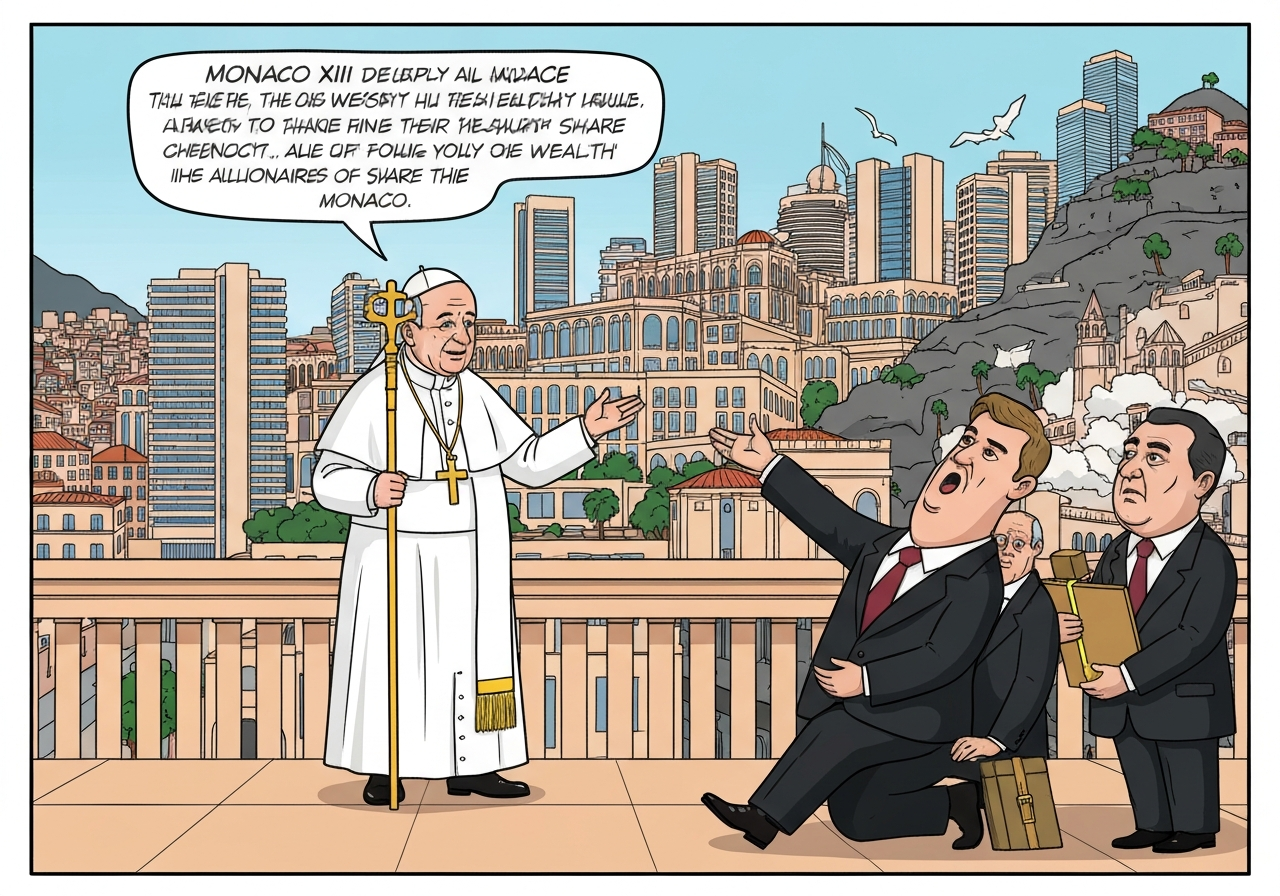
On March 28 in Monaco, Pope Leo made a one-day visit to the tax-free principality known for its concentration of extreme wealth and luxury yachts, urging residents to put their prosperity at the service of others. He arrived after a roughly 90-minute helicopter trip from the Vatican and met Prince Albert at the prince’s official residence. Speaking to gathered crowds, the pope framed private wealth as a responsibility to be shared so that “everyone’s life may be better.” The visit, the pope’s second trip outside Italy since his election, combined ceremonial protocol with a direct appeal to generosity.
Key Takeaways
- Pope Leo visited Monaco on March 28, arriving by helicopter after a 90-minute flight from the Vatican.
- He met Prince Albert and presented a mosaic image of St. Francis of Assisi made by the Vatican’s mosaic studio.
- Monaco, at about 0.8 square miles, is the world’s second smallest state and has the highest concentration of billionaires per capita.
- The pope urged residents to “put your prosperity at the service of law and justice,” linking private wealth to public responsibility.
- Crowds were relatively thin along the route as the pope toured Monaco in an open-air popemobile.
- In a meeting with local Catholics, the pope used Church language defending the human person and appeared to commend Prince Albert’s 2025 veto of a bill to legalize abortion.
- Pope Leo, 70, was elected in May to succeed the late Pope Francis and has a busy travel schedule, with an Africa tour planned for April and a Spain visit set for June.
Background
Monaco is a tiny, sovereign principality on the French Riviera long associated with luxury, favorable tax rules and a high number of ultra-high-net-worth residents. The state covers roughly 0.8 square miles and maintains Catholicism as its state religion, a rarity among modern nations. Its tax environment and lifestyle have drawn wealthy individuals and their yachts, concentrating private capital within a small territory.
Papal visits to such enclaves are uncommon: the Vatican characterized the trip as a signal that small countries can exert influence on global conversations. The Vatican’s mosaic workshop gifted an image of St. Francis of Assisi — a 13th-century figure who renounced wealth to serve the poor — underscoring the visit’s moral framing. Prince Albert, Monaco’s head of state and the son of late actress Grace Kelly, has been a frequent interlocutor of the Vatican on social and ethical matters.
Main Event
The pope’s March 28 itinerary combined ceremonial tradition with pastoral messaging. After his helicopter arrival, he toured Monaco in an open popemobile and spoke at the prince’s official residence, where he presented the mosaic artwork. He addressed assembled crowds under clear skies, calling on Monaco’s well-off residents to share material goods and to align their prosperity with law and justice.
Attendance along the route was described as modest, with relatively thin crowds lining the principality’s narrow streets. At a separate meeting with local Catholics, the pope reiterated Church positions on protecting the human person, language commonly used by Church leaders when speaking on issues such as abortion and the death penalty. Observers noted that his remarks came after Prince Albert vetoed a 2025 bill to legalize abortion in Monaco, a decision applauded by many in the local Church.
During the public appearances, a Monaco resident among the crowd, Jean Claude Haddad, said he hoped the pope could help bring people together amid tensions linked to the Iran war. The pope’s short stay was punctuated by the usual protocol of a papal tour, including security measures and carefully staged public moments, while emphasizing outreach to the poor and vulnerable.
Analysis & Implications
The visit is symbolically significant: a pope urging a wealthy, tax-attractive microstate to redistribute or share resources sends a moral signal to global elites concentrated in such jurisdictions. For the Vatican, the trip served to highlight a pastoral priority — encouraging private wealth to be used for social justice — without prescribing specific policy instruments. That approach preserves Church moral teaching while avoiding direct political prescriptions in sovereign fiscal matters.
Practically, Monaco’s governance and tax regime are sovereign choices shaped by history, geography and economic strategy. A papal appeal may prompt philanthropic pledges or high-profile donations by individuals moved by the message, but changing systemic tax or regulatory frameworks requires domestic and international political negotiation. The visit could nudge elite discourse toward visible charity, even if structural reforms remain unlikely as a direct consequence.
Internationally, the trip fits within a broader Vatican strategy of engaging with diverse states and elites to influence global debates on inequality, migration and human dignity. For Pope Leo personally, the Monaco stop complements an active travel agenda — a multination Africa tour in April and a Spain visit in June — signaling a papacy that intends to be present on the world stage and to shape conversations through moral leadership rather than administrative power alone.
Comparison & Data
| State | Area (sq mi) | Notable fact |
|---|---|---|
| Monaco | 0.8 | Second smallest sovereign state; high billionaire concentration |
| Vatican City | 0.17 | Smallest state; spiritual center of the Catholic Church |
The table frames Monaco’s geographic limits alongside the Vatican’s tiny footprint. Monaco’s compact territory concentrates wealth and visibility: a small population with outsized financial resources relative to land area. That concentration makes symbolic appeals and high-profile philanthropy particularly visible and newsworthy.
Reactions & Quotes
The pope’s remarks were met with a mix of appreciation and reflection from attendees and observers. Below are representative quotes and context.
“In God’s eyes, nothing is received in vain! Every good placed in our hands… bears an intrinsic need not to be held back, but to be shared.”
Pope Leo (public address)
Those lines framed the moral core of the visit, using theological language to argue for generosity rather than hoarding of resources.
“At the moment there is a lot of tension. He could reunite people… he brings people together.”
Jean Claude Haddad (Monaco resident)
Haddad’s comment reflected local hopes that the pope’s moral stature could ease international tensions, including those tied to the Iran war referenced by some attendees.
“Put your prosperity at the service of law and justice.”
Pope Leo (address to Prince Albert and guests)
This short line encapsulated the visit’s policy-adjacent appeal: an ethical encouragement for wealthy residents to align private resources with broader societal obligations.
Unconfirmed
- Whether the pope intended his remarks as a direct rebuke of Monaco’s fiscal regime rather than a moral appeal to individuals remains unclear.
- It is uncertain whether the pope’s apparent praise for Prince Albert’s 2025 veto was a formal endorsement or an observational comment; reports describe the praise as circumstantial.
- The extent to which the visit will produce measurable increases in philanthropy or policy shifts among Monaco’s wealthy residents is not yet confirmed.
Bottom Line
Pope Leo’s Monaco visit on March 28 combined ceremonial diplomacy with a pointed moral appeal: wealthy residents were asked to consider their resources as instruments for public good. The trip highlighted the Vatican’s strategy of using high-profile pastoral moments to influence elite behavior and public discourse without prescribing specific legal changes.
While the visit is symbolically powerful — reinforced by the gift of St. Francis imagery and direct appeals to Prince Albert — tangible policy outcomes or sustained shifts in charitable flows will require follow-up, domestic decisions and international cooperation. For now, the visit sets a moral tone and places Monaco’s concentration of wealth in a global conversation about responsibility and justice.