
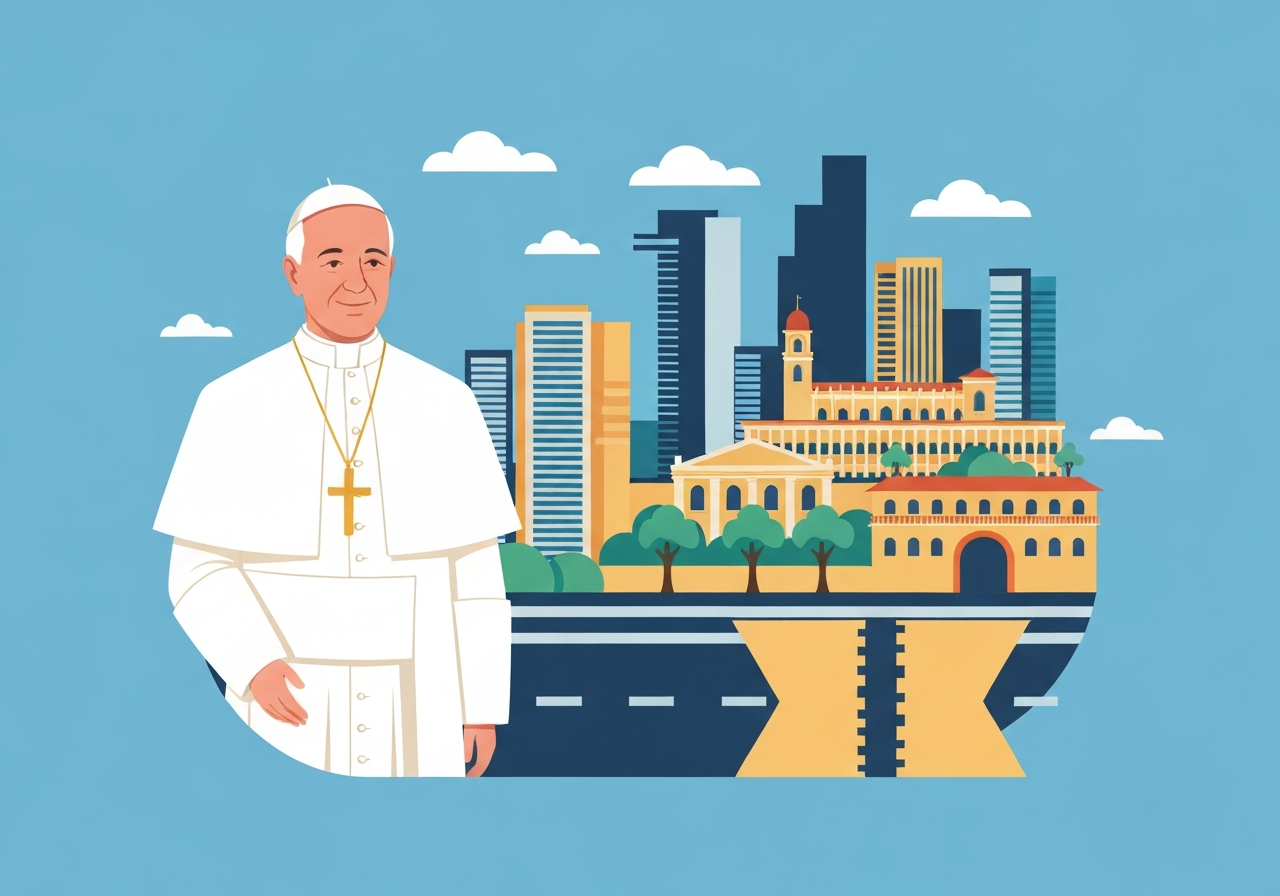
On Saturday, March 28, 2026, Pope Leo XIV made a historic one-day visit to Monaco — his first foreign trip of 2026 and his first papal journey in Europe outside Italy. The pontiff flew by helicopter from the Vatican, was received at the Prince’s Palace by Prince Albert and Princess Charlene, and greeted crowds waving Monaco and Vatican flags. The visit combined ceremonial worship—a public Mass at the national stadium—with private diplomacy, including a palace meeting and conversations about shared moral priorities. The trip has prompted public and diplomatic questions about why the Vatican selected a small, affluent principality known as a playground for the wealthy for this early international outing.
- Pope Leo XIV visited Monaco on March 28, 2026; he arrived by helicopter and held both a private palace meeting and a public Mass at the national stadium.
- The pope met Prince Albert II and Princess Charlene; Princess Charlene was among the few Catholic royal women allowed to wear white in the pope’s presence.
- Cardinal Pietro Parolin framed the visit as reinforcing small states’ moral and multilateral roles, warning about weakened international law and the return of preventive-war rhetoric.
- Monaco and the Holy See cited shared priorities including environmental protection and opposition to abortion; Prince Albert recently vetoed an abortion bill in the principality.
- The visit highlighted personal ties: Pope Leo is the first US-born pope, and Prince Albert has American connections through his mother, Grace Kelly.
- The pope avoided Monaco’s casino district; family recollections note he gave up gambling after missionary work in Peru.
Background
Monaco is among the world’s smallest sovereign states but holds outsized diplomatic visibility because of its wealth, prominent residents and strategic coastal location on the French Riviera. Catholicism is the state religion and the principality maintains close ceremonial and institutional ties to the Holy See; those ties have included formal diplomatic relations and frequent clerical engagement over social issues. The Vatican has in recent years sought partnerships with small states as platforms for moral influence and diplomatic consistency, particularly on topics where larger powers are divided.
The choice of Monaco for a papal visit also carries symbolic resonance: it showcases a relationship that mixes traditional religiosity with contemporary policy cooperation, from environmental initiatives to stances on family and bioethical matters. Monaco’s ruling family, led by Prince Albert II, occupies a dual role as national leaders and international interlocutors with cultural cachet thanks in part to the late Princess Grace, an American-born actress. For the Vatican, small-state visits can yield diplomatic mileage—visible moments of soft power that reinforce values and partnerships without the logistical scale of visits to large states.
Main Event
Pope Leo arrived in Monaco by helicopter and was met at the Prince’s Palace by Prince Albert and Princess Charlene, who joined him for a private audience before he addressed a public gathering outside the palace. Crowds, including children in yellow hats, lined parts of the city waving Vatican and national flags as the pope made brief remarks urging that prosperity be placed at the service of law and justice. He criticized contemporary displays of power and warned that oppressive logics threaten peace, framing Monaco’s “gift of smallness” as an ethical resource.
Cardinal Pietro Parolin, the Holy See’s Secretary of State, used the visit to articulate a diplomatic rationale: small states, he said, can act as bulwarks against authoritarian tendencies and as natural guardians of multilateralism when international law seems weakened. Monaco’s own policy agenda—particularly its public commitment to a green transition—was highlighted as a complementary focus between the two states. The trip’s program also included a formal Mass at Monaco’s national stadium attended by the local Catholic community and other invited faithful.
Notably, the pope did not visit Monaco’s famed casino district; his brother John told media the pope gave up gambling after his missionary service in Peru. That personal anecdote underscored a domestic, pastoral dimension to the visit that balanced ceremonial statecraft with private faith testimony. The one-day itinerary kept diplomatic and pastoral activities tightly scheduled and confined to official venues.
Analysis & Implications
At first glance, Monaco might appear an unlikely first foreign stop for a pope seeking global moral influence, given the principality’s reputation as a hub for wealth and leisure. But from the Vatican’s diplomatic perspective, the visit advances a specific calculus: small, devoutly Catholic states can provide visible examples of values the Holy See seeks to amplify—multilateralism, environmental stewardship and conservative stances on bioethical issues. By visiting Monaco early in the year, the Holy See signals an intent to engage partners who can both model and promote its priorities on the international stage.
The trip also reflects a strategic use of symbolism. A papal visit to a tiny, affluent state invites public conversation about how prosperity is stewarded, a theme the pope explicitly raised. That framing allows the Vatican to critique global inequalities and power abuses without directly confronting larger states, using Monaco as a case study in moral responsibilities attached to wealth. For the principality, the visit reinforces its identity as a Catholic polity and strengthens soft-power credentials tied to tradition and international visibility.
Politically, the visit presents a nuanced diplomatic signal: the Vatican is reaffirming alliances with like-minded governments on issues such as opposition to abortion and environmental policy while avoiding entanglement in great-power rivalries. This approach can broaden the Holy See’s coalition-building capacity in international forums where smaller states punch above their weight by voting in blocs or championing particular treaty measures. The long-term effect will depend on follow-through—joint initiatives, statements in multilateral bodies, and continued pastoral outreach.
Comparison & Data
| State | Area (km²) | Population (approx.) |
|---|---|---|
| Vatican City | 0.44 | ~800 |
| Monaco | 2.02 | ~39,000 |
The table underscores the scale difference: both are microstates by area and population, but Monaco’s larger resident population and international economic profile give it a different kind of diplomatic reach. The Vatican’s global moral authority stems from religious leadership and diplomatic history; Monaco’s influence comes through wealth, high-profile residents and targeted environmental and cultural diplomacy. Together, the two states present complementary platforms for symbolic and policy-focused cooperation.
Reactions & Quotes
Officials framed the visit as both pastoral and diplomatic. Below are representative public remarks and the context in which they were made.
“The gift of smallness and a living spiritual heritage invite you to put your prosperity at the service of law and justice,” the pope told the crowd outside the palace, linking Monaco’s wealth to moral responsibility.
Pope Leo XIV
This remark set the visit’s thematic tone: financial success should align with justice and the common good. It was delivered in a public setting and echoed in pastoral messages during the stadium Mass.
“Smaller states can be natural guardians of multilateralism,” Cardinal Pietro Parolin said, warning about a weakening of international law and a resurgence of theories that rationalize preventive wars.
Cardinal Pietro Parolin, Holy See Secretary of State (official)
Parolin framed the visit in diplomatic terms, positioning Monaco as an ally for the Vatican’s broader multilateral agenda. His comments were given in an official capacity and highlight specific international-law concerns enumerated by the Holy See.
“After my time as a missionary in Peru, I gave up gambling; there were better things you could do with your money,” John said, recalling the pope’s personal change in habits.
John (Pope Leo’s brother), as reported to National Catholic Reporter
This anecdote, reported by religious press, provided a personal counterpoint to the state-level messaging and explained why the pope avoided the casino district during his Monaco visit.
Unconfirmed
- Reports that the visit was primarily arranged to court wealthy donors have not been substantiated by official Vatican or Monaco sources.
- Details about any private policy commitments between the Vatican and Monaco beyond public statements have not been publicly documented.
Bottom Line
Pope Leo XIV’s visit to Monaco on March 28, 2026, combined pastoral ministry with deliberate diplomatic signaling. The choice of Monaco underscores a Vatican strategy that privileges symbolic, value-driven partnerships and leverages small-state platforms to promote multilateralism, environmental stewardship and conservative social positions.
For Monaco, the papal visit strengthened its identity as a devout, outward-facing principality and reinforced the principality’s role in international cultural and environmental initiatives. Observers should watch for follow-up statements or joint initiatives in multilateral venues that would translate ceremonial affinity into policy cooperation.
Ultimately, the trip was as much about messaging as it was about ceremony: it offered the Vatican a controlled, high-visibility setting to reiterate moral priorities while keeping diplomatic friction low. How that messaging is converted into concrete action will determine whether the visit yields lasting policy influence.
Sources
- CNN — International news report (journalism)
- Vatican Press Office — Official Holy See communications (official)
- Prince’s Palace of Monaco — Official principality site (official)
- National Catholic Reporter — Religious press reporting (journalism)