
Lead
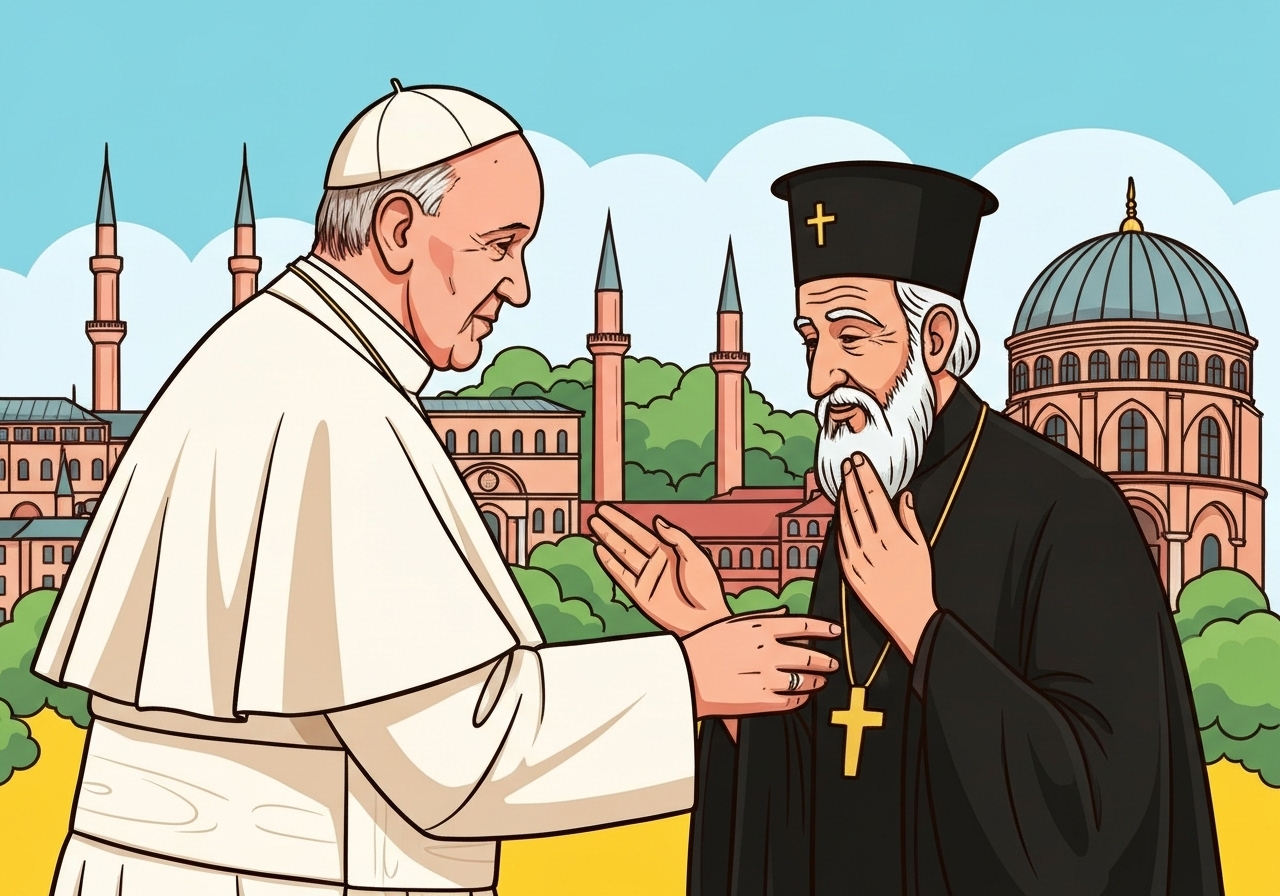
On Nov. 28, 2025, Pope Leo XIV began a four-day visit to Turkey aimed at signaling warmer ties with the Eastern Orthodox Church. In Istanbul he is scheduled to meet Ecumenical Patriarch Bartholomew I on Saturday and share a dinner with him on Sunday, before continuing to Lebanon as part of the same international trip. The meetings are largely symbolic, intended to reinforce encounter and dialogue between two of Christianity’s largest communions while stopping short of resolving deep doctrinal differences.
Key Takeaways
- Pope Leo XIV’s visit began on Nov. 28, 2025, and is planned to last four days, including a meeting with Ecumenical Patriarch Bartholomew I in Istanbul.
- The scheduled Istanbul summit includes a Saturday meeting and a Sunday dinner; the pope will then travel to Lebanon for the next leg of his first international journey as pontiff.
- The trip comes roughly 971 years after the 1054 schism that formally separated the Roman Catholic and Eastern Orthodox Churches.
- Toursists and local Christian communities remain focused on practical issues such as seminary access and legal protections for minority congregations in Turkey.
- Officials describe the visit as highly symbolic: it aims to deepen cooperation on social and humanitarian matters rather than to settle theological disputes.
- Public and press reactions in Istanbul range from hopeful to cautious; some observers say increased goodwill may ease joint responses to regional crises.
Background
The rift between Rome and Constantinople that crystallized in 1054 remains a defining feature of Christian institutional history. Over centuries the divide produced separate ecclesial structures, liturgical traditions and theological emphases; occasional rapprochements have not erased those foundational distinctions. In recent decades, formal dialogues and joint statements have narrowed the rhetorical distance, with both sides emphasizing shared heritage and cooperative projects.
Turkey’s religious landscape has shaped the political anatomy of such meetings. The Ecumenical Patriarchate, based in Istanbul, serves as a spiritual center for many Orthodox Christians but operates as a religious minority within a predominantly Muslim republic. Issues such as the legal status of church properties, the closure of the Halki Theological School and recognition of religious education have long been on the agenda for Christian leaders visiting Ankara and Istanbul.
Main Event
Pope Leo XIV arrived in Istanbul at the start of his four-day program, holding private and public engagements with Turkish officials and local Christian communities. The program’s high point is his scheduled meeting with Ecumenical Patriarch Bartholomew I, an encounter designed to emphasize mutual respect and collaboration on shared concerns such as refugee assistance and interfaith dialogue. Organizers framed the meeting as pastoral and diplomatic rather than doctrinal.
On Saturday, the two leaders will meet for a formal conversation at a site in Istanbul; planners expect brief public gestures—handshakes and shared prayers—intended for a global audience. The following day they are to dine together, an event intended to build personal rapport. Vatican and Patriarchate statements ahead of the visit stress modest, concrete outcomes: cooperative social projects and continuing theological conversations.
Local Christian communities attended public liturgies and visited historic sites during the pope’s stay. Activists and community leaders used the occasion to press longstanding demands—most notably reopening the Halki Theological School and restoring property rights to minority congregations. Turkish authorities have signaled openness to symbolic gestures but have not announced major legal reforms tied directly to the visit.
Analysis & Implications
The visit carries layered significance. Symbolically, it signals an ongoing warming of relations between Rome and Constantinople that began in earnest in the late 20th century. That rapprochement has helped both communions present a more united front on humanitarian issues and to cooperate in ecumenical forums. For the Vatican, visible engagement with Orthodoxy reinforces a broader diplomatic posture in the Middle East.
Politically, the meeting navigates delicate terrain. Turkey balances secular governance and Muslim-majority public sentiment while hosting a global Orthodox institution on its soil. Any movement on contentious domestic matters—property restitution, education rights—would require legislative or administrative steps from Ankara, which has historically proceeded cautiously on such reforms.
Religiously, deep theological disagreements remain unresolved: issues of papal primacy, ecclesiology and sacramental theology are not likely to be concluded in a state visit. Instead, the practical dividends of improved relations are more immediate: joint humanitarian initiatives, coordinated relief in crises and amplified moral voice on regional conflicts. Observers say incremental trust-building may open more structured theological dialogue in the years ahead.
Comparison & Data
| Event | Year | Years Elapsed (2025) |
|---|---|---|
| Great Schism (Rome–Constantinople) | 1054 | 971 |
| Pope Leo XIV’s visit to Turkey | 2025 | — |
The numerical contrast underscores the historical distance between the two communions and explains why symbolic gestures remain more feasible than doctrinal settlements. Measured cooperation—shared relief efforts, coordinated statements on persecution or migration—constitutes the most realistic short-term output.
Reactions & Quotes
“This meeting has strong symbolic value and could help Christians work together on today’s problems,”
Minas Vasiliadis, editor, Apoyevmatini (local Greek-language newspaper)
Vasiliadis framed the visit as an opportunity for practical collaboration rather than a forum to erase doctrinal differences. Community leaders echoed that theme, urging the leaders to translate goodwill into concrete measures for minority communities in Turkey.
“We welcome dialogue that promotes peace and social support across communities,”
Vatican spokesperson (official statement)
The Vatican statement emphasized pastoral outreach and humanitarian cooperation. It avoided promises of doctrinal breakthroughs while committing to continued conversations between theological commissions.
Unconfirmed
- Any immediate reopening of the Halki Theological School has not been officially confirmed by Turkish authorities as part of this visit.
- Reports suggesting a formal doctrinal agreement between Rome and Constantinople as an outcome of the talks remain unsubstantiated.
- Specific legal commitments from Ankara on property restitution for minority churches have not been announced publicly.
Bottom Line
Pope Leo XIV’s Istanbul meetings with Ecumenical Patriarch Bartholomew I are primarily symbolic steps in a long-running effort to improve Catholic–Orthodox relations. While they do not resolve core theological disputes, the encounters can strengthen joint action on humanitarian and social issues and may ease practical frictions affecting minority communities in Turkey.
Expect tangible, incremental outcomes—cooperation on relief, pastoral initiatives and possibly confidence-building administrative measures—rather than landmark doctrinal breakthroughs. For observers and local communities, the value of the visit will be measured by follow-through: whether symbolic gestures translate into legal and institutional progress over the coming months and years.
Sources
- The New York Times — international news reporting
- Vatican News — official Vatican press/service
- Ecumenical Patriarchate — official Patriarchate communications
- Apoyevmatini — local Greek-language newspaper reporting