
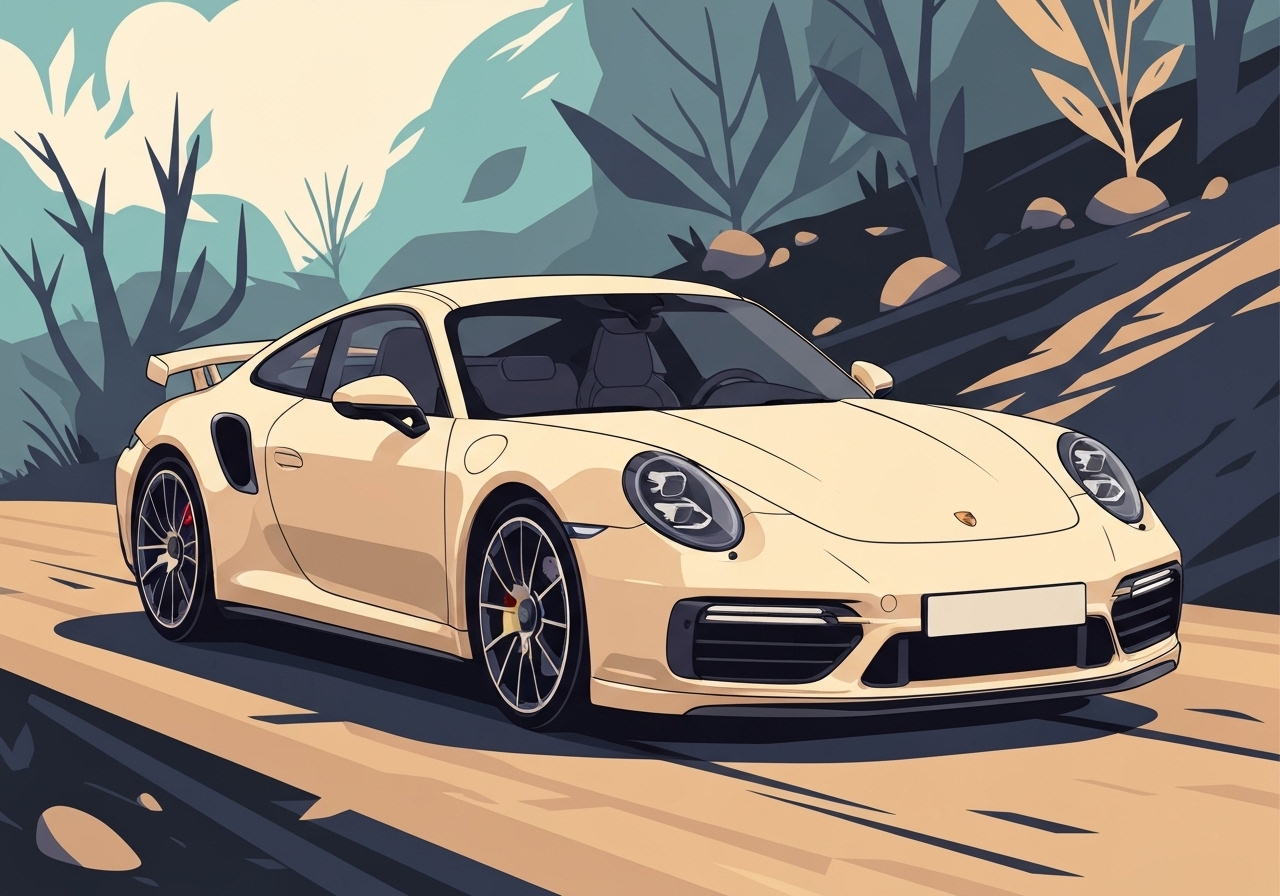
Who/When/Where/What/Result — Porsche unveiled the new 911 Turbo S at the IAA Mobility event in Munich (, release; published ), introducing a twin e‑turbo T‑Hybrid powertrain that yields 523 kW (711 PS) and 800 Nm, cuts 0–100 km/h to 2.5 seconds, and posts a Nürburgring development lap of 7:03.92.
Key Takeaways
- System output: 523 kW (711 PS); peak torque 800 Nm available from 2,300–6,000 rpm.
- Twin eTurbo T‑Hybrid architecture with a compact 1.9 kWh 400 V battery and an eight‑speed PDK with integrated electric motor.
- Performance: 0–100 km/h in 2.5 s (0.2 s faster than predecessor), 0–200 km/h in 8.4 s, top speed 322 km/h.
- Nürburgring Nordschleife development lap: 7:03.92 (around 14 s quicker than previous Turbo) under notarial supervision.
- Weight up 85 kg versus predecessor, but handling, grip and agility improved via chassis and tyre upgrades.
- New PCCB brakes (420 mm front / 410 mm rear), rear tyres 325/30 ZR 21, front tyres 255/35 ZR 20.
- Intelligent active aerodynamics reduce lift or drag as needed; coupé drag cut by 10% in most efficient configuration.
- Turbo‑exclusive styling and Turbonite accents inside and out; broad customization via Porsche Exclusive Manufaktur.
Verified Facts
The new 911 Turbo S uses an evolved T‑Hybrid system, now with two electric exhaust gas turbochargers (eTurbos) specifically sized for the top model. The complete drive package produces a system output of 523 kW (711 PS) and 800 Nm of torque, with the full power plateau present between 6,500 and 7,000 rpm. The compact high‑voltage battery capacity is 1.9 kWh and operates on a 400 V architecture, the same nominal capacity introduced in the 911 Carrera GTS.
Power is delivered through an eight‑speed PDK transmission that integrates an electric motor and forwards drive to Porsche Traction Management (PTM) all‑wheel drive. Porsche lists sprint figures of 0–100 km/h in 2.5 seconds (0.2 s quicker than the outgoing Turbo S) and 0–200 km/h in 8.4 seconds, with a top speed of 322 km/h. WLTP preliminary consumption and emissions figures are provided for reference: combined fuel consumption ~11.6–11.8 l/100 km and CO₂ around 262–267 g/km depending on body style and equipment.
Despite adding hybrid components, the car gains approximately 85 kg relative to its predecessor. Engineers countered that mass increase with chassis, tyre and brake improvements: the rear tyre width grows to 325/30 ZR 21, front tyres remain 255/35 ZR 20, and the PCCB system now uses 420 mm discs at the front and 410 mm at the rear—described as the largest PCCB package fitted to a Porsche two‑door to date.
Porsche reports a development lap of the Nürburgring Nordschleife of 7:03.92 in autumn 2024, achieved by a lightly camouflaged prototype under notarial supervision. Porsche Brand Ambassador Jörg Bergmeister took part in development and testing and noted the car felt more agile and faster across the course despite the weight increase.
Context & Impact
The Turbo S continues Porsche’s strategy of blending high performance with everyday usability. T‑Hybrid technology first appeared in the 2024 Carrera GTS; for the Turbo S Porsche has doubled the eTurbo count and refined components to push power and responsiveness into a new range for production 911s.
For buyers, the package promises supercar acceleration with familiar 911 ergonomics and usability—large power gains without sacrificing long‑distance comfort or everyday features. The 10% drag reduction (coupé, with aerodynamics in their most efficient setting) and active cooling flaps aim to balance high‑speed stability, brake cooling and wet‑weather braking performance.
From an industry perspective, the Turbo S highlights a route for high‑performance combustion platforms to use modest electric assistance (1.9 kWh battery) to deliver step changes in transient response and peak output without moving to full electrification.
“The 911 Turbo S is the most complete and versatile form of driving a Porsche 911. We have made it more comfortable, more individual and significantly faster than its predecessor,”
Frank Moser, Vice President of the 911 and 718 model line (Porsche)
Unconfirmed
- Exact European and global pricing and order start dates beyond Porsche’s announcement were not specified in the release.
- Final WLTP figures for specific markets and full equipment permutations will vary; Porsche lists preliminary ranges.
Bottom Line
Porsche’s new 911 Turbo S advances the 911 line by combining a significant horsepower and torque increase with targeted chassis, brake and aerodynamic upgrades. The twin eTurbo T‑Hybrid approach delivers rapid response and higher peak power, producing track times and everyday usability that together reaffirm the Turbo S as the 911 range’s high‑performance flagship. Availability, pricing and market‑specific emissions figures should follow from Porsche in coming months.