
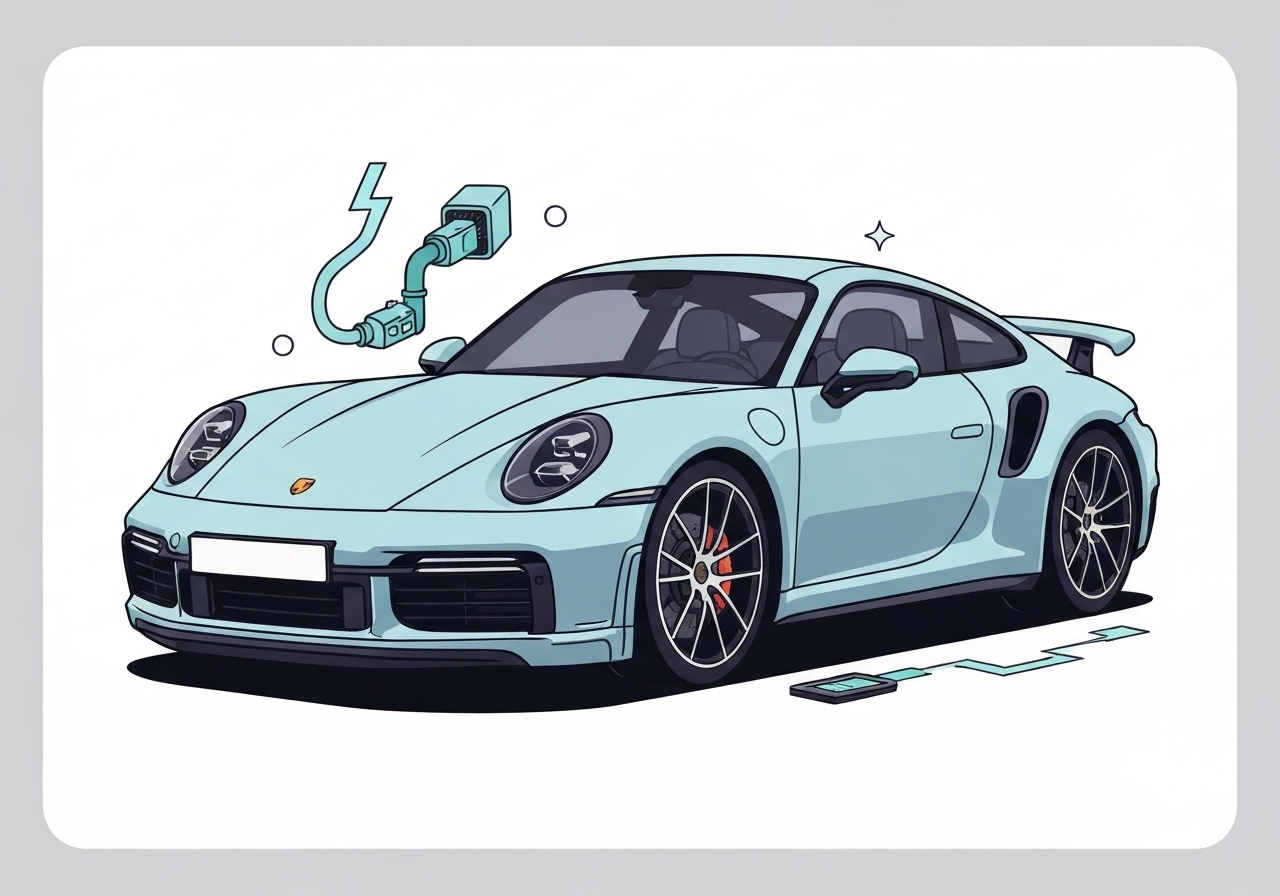
At the IAA Mobility show in Munich on 7 September 2025, Porsche introduced the 2026 911 Turbo S fitted with its new T‑Hybrid system: a redesigned 3.6 L flat‑six, twin electric turbochargers and an integrated 400 V traction battery. The package raises output to 701 hp (523 kW) and 590 lb‑ft (800 Nm), cuts 0–60 mph to 2.4 seconds and produced a 7:03.92 Nürburgring lap in testing.
Key Takeaways
- New 3.6 L flat‑six built for hybrid integration, ancillaries driven by a 400 V battery.
- Two electric turbochargers eliminate perceptible turbo lag and recover turbine energy.
- An internal 53 hp (40 kW), 110 lb‑ft (150 Nm) permanent synchronous motor sits inside the eight‑speed dual‑clutch transmission.
- Total system output: 701 hp (523 kW) and 590 lb‑ft (800 Nm); 0–60 mph in 2.4 s.
- Hybrid Turbo S gained ~180 lb (82 kg) but lapped the 12.9‑mile Nürburgring Nordschleife in 7:03.92, 14 seconds faster than the previous Turbo S.
- New electrohydraulic antiroll bars and enhanced chassis control improve agility despite added mass.
- No manual transmission option is offered for this hybridized Turbo S.
- U.S. base pricing: $270,300 for the coupe, $284,300 for the Cabriolet; deliveries expected in spring 2026.
Verified Facts
Porsche developed a fresh 3.6 L flat‑six for the T‑Hybrid architecture, removing the traditional belt drive and allowing some engine ancillaries to be powered electrically from the car’s 400 V traction battery. That electrical architecture also supplies the car’s new electrohydraulic systems.
The T‑Hybrid concept first appeared on the 911 GTS T‑Hybrid. It pairs turbochargers with electric motors: the electric turbine actuator can spin to very high speed to bring boost online almost instantly and it harvests excess turbine energy to charge a 1.9 kWh battery pack.
For the 2026 Turbo S, Porsche uses a pair of electrically assisted turbochargers and places a 53 hp (40 kW), 110 lb‑ft (150 Nm) permanent synchronous motor within the eight‑speed dual‑clutch transmission. Combined output is rated at 701 hp (523 kW) and 590 lb‑ft (800 Nm), enabling the claimed 0–60 mph time of 2.4 seconds and 124 mph (200 km/h) in 8.4 seconds.
| Specification | Value |
|---|---|
| Engine | 3.6 L flat‑six (T‑Hybrid) |
| Hybrid motor (in DCT) | 53 hp / 40 kW, 110 lb‑ft / 150 Nm |
| Total power / torque | 701 hp / 523 kW; 590 lb‑ft / 800 Nm |
| 0–60 mph | 2.4 seconds |
| Nürburgring Nordschleife (test lap) | 7:03.92 (Jörg Bergmeister) |
| Weight gain vs predecessor | ~180 lb / 82 kg |
| Battery (pack) | 1.9 kWh (recuperation to traction battery) |
In Porsche testing last autumn, factory driver Jörg Bergmeister lapped the 12.9‑mile Nürburgring Nordschleife in 7 minutes, 3.92 seconds in a hybrid Turbo S prototype, a time 14 seconds quicker than the non‑hybrid Turbo S benchmark used for comparison.
Context & Impact
Porsche designed the T‑Hybrid to address two typical turbocharged ICE tradeoffs: lag and energy recovery. The electric turbochargers act like an MGU‑H concept from Formula 1, spinning rapidly to supply immediate boost and reclaiming energy that would otherwise be lost.
That approach changes perceived driveability: throttle response is described as closer to that of an electric vehicle, with near‑instantaneous power delivery even at low revs. The new electrohydraulic antiroll bars and updated chassis control allowed engineers to tune greater grip and agility, offsetting the added mass.
Commercially, the Turbo S demonstrates how hybridization can improve lap times and everyday usability, but it also narrows options for purists: Porsche has not offered a manual gearbox for this hybrid Turbo S, reflecting packaging and integration constraints.
- Performance buyers gain sharper transient response and better on‑track speeds.
- Owners accept roughly 82 kg more mass in exchange for quicker acceleration and enhanced chassis systems.
- Pricing and limited options may keep this model in the high‑end collector or enthusiast market.
“You don’t feel the weight gain. On the contrary—the car is much more agile,” said Jörg Bergmeister.
Jörg Bergmeister, Porsche test driver
“The 911 Turbo S is the most complete and versatile way to drive a Porsche 911,” said Frank Moser, noting improvements in comfort and track performance.
Frank Moser, Porsche VP of 911 and 718 model lines
Unconfirmed
- Claims that this Turbo S is definitively the quickest production 911 from 0–60 mph, once limited special editions are excluded, remain presented as probable rather than independently verified by third‑party testing.
Bottom Line
Porsche’s T‑Hybrid in the 911 Turbo S shows how targeted electrification can sharpen performance and eliminate classic turbo drawbacks without sacrificing top power. The approach raises price and weight, but Porsche’s testing indicates net gains in lap times and everyday usability. Expect deliveries to begin in spring 2026 for buyers who accept the tradeoffs.