
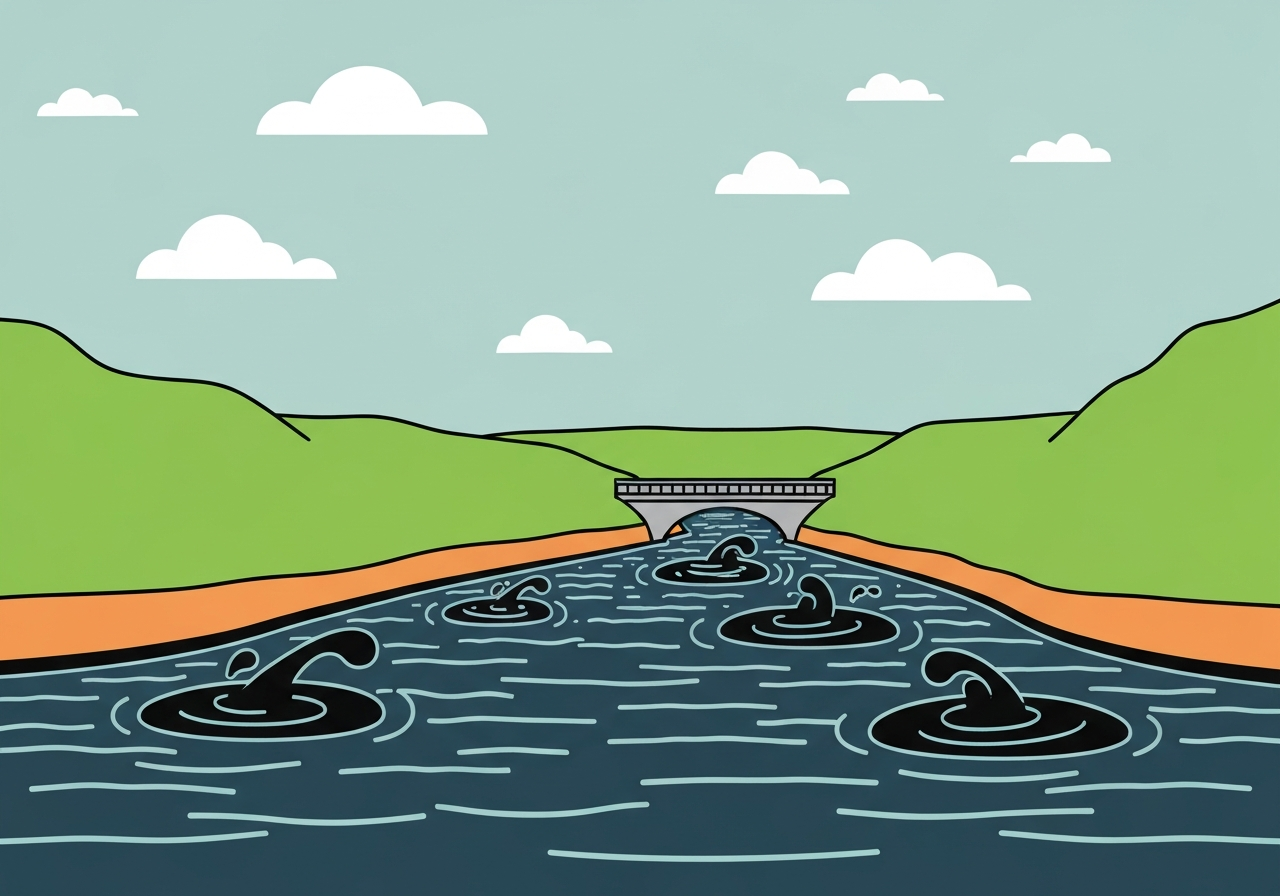
On Jan. 19 a section of the 72-inch Potomac Interceptor sewer line collapsed near the Clara Barton Parkway in Montgomery County, Md., sending hundreds of millions of gallons of untreated human waste into the Potomac River roughly five miles upstream of Washington. The spill, which overwhelmed the river for about a week before D.C. Water rerouted flow to a downstream treatment line, has raised immediate public‑health and environmental alarms and triggered a bitter political exchange that reached the White House by mid‑February. Initial tests recorded elevated E. coli, Staphylococcus aureus and antibiotic‑resistant MRSA in affected waters, though municipal drinking water systems reported no contamination. As repair work continues — with engineers estimating four to six more weeks to complete permanent fixes — regulators, local communities and federal officials are weighing environmental, recreational and funding consequences.
Key Takeaways
- Spill start: Jan. 19, 2026, when a 72‑inch section of the Potomac Interceptor collapsed near Clara Barton Parkway, Montgomery County, Md.
- Volume: Authorities say the accident released hundreds of millions of gallons of untreated sewage; the Interceptor normally conveys up to 60 million gallons per day.
- Duration and containment: Raw sewage flowed freely for about one week before D.C. Water diverted it to a downstream line; intermittent releases continued through Feb. 10.
- Public‑health tests: Early sampling detected elevated E. coli, Staphylococcus aureus and MRSA in river water; municipal drinking water systems remain unaffected.
- Repair timeline: D.C. Water projects a 4–6 week period to finish pipe repairs after temporary bypasses and emergency work.
- Political fallout: On Feb. 16–17, President Trump publicly criticized Maryland Governor Wes Moore and signaled possible FEMA involvement, turning the event into a national political flashpoint.
- Recreational impact: Boating, fishing and shoreline activities popular in recent years are at risk while contamination persists and testing continues.
Background
The Potomac Interceptor is a primary trunk sewer that carries wastewater from Washington’s metropolitan area toward regional treatment centers; its 72‑inch diameter design regularly handles tens of millions of gallons per day. Aging underground infrastructure, heavy use and complex jurisdictional ownership across D.C., Maryland and federal land create coordination challenges when failures occur. In recent years the Potomac has seen a resurgence in recreational use — kayaking, sport fishing and riverfront tourism — raising the stakes for any contamination event that threatens public access and local businesses.
Utilities such as D.C. Water are responsible for large conveyance lines but often rely on county partners and state agencies for land access, emergency contracting and environmental oversight. Federal agencies, including the Environmental Protection Agency and FEMA, can become involved when incidents cross jurisdictional or public‑health thresholds. Prior to this incident there had been periodic, smaller overflows during heavy storms across the region; officials characterize the current discharge as far larger in scale.
Main Event
On Jan. 19 a section of the Potomac Interceptor collapsed near the Clara Barton Parkway, releasing raw sewage directly into the Potomac River. The Interceptor, a 72‑inch pipe designed to carry up to 60 million gallons per day, failed at a point about five miles upstream of Washington, creating an immediate uncontrolled outflow. For roughly one week the river received sewage until crews installed bypass piping and diverted flow to a downstream line leading to a treatment facility.
Despite the diversion, D.C. Water reported intermittent discharges as crews worked around damaged infrastructure; the most recent recorded intermittent spill occurred on Feb. 10. Utility engineers installed temporary bypasses and staged materials for a permanent repair, but constrained access and the need to maintain river‑flow control have slowed progress. D.C. Water estimates a remaining repair window of four to six weeks to restore the Interceptor fully.
Public‑health authorities quickly prioritized sampling. Initial laboratory analyses found elevated counts of E. coli, Staphylococcus aureus and antibiotic‑resistant MRSA in surface water at and downstream of the collapse site. Officials emphasized that municipal drinking water treatment and distribution systems were not affected by the incident, but they warned that direct contact with river water and consumption of locally caught fish could carry increased risk until contamination levels decline and testing shows recovery.
Analysis & Implications
Environmental impact: The release of hundreds of millions of gallons of untreated sewage represents a major pulse of organic matter, nutrients and pathogens into the Potomac system. Such inputs can deplete dissolved oxygen, stress aquatic life and contribute to algal blooms in estuarine zones downstream, including parts of the Chesapeake Bay. The magnitude and duration of ecological harm will depend on flow conditions, temperatures and dilution but the immediate biological stress to near‑shore habitats is significant.
Public health and recreation: Elevated E. coli and Staph bacteria increase acute risks for swimmers, paddle‑sport users and anglers. Even if municipal drinking water remains safe, the presence of antibiotic‑resistant organisms like MRSA complicates medical guidance for people with open wounds or weakened immune systems. Local businesses that rely on river tourism face reputational and economic losses while advisories remain in place.
Regulatory and legal consequences: A spill of this scale is likely to prompt reviews by state environmental regulators and the EPA, including inquiries into permit compliance, inspection histories and emergency response protocols. Liability questions may arise among D.C. Water, property holders at the collapse site, and contractors if investigations find maintenance or design shortcomings. The event also strengthens arguments for accelerated investment in wastewater infrastructure at municipal, state and federal levels.
Political and fiscal fallout: The episode has already entered partisan debate, with calls for federal support and scrutiny of local management. That dynamic could influence funding decisions — including potential FEMA assistance or federal grants — and heighten pressure on elected officials to produce transparent remediation plans and to secure resources for repair and long‑term upgrades.
Comparison & Data
| Item | Figure/Date |
|---|---|
| Pipe diameter | 72 inches |
| Typical conveyance | Up to 60 million gallons/day |
| Spill began | Jan. 19, 2026 |
| Uncontrolled discharge period | ~1 week (then diversion) |
| Last reported intermittent spill | Feb. 10, 2026 |
| Estimated repair time | 4–6 weeks (projected) |
The table above places the core technical numbers cited by utilities and testing officials alongside the incident timeline. Comparing the Interceptor’s normal daily throughput with the reported multi‑week uncontrolled discharge helps explain why sources describe the event as orders of magnitude larger than routine overflows. Longitudinal monitoring of bacterial counts and dissolved oxygen will be necessary to quantify ecological impact and to benchmark recovery against historical incidents.
Reactions & Quotes
Federal and local leaders quickly exchanged public statements as the spill became a national story. The political dimension intensified when the president posted on a social media platform, criticizing state and local officials and announcing potential federal involvement.
“Local officials bungled the cleanup — FEMA will step in if needed,”
President Donald J. Trump (social media post)
That post escalated a dispute between federal and state actors and prompted Maryland officials to outline the work already underway. The White House did not immediately confirm a formal FEMA deployment beyond monitoring options and offering technical support.
D.C. Water framed its response around emergency repair work and ongoing sampling to protect public health.
“Crews have been working for weeks to divert flow and install temporary bypasses while we plan permanent repairs,”
D.C. Water (utility statement)
The utility emphasized that diversion actions reduced continuous discharge and that engineers are sequencing safe repair steps to avoid further releases. D.C. Water also committed to regular public updates on sampling and repair milestones.
Maryland Governor Wes Moore responded by highlighting state coordination with local agencies and calling for transparency and resources to secure the river.
“We are coordinating with partners to protect public health and hold parties accountable,”
Governor Wes Moore (state announcement)
The governor urged federal support for remediation and noted that state environmental teams were conducting ongoing water quality monitoring and outreach to affected communities.
Unconfirmed
- That this spill is definitively the largest sewage discharge in U.S. history — contemporaneous reports describe it as appearing to be the largest, but a comprehensive national comparison has not been released.
- Any formal FEMA field deployment or federal takeover of repairs — the president’s post suggested intervention, but an official, mission‑specific FEMA deployment had not been confirmed at the time of reporting.
- Exact total volume of sewage released — authorities describe the discharge as “hundreds of millions of gallons,” but a final cumulative tally remains under review.
Bottom Line
The Potomac Interceptor collapse and subsequent sewage release represent both an acute environmental crisis and the opening of a political contest over responsibility, funding and remediation. Immediate priorities are completing permanent repairs safely, continuing rigorous water‑quality monitoring, and communicating clear health guidance to residents and river users. Short‑term ecological and recreational harms are likely; longer‑term recovery will depend on river conditions, the effectiveness of remediation measures and sustained monitoring.
Beyond recovery, this incident underscores the vulnerabilities of aging wastewater networks in major metropolitan regions and the need for coordinated investment and accountability across local, state and federal jurisdictions. Expect intensified regulatory scrutiny, public demand for transparent after‑action reviews, and renewed debates over infrastructure funding in coming weeks and months.
Sources
- The New York Times (news report summarizing timeline and testing)
- D.C. Water (utility official site and statements)
- Federal Emergency Management Agency (FEMA) (federal emergency management agency)
- Office of the Governor of Maryland (official state communications)