
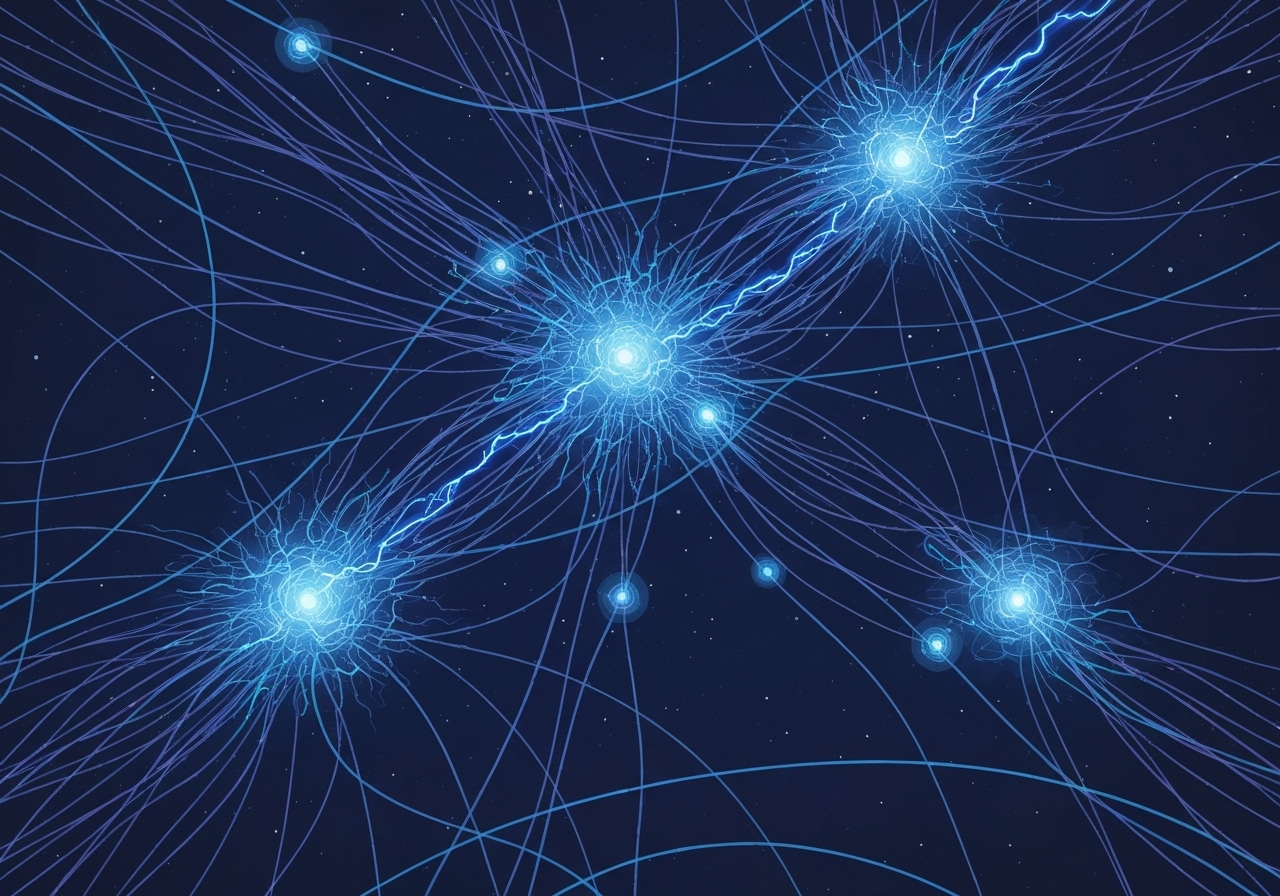
Lead: A new study by researchers at the International School for Advanced Studies (SISSA) published in Physical Review Letters on Aug. 13, 2025, finds that the universe’s earliest magnetic fields were extremely weak—peaking near 2×10⁻¹¹ gauss, a strength comparable to the magnetic activity of human neurons—and traces of those primordial fields may still persist inside the intergalactic “cosmic web.”
Key Takeaways
- Researchers Mak Pavičević and Matteo Viel (SISSA) used roughly 250,000 computer simulations to constrain the strength of primordial magnetic fields.
- The team reports an upper limit of about 0.00000000002 gauss (2×10⁻¹¹ G) for those early fields.
- That intensity is billions of times weaker than a typical refrigerator magnet (~100 G) and similar to magnetism generated by neuronal activity.
- Remnants of such weak fields could have been stretched into the intergalactic cosmic web during the universe’s expansion.
- These results are theoretical limits derived from simulations and comparisons with cosmological observables rather than direct detection.
- Future observations—especially deeper mapping of the cosmic web with facilities like JWST—could refine or challenge the limits.
Verified Facts
The study, led by Mak Pavičević with co-author Matteo Viel at SISSA in Trieste, analyzed observational constraints on large-scale structure alongside a large ensemble of magnetohydrodynamic simulations. By evolving model primordial fields forward and comparing outcomes with known properties of the cosmic web, the team set a conservative upper bound on the initial field strength: about 2×10⁻¹¹ gauss (0.00000000002 G).
The simulation campaign totaled on the order of 250,000 runs, sampling different initial field configurations and cosmological conditions to test how weak primordial magnetism would appear after 13.8 billion years of cosmic expansion and structure formation.
The authors note that while astrophysical objects (stars, black holes, galaxies) generate much stronger magnetic fields locally, extremely faint primordial fields could survive in the low-density filaments and voids of the cosmic web where amplification is limited.
The reported upper limit is framed as a theoretical constraint rather than a direct measurement: no instrument has yet directly detected these primordial fields, so the conclusion depends on the simulation assumptions and the observational priors used.
Context & Impact
The cosmic web is a vast network of tenuous filaments linking galaxies across the universe. Its low-density regions are prime locations to search for faint relics of early-universe processes because local magnetic amplifiers (like galactic dynamos) are weaker there.
If primordial fields were indeed as weak as the new limit, many magnetogenesis models that predict stronger seed fields would be disfavored or would require additional processes to reconcile with the constraint. Conversely, a very weak primordial field leaves more room for astrophysical sources to dominate later magnetic evolution.
Practically, the result guides observational strategies: instruments that probe the intergalactic medium and faint filament emission (radio telescopes, deep optical/IR mapping, and studies of the cosmic microwave background) should prioritize sensitivity to extremely small polarization or Faraday rotation signatures across large sky areas.
Planned and operating observatories—including radio arrays and space telescopes like JWST—could sharpen these bounds by improving maps of the cosmic web and its baryon distribution, which are inputs to future simulation tests.
Official Statements
“Our hypothesis was that early-universe events could leave a magnetic legacy embedded in the cosmic web, and our simulations set strict limits on how intense those fields could have been,”
SISSA researchers Mak Pavičević & Matteo Viel
Unconfirmed
- No direct detection of primordial magnetic fields exists; the study provides a simulation-based upper limit.
- The paper states consistency with some cosmic microwave background (CMB) results, but which specific CMB analyses are compatible is not made explicit in the press briefing.
- How much subsequent astrophysical amplification (from galaxies, jets, or shocks) may have altered primordial signatures in different filament environments remains model-dependent.
Bottom Line
The work offers a tighter theoretical ceiling on the strength of primordial magnetic fields—around 2×10⁻¹¹ gauss—and suggests faint relics could survive inside the cosmic web. These constraints refine our picture of cosmic magnetism and will inform observational campaigns aimed at detecting or further constraining primordial seeds.