
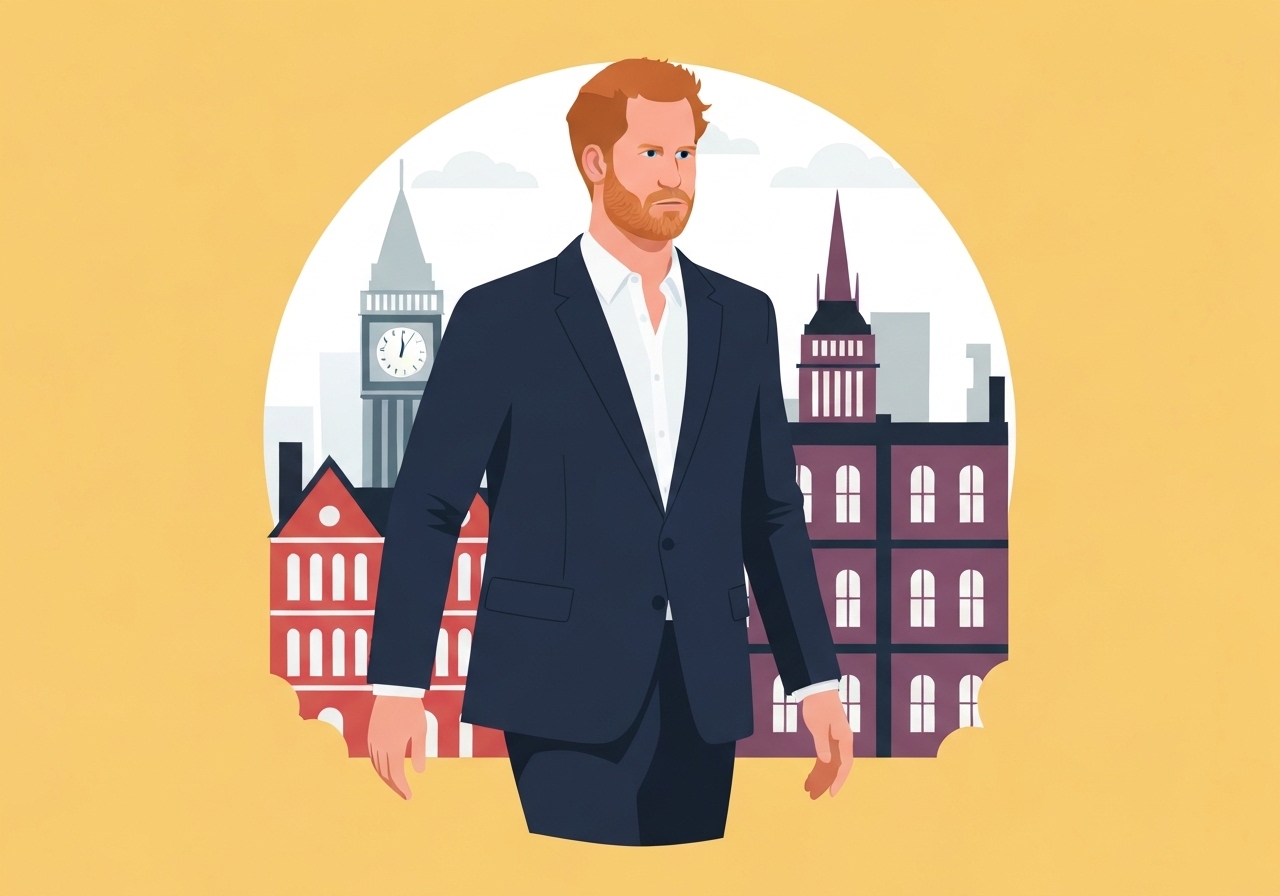
Lead: Prince Harry returned to London on Jan. 19, 2026, to attend the third and final civil trial in a series of lawsuits claiming Britain’s tabloid press engaged in unlawful information gathering. The 41-year-old Duke of Sussex is among high-profile claimants — including Sir Elton John and actresses Elizabeth Hurley and Sadie Frost — who accuse Associated Newspapers (publisher of the Daily Mail and MailOnline) of hiring private investigators to hack phones, bug vehicles and access private records. The publisher denies the allegations and calls them defamatory; the trial is expected to run nine weeks and will determine reputational damage and who pays tens of millions in legal costs.
Key Takeaways
- Prince Harry appeared at the Royal Courts of Justice on Jan. 19, 2026, for a case tied to 14 separate Daily Mail/Mail on Sunday stories.
- Claimants allege unlawful information gathering occurred between 1993 and 2011; Associated Newspapers denies wrongdoing.
- Private investigators’ testimony, including claims one investigator was paid the equivalent of more than $1 million over two decades, is central to the trial.
- The suit follows Harry’s 2019 legal victory against Mirror publishers for phone hacking, where he gave in-person testimony.
- Last year (2025) News Group Newspapers settled with Harry, offering a full apology and a multi‑million dollar payout for intrusion.
- Judge Matthew Nicklin will preside; his eventual ruling could set precedent on media liability and legal costs allocation.
- The case blends personal harm claims — including Harry’s long-held view that intrusive reporting contributed to Princess Diana’s distress — with broader questions about tabloid newsgathering practices.
Background
The lawsuit forms part of a larger post-Hacking Inquiry era in which senior public figures have pursued damages from tabloid publishers for invasive newsgathering. Harry’s claim targets 14 discrete stories published by Associated Newspapers, alleging systematic use of private investigators to obtain information for scoops. Those practices, claimants say, included phone interception, vehicle bugging and accessing private records—techniques the publishers dispute were used or sanctioned.
Legal battles between British celebrities and tabloids have shaped media regulation and public debate since the 2000s, culminating in the Leveson Inquiry and a series of civil suits. Harry’s previous litigation, notably the 2019 case against Mirror Group owners for phone hacking, resulted in rulings favorable to him and heightened scrutiny of tabloid methods. Publishers have sometimes settled to avoid protracted trials, as News Group Newspapers did in 2025 with a formal apology and a multi‑million dollar settlement.
Main Event
On the trial’s opening day, lawyers for Harry argued there was “clear, systematic and sustained use of unlawful information gathering at both the Daily Mail and the Mail on Sunday,” framing the case as more than isolated wrongdoing. The Duke, who lives in California, attended court in person and is expected to provide evidence; his witness statement, seen by CBS News, described feeling monitored and isolated by the alleged intrusions.
Proposed evidence includes testimony from multiple private investigators who say they acted for Associated Newspapers. One named investigator, Steve Whittamore, provided a witness statement characterizing the techniques used as the ‘Dark Arts’ and saying journalists sought information that could not be obtained legitimately. Another witness, identified in court papers as “Detective Danno,” claims to have been paid more than $1 million over 20 years for work for the paper.
Associated Newspapers has rejected the allegations as “preposterous smears” and has sought to undermine the credibility of private-detective testimony. The publisher’s defence will centre on denying authorization or knowledge of unlawful tactics and challenging the reliability of former investigators’ statements. The court will hear detailed accounts of alleged contacts between journalists and investigators and assess documentary and testimonial evidence across the 14 contested stories.
Analysis & Implications
The trial tests whether longstanding newsroom practices cross legal lines when they rely on private investigators. A ruling for Harry could reinforce civil remedies for intrusion and encourage other claimants to pursue trials rather than settlements, potentially increasing legal exposure for large publishers. It would also bolster the position that compensation and reputational remedies are appropriate where systematic intrusion is established.
Conversely, a ruling for Associated Newspapers would be significant for press freedom arguments and the economics of tabloid reporting: publishers defending aggressive newsgathering might face fewer incentives to settle and could press for clearer standards that protect investigative reporting. The outcome will influence how editors sign off on investigative leads and how newsrooms vet sources obtained via intermediaries.
Beyond legal doctrine, the trial carries reputational weight. For Harry, victory would validate long-held concerns about invasive media behaviour and offer personal redress; for the publisher, prevailing would limit commercial and legal fallout. For the wider public, the case could shape expectations about privacy, transparency in newsgathering, and accountability for intermediaries such as private investigators.
Comparison & Data
| Case / Year | Outcome | Notes |
|---|---|---|
| Harry v. Mirror Group / 2019 | Rulings for claimant | Phone‑hacking claims led to favorable judgments and settlements |
| NGN settlement / 2025 | Out‑of‑court settlement | Formal apology and multi‑million dollar payout |
| Associated Newspapers trial / 2026 | Pending (nine weeks) | Addresses 14 stories (1993–2011); judge: Matthew Nicklin |
The table situates this trial among high‑profile precedents. Past outcomes show two paths — court judgments that endorse claimants’ harms, and settlements that resolve disputes without judicial findings. The 2026 trial’s full record will be public and may produce a detailed factual account of alleged methods, unlike many settlements that leave questions unanswered.
Reactions & Quotes
“It was disturbing to feel that my every move, thought or feeling was being tracked and monitored just for the Mail to make money out of it.”
Prince Harry (witness statement)
Harry’s statement, filed to the court, links alleged intrusion to psychological harm and social isolation. Counsel for the claimant emphasized the cumulative effect of multiple episodes across years rather than one-off incidents.
“If the information the journalists requested could have been acquired legitimately … then the newspapers would have had no need to use my particular services.”
Steve Whittamore (private investigator witness)
Whittamore’s statement frames the investigators’ role as a last resort for information that could not be obtained through lawful channels. Associated Newspapers has sought to discredit such testimony and to argue for editorial distance from investigators’ actions.
“If Harry wins this case, it will give him a feeling … that he wasn’t being paranoid all the time. If Harry loses this case, it’s huge jeopardy for him.”
Royah Nikkhah, Royal Editor, The Sunday Times (commentary)
Nikkhah’s comment highlights the high stakes: personal vindication for Harry and substantial financial and reputational consequences for both sides depending on the verdict.
Unconfirmed
- Whether Harry will give live testimony during the trial is reported as expected by some outlets but has not been formally confirmed in open court at the time of reporting.
- Specific technical means alleged in every one of the 14 stories (for example, precise phone‑hacking methods or device‑level bugging) remain matters for evidence and judicial finding, not established fact.
- The exact sums paid to individual investigators beyond the claim of more than $1 million by one witness have not been independently verified in public records.
Bottom Line
The Jan. 19, 2026 opening marks a consequential test of how British courts allocate responsibility for intrusive newsgathering when intermediaries like private investigators are involved. A ruling for claimants could expand civil accountability and encourage more detailed public records of newsroom practices; a ruling for the publisher would restrain the legal risks publishers face for historic newsgathering methods.
Beyond law, the trial is a reputational contest with personal stakes for Prince Harry and institutional stakes for a major media group. Observers should expect detailed witness accounts, sustained legal argument over documentary proof, and a decision from Judge Matthew Nicklin that will be watched by media organisations, privacy advocates and potential future claimants.