
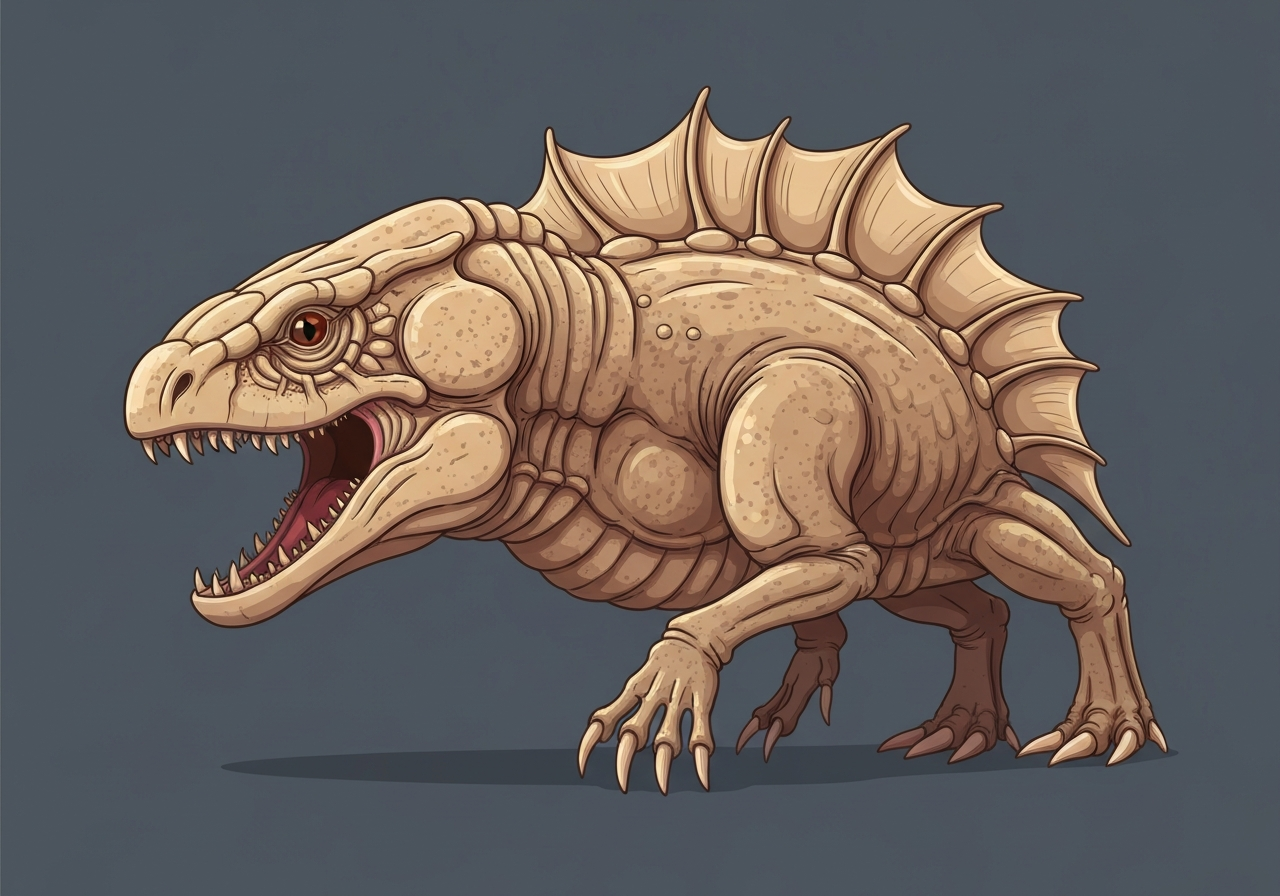
Lead: New chemical and structural analyses of three Prototaxites specimens from the Rhynie chert near Aberdeen suggest this 400‑million‑year‑old, tree‑sized organism cannot be confidently placed among plants, fungi or animals. The study, published last month in Science Advances, finds biomarker signatures and internal anatomy that differ from co‑occurring fungal fossils preserved under the same conditions. Researchers conclude Prototaxites—first described about 160 years ago and known to reach about 9 meters (30 feet)—may represent a distinct, previously unrecognized branch of multicellular life. The team cautions the result is preliminary and limited to a subset of known Prototaxites species.
Key takeaways
- Age and context: Prototaxites fossils date to the early Devonian, roughly 400 million years ago, from the Rhynie chert hot‑spring deposits near Aberdeen, Scotland.
- Size: Specimens can reach up to about 9 meters (30 feet) tall, towering over contemporary plants that were generally under 1 meter.
- Chemical evidence: Biomarker analysis found Prototaxites lacks chitin‑ and glucan‑derived compounds present in nearby fungal fossils preserved under the same conditions.
- Structural differences: Internal, branching spheroidal zones and interwoven tubular tissues differ from known fungal architectures, living or extinct.
- Metabolism inference: Earlier work indicates Prototaxites did not photosynthesize and likely acquired carbon from environmental sources, but metabolic mode remains unresolved for all species.
- Sampling scope: The new chemical study examined three Rhynie chert specimens and represents one species out of some 25 named Prototaxites types; broader sampling is needed.
- Scientific significance: If the findings hold across more specimens, Prototaxites would indicate a major, now‑extinct experiment in complex multicellularity early in terrestrial ecosystems.
Background
The Rhynie chert is an exceptionally preserved early Devonian terrestrial site where hot‑spring silica cemented organisms quickly after death, retaining microscopic anatomy and molecular fossils. Excavations there have produced detailed fossils of some of the earliest land plants, fungi and small animals, making the deposit a key window into ecosystem assembly about 400 million years ago. Prototaxites was first described in the mid‑19th century and for decades was variously identified as a conifer trunk, a giant fungus, or a lichen‑like consortium of fungus and algae.
Over time, interpretations shifted as microscopic study showed the body was composed of interwoven tubes rather than plant‑type blocky cells; later chemical work and size arguments led some researchers to favor fungal affinities. However, fungal groups with complex macroscopic forms known today (for example, many mushroom‑forming lineages) appear much younger in the molecular record, complicating direct comparison. This long history of shifting hypotheses makes Prototaxites a focal point for debates about how multicellular life diversified on land.
Main event
Researchers led by Corentin Loron of the University of Edinburgh reanalyzed three Prototaxites specimens from the Rhynie chert using high‑resolution chemical and microscopic methods reported in Science Advances last month. The team targeted fossilization products—stable molecular remnants that can preserve traces of original biomolecules—and compared Prototaxites signatures with co‑buried fungal remains preserved in the same silica matrix. Because burial and diagenesis were essentially identical, the authors argue chemical contrasts are unlikely to be taphonomic artifacts.
The contrasts were pronounced: fungal fossils from the same horizons contained compounds consistent with degraded chitin and glucan, canonical structural polymers of fungal cell walls, whereas Prototaxites lacked those biomarkers. Microscopy revealed internal dark, spheroidal regions with complex branching networks that the authors interpret as possible conduits for exchange of gas, water or nutrients—architectures not matching known fungal hyphal aggregations. Taken together, the chemical and structural lines of evidence led the authors to conclude Prototaxites cannot be confidently placed within any extant kingdom.
Independent experts praised the analytic rigor but urged caution. Kevin Boyce (Stanford University), who has previously investigated Prototaxites metabolism, noted the organism’s size and apparent heterotrophy align with some fungal lifestyles but emphasized that modern analogues are not directly comparable to a 400‑million‑year‑old organism. Marc‑André Selosse (Natural History Museum, Paris) commended the new analyses yet highlighted that only a fraction of described Prototaxites species were sampled, leaving questions about diversity and function across the genus.
Analysis & implications
If Prototaxites represents a distinct lineage of complex multicellular life, it expands our picture of early terrestrial innovation and indicates multiple, independent experiments in large body plans occurred during the Devonian. Early land ecosystems were still assembling, with plants generally small and soils thin; a giant, nonphotosynthetic column would have occupied a unique ecological role, perhaps as a decomposer, nutrient conduit, or structural element in the landscape.
From a phylogenetic standpoint, the absence of fungal biomarkers in these specimens challenges the practice of assigning deep time megascopic fossils to modern phyla by superficial similarity. Molecular clocks and modern diversity sampling both show many modern multicellular clades postdate the earliest macroscopic fossils, so deep branching, now‑extinct experiments may not map onto living groups. This result underscores the need for combined chemical, microstructural and contextual evidence when placing enigmatic fossils.
Practically, the finding will prompt targeted sampling campaigns across Prototaxites species, stratigraphic horizons and preservation settings to test whether the observed chemical signature is widespread or restricted to particular taxa or taphonomic windows. If corroborated, textbooks will need to accommodate a now‑extinct, major multicellular lineage in reconstructions of Devonian ecology and terrestrialization processes. Conversely, alternative explanations—such as loss or transformation of diagnostic biomarkers under specific conditions—remain plausible until broader data arrive.
Comparison & data
| Feature | Prototaxites (Rhynie specimens) | Co‑occurring fungi (Rhynie) |
|---|---|---|
| Biomarkers (chitin/glucan) | Absent | Present |
| Photosynthetic evidence | Absent | Absent |
| Maximum preserved height | ~9 m (30 ft) | generally <1 m |
| Internal architecture | Interwoven tubes + branching spheroids | Hyphal networks with chitinous walls |
The table summarizes key contrasts used by the authors: chemical biomarkers, lack of photosynthetic signatures, size, and microstructure. Together these metrics form the basis for arguing Prototaxites does not match known fungal fossils from the same deposit. However, single‑site sampling and species coverage remain limitations, so the comparison should be read as provisional rather than definitive.
Reactions & quotes
The new paper has elicited careful interest across paleontology and mycology communities, with experts emphasizing both the novelty and the need for expanded sampling.
“It’s so different from any modern group we have,”
Corentin Loron, University of Edinburgh (co‑lead author)
Loron framed the result as a persuasive but incomplete reclassification effort, noting chemical and anatomical data together produce an unusual signal.
“You can compare it to mushrooms, but mushrooms just aren’t that old,”
Kevin Boyce, Stanford University (independent researcher)
Boyce emphasized evolutionary timing: superficially similar modern groups do not necessarily imply direct ancestry for ancient macroscopic forms.
“The sampling is not encompassing the diversity of Prototaxites species,”
Marc‑André Selosse, Natural History Museum, Paris (independent researcher)
Selosse urged broader taxonomic sampling before declaring a final classification, reflecting a common theme among commentators.
Unconfirmed
- Whether the absent fungal biomarkers reflect genuine biological difference or selective molecular loss under microenvironmental conditions remains unresolved.
- It is unconfirmed how Prototaxites anchored itself or whether its upright posture was permanent during its lifespan.
- The study sampled three specimens from one locality and one named species; whether other Prototaxites species share the same chemistry is not yet shown.
- The metabolic pathways used to obtain carbon (decomposer, parasite, or other) are inferred but not directly demonstrated for all specimens.
Bottom line
The new analyses strengthen the argument that Prototaxites does not comfortably fit within modern plant, fungal or animal categories—at least for the sampled Rhynie specimens—and raise the possibility of an extinct, distinct multicellular lineage in the early Devonian. The combination of absent fungal biomarkers and atypical internal anatomy is a persuasive line of evidence, but it is not yet conclusive across the diversity of Prototaxites.
Definitive resolution will require wider geographic, stratigraphic and taxonomic sampling, replication of chemical results using independent labs and additional contextual data on growth form and ecology. Until then, Prototaxites remains an important, if enigmatic, reminder that Earth’s early terrestrial biosphere experimented with forms and strategies that have no exact modern counterpart.
Sources
- CNN — news report summarizing the new study and expert responses (news media).
- Science Advances — peer‑reviewed journal where the study was published (peer‑reviewed journal).
- University of Edinburgh — institutional affiliation of co‑lead author Corentin Loron (academic institution).
- Stanford University Department of Earth and Planetary Sciences — affiliation of Kevin Boyce, independent commentator (academic institution).
- Natural History Museum, Paris — affiliation of Marc‑André Selosse, independent commentator (museum / research institution).