
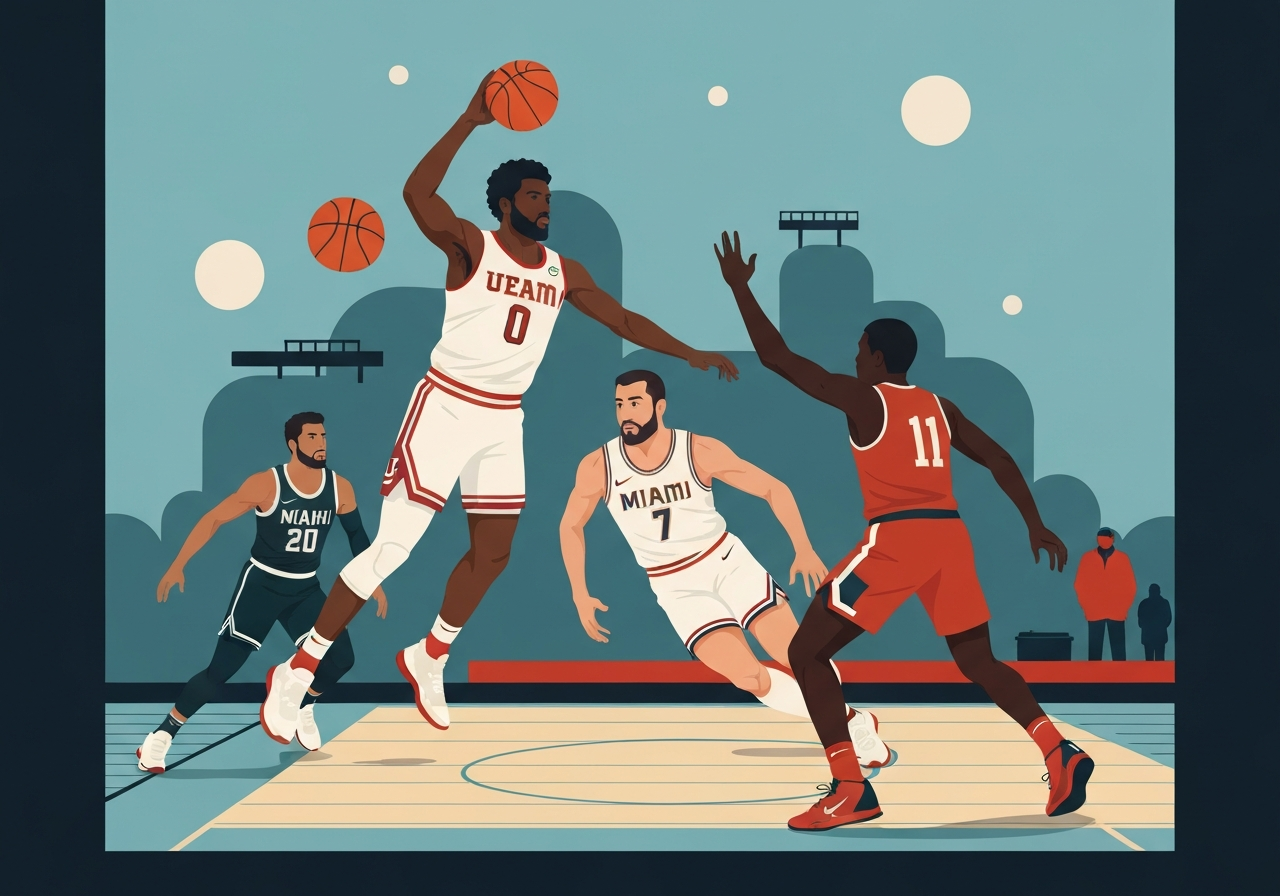
On Sunday, March 22, 2026, at 12:10 p.m. ET in St. Louis, No. Purdue (27-8) meets Miami (26-8) in the NCAA Tournament Round of 32 with a Sweet Sixteen berth at stake. The winner will travel to San Jose to face Texas after the Longhorns eliminated Gonzaga Saturday night. CBS will carry the game with Spero Dedes, Jim Spanarkel and Jon Rothstein on the call; Purdue enters riding a strong postseason run while Miami presents size and interior athleticism that could change the matchup. Key storylines include Purdue’s elevated postseason offense, Oscar Cluff’s breakout impact, and how the Boilermakers will defend Miami’s frontcourt.
- Purdue enters 27-8 (13-7 Big Ten) and has averaged 82.4 points while shooting 51.5% overall and 38.3% from three in the postseason.
- Miami is 26-8 (13-5 ACC) under first-year coach Jai Lucas; four of its ACC losses were decided by three points or fewer.
- Oscar Cluff is averaging 15.6 points and 9.8 rebounds across five postseason games, shooting 63% with eight blocks (four vs. Queens).
- Braden Smith became the NCAA’s career assists leader and scored 26 points in Purdue’s opener against Queens.
- Fletcher Loyer has hit 54-of-112 threes (48.2%) since Feb. 1 across 15 games and is Purdue’s all-time leader in made threes.
- Trey Kaufman-Renn is shooting roughly 68% in the postseason and has posted 20 and 25 points in his last two outings.
- KenPom projects a clear advantage for Purdue (KenPom win% listed as 73%) versus Miami (KenPom win% listed as 27%).
Background
Purdue’s 2025-26 season has featured a late push that carried into the NCAA Tournament. The Boilermakers finished 13-7 in Big Ten play, leaned on veteran leadership, and entered the tournament with top-tier offensive metrics. Braden Smith’s season reached a milestone when he became the NCAA’s all-time assists leader, a development that coincided with more aggressive scoring from veterans in March. Purdue’s postseason offensive surge has been particularly notable: across five tournament games the team is scoring above 82 points and shooting at elite percentages.
Miami, under coach Jai Lucas in his first season, compiled 26 wins and consistently contended in the ACC despite several narrow defeats. The Hurricanes’ identity centers on two physical interior players — Malik Reneau and Ernest Udeh — who combine post scoring, perimeter mobility and rim protection. Miami’s offensive rebounding and transition athleticism put pressure on opponents to box out and finish possessions, traits that complicate matchups for teams that prefer half-court play. The Hurricanes’ resume shows they can both grind close games and capitalize on second-chance opportunities.
Matchup context matters: Purdue typically defends through help-side structure and senior leadership, while Miami’s size forces opponents to choose where to send help. The tournament setting — a neutral site in St. Louis — neutralizes home-court advantages but elevates execution on fundamentals such as turnover minimization, free-throw attempts and rebounding. The Round of 32 winner will have to pivot quickly, as San Jose awaits for the Sweet Sixteen matchup against Texas.
Main Event
The game will hinge on interior battles. Oscar Cluff has been a postseason revelation for Purdue, giving the Boilermakers a combo of finishing and rim protection that offsets Miami’s twin bigs. Containing Ernest Udeh near the rim is essential; Udeh’s shot-blocking and athletic finishes have altered opposing offenses this season. Purdue’s defensive game plan will likely emphasize help-side rotations and avoiding foul trouble for frontline defenders tasked with guarding Reneau and Udeh.
Offensively, Purdue’s spacing and perimeter accuracy — led by Fletcher Loyer and senior guards — create driving lanes and offensive rebounding opportunities for interior scorers. Braden Smith’s playmaking remains central: his ability to both initiate offense and score when needed was on display with a 26-point game in the opener. For Miami, ball-screen actions that free Reneau to face up or slip to the rim, and Udeh finishes on the interior, will be primary scoring vectors.
Rebounding and transition will be decisive. Miami ranks among the better offensive rebounding teams, so Purdue must commit to box-outs and crash the glass with multiple defenders. Conversely, Purdue’s preference to control tempo, take care of the ball and convert in transition off offensive rebounds has been a hallmark of its postseason success. Turnover margin and free-throw efficiency could tip a close game in either direction.
Bench production and matchup adjustments matter in tournament play. Trey Kaufman-Renn’s recent scoring spike gives Purdue a complementary scorer who can relieve ball-handlers and punish soft closeouts. Miami’s rotation depth and the ability of role players like Tre Donaldson to hit tough threes on high volume will test Purdue’s on-ball defense. Coaching adjustments during the game — whether to double the paint, switch screens, or foul strategically — will shape the fourth-quarter script.
Analysis & Implications
Purdue’s offensive efficiency — currently ranked at the top of KenPom’s metrics interchangeably with Illinois at times this season — signals a high floor for scoring, but single-game variance can still produce surprises. If Purdue sustains its postseason shooting splits (51.5% overall, 38.3% 3PT), it projects well against most defenses; the challenge is preventing Miami’s second-chance points, which can erase even efficient offensive nights. Maintaining ball security and limiting live-ball turnovers will be critical to keep Miami out of transition.
Miami’s frontcourt pairing presents a matchup dilemma: help-heavy defense against Reneau opens perimeter shots; staying home risks interior domination. Purdue’s solution will likely mix drop coverage, timely closeouts and situational double-teams rather than leaving a single defender isolated on Reneau or Udeh. How Purdue chooses to rotate from the weak side will influence foul trouble and minutes distribution for its bigs — an acute concern if key defenders pick up early fouls.
On the personnel side, Oscar Cluff’s minutes and production have compressed the Boilermakers’ rotation into a more frontcourt-focused attack, and his efficiency (63% shooting in the postseason) creates a tested inside-out threat. Fletcher Loyer’s hot streak from beyond the arc since Feb. 1 (48.2% on 54-for-112) forces defenses to respect Purdue’s kick-out game; that spacing should open driving lanes for guards. Conversely, Tre Donaldson’s volume shooting for Miami demands disciplined on-ball defense to keep him from establishing rhythm.
Looking beyond this matchup, the winner faces Texas in San Jose, which changes strategic incentives: teams may consider minute management and injury precaution, especially if the game is decided comfortably. For Purdue, an advance would mean testing its offense against elite athleticism in Texas and would continue a seniors-led March run that has so far shown sustainability. For Miami, a win would validate Jai Lucas’s first-year program-building and the Hurricanes’ inside-out approach as NCAA Tournament-ready.
| Team | Postseason PPG | FG% | 3P% | KenPom Win% |
|---|---|---|---|---|
| Purdue | 82.4 | 51.5% | 38.3% | 73% |
| Miami | — | — | — | 27% |
Context: Purdue’s postseason offensive numbers reflect five tournament games; Miami’s game-by-game postseason splits vary with opponent style, but the Hurricanes’ strengths consistently show up in offensive rebounding and interior defense. The KenPom win% figures offer a predictive framework, not determinative outcomes, and individual matchups often swing single-elimination results.
Reactions & Quotes
“We have to take care of the ball and be disciplined on the glass — that’s how we’ll control the pace.”
Paraphrase of Purdue coach comments at pregame media availability
Context: Purdue’s coaching staff emphasized fundamentals in pregame remarks, pointing to turnover avoidance and rebounding as keys to limiting Miami’s transition chances. Those themes reflect the team’s postseason priorities and the matchup challenges posed by Miami’s size.
“Our bigs change the paint; we’ll try to take advantage of any mismatches and crash offensively.”
Paraphrase of Miami coach Jai Lucas (team press notes)
Context: Miami framed the game around its frontcourt strengths and offensive rebounding. Coach Lucas highlighted the plan to leverage interior size while still creating perimeter opportunities for shooters like Tre Donaldson.
Unconfirmed
- Any late-game rotation changes for Purdue’s frontcourt are not officially confirmed and will depend on foul trouble and matchup choices during the game.
- Minor injury statuses for role players on either roster were not released publicly before tip; final availability could affect small-ball lineups.
- Specific scouting adjustments Miami will make to counter Fletcher Loyer’s recent hot shooting were not detailed in available pregame materials.
Bottom Line
This matchup pitches Purdue’s high-octane, senior-led offense and emerging postseason frontcourt (Oscar Cluff) against Miami’s size, interior defense and offensive-rebounding profile. If Purdue sustains its efficient shooting and limits second-chance points, it projects as the stronger team to reach the Sweet Sixteen; however, Miami’s ability to control the paint and force contested outside shots introduces a clear path to an upset. Execution in help defense, rebounding discipline and turnover management will ultimately determine which team advances to San Jose to face Texas.
Expect a physical, half-court chess match interspersed with transition bursts — the side that makes the fewest mistakes and wins the rebound battle should prevail. Tip-off is at 12:10 p.m. ET on CBS; the victor moves on with a quick turnaround and a high-stakes date with the Longhorns next week.
Sources