
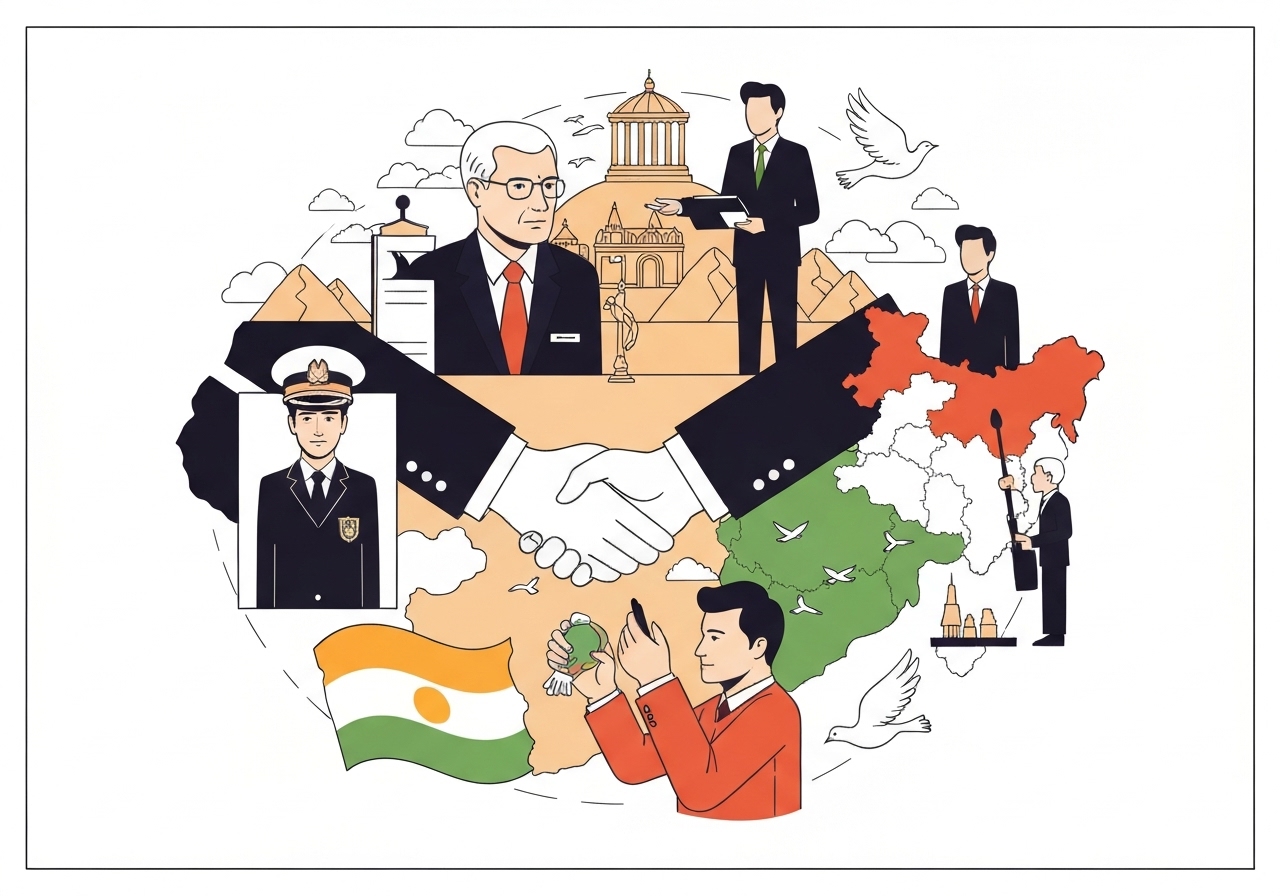
Russian President Vladimir Putin landed in New Delhi on Thursday for a compressed, roughly 30-hour visit — his first trip to India since Moscow launched a full-scale invasion of Ukraine nearly four years ago. The visit, set against an intermittent US-led push for a negotiated end to the war, comes amid heightened US–India tensions over New Delhi’s rising purchases of Russian crude and resulting US punitive measures. Indian leaders say the talks aim to preserve a long-standing strategic partnership while exploring trade, defence and energy cooperation. Officials in both capitals will be watching for visible signs of whether New Delhi can maintain its balancing act between Washington and Moscow without conceding core commercial or security interests.
Key Takeaways
- Putin’s visit is a 30-hour trip beginning Thursday, with state-level events including a reception at Rashtrapati Bhavan and a summit at Hyderabad House on Friday, December 5, 2025.
- India and Russia mark 25 years of their strategic partnership; the annual summit rhythm resumed in 2024 after being disrupted by the 2022 invasion of Ukraine.
- Energy ties surged after 2022: Russian crude imports to India rose by about 2,250%, lifting Russia’s share from ~1% to ~40% of India’s crude mix at the peak.
- Bilateral trade ballooned from roughly $10 billion pre-2022 to nearly $69 billion in 2025, creating a near $64 billion deficit driven largely by oil purchases.
- Defence cooperation remains strong: Russia supplies roughly 36% of India’s new arms imports and accounts for over 60% of existing systems, including S-400 air-defence batteries used in May’s India–Pakistan air clashes.
- Washington has responded with tariffs and sanctions pressure — US tariffs on Indian goods were raised from 25% to 50%, and October sanctions targeted Rosneft and Lukoil.
- Economic signals are shifting: Reliance has announced it will stop exporting products made from Russian crude and Indian imports of Russian oil are expected to fall toward a three-year low.
- Both governments are discussing broader trade, defence hardware (S-400, Su-57), pharmaceuticals, machinery and labour migration as a stabilising avenue for ties.
Background
India and Russia trace a formal strategic partnership back more than two decades; the relationship deepened during Vladimir Putin’s early years in the Kremlin and has traditionally been maintained through an annual summit routine. That summit cadence was interrupted by Russia’s February 2022 full-scale invasion of Ukraine. Planned high-level exchanges were postponed that year and again complicated in 2023 by geopolitical discomfort among Western peers during multilateral meetings.
Historically non-aligned since independence in 1947, India has avoided binding alliances with great powers while cultivating pragmatic ties with both Moscow and Washington. Since the end of the Cold War New Delhi has expanded defence and strategic cooperation with the United States even as it preserved close military and energy links to Russia. The Ukraine war has tested that approach: economic and defence bargains with Moscow now collide with intensified US pressure aimed at isolating Russia and constraining revenue flows that sustain its war effort.
Main Event
Putin is expected to arrive Thursday evening and attend a private dinner hosted by Prime Minister Narendra Modi at the prime minister’s official residence. On Friday morning, December 5, the president will follow the usual state-visit protocol with a guard of honour at Rashtrapati Bhavan, a visit to Raj Ghat, and a bilateral summit at Hyderabad House where leaders will review a broad agenda from defence sales to trade and energy cooperation.
The Kremlin framed the visit as an opportunity to “comprehensively discuss” a wide-ranging partnership, and Putin will be accompanied by senior ministers and a business delegation reportedly including figures from state arms exporter Rosoboronexport and sanctioned oil companies. Russian and Indian officials are expected to sign or review memoranda on defence supplies, energy collaboration and industrial cooperation.
Defence sales are likely to dominate substantive talks. Moscow is expected to press New Delhi to acquire additional S-400 surface-to-air missile systems and to consider deliveries of Su-57 fifth-generation fighters. India’s defence leadership has publicly praised the S-400’s performance after its use in May’s limited air conflict with Pakistan, while Russia’s delegation has openly touted its advanced platforms as central to the bilateral military relationship.
Energy will also be front and centre. Indian purchases of discounted Russian crude since 2022 transformed bilateral trade but drew Washington’s ire, prompting tariffs and sanctions which in turn have altered commercial flows — including a decision by India’s largest refiner, Reliance, to halt exports of products made from Russian crude.
Analysis & Implications
Short term, the summit offers political optics for both sides. For Moscow, a high-profile visit to New Delhi signals international engagement and counters narratives of isolation. For New Delhi, hosting Putin allows India to assert strategic autonomy and to demonstrate it can pursue relationships independently of Western pressure, even if that autonomy now carries higher economic and diplomatic costs.
Economically, the post-2022 spike in Russian oil imports produced a lopsided trade ledger: almost $69 billion in bilateral trade in 2025 versus about $10 billion before 2022, with India’s exports roughly $5 billion — creating a large deficit. That imbalance makes India vulnerable to external leverage; US tariffs and sanctions risk dampening the advantages India gained from discounted crude while complicating its industrial and export plans.
In defence, Russia remains deeply embedded in India’s inventory and industrial base. Even as New Delhi seeks to diversify suppliers and grow domestic production, legacy platforms, maintenance networks and technology links mean Russian equipment will likely dominate capabilities for years. A deal for more S-400 batteries or Su-57 aircraft would reinforce strategic interoperability with Russia but could heighten US pressure and complicate procurement choices with Washington and European partners.
Geostrategically, the visit tests India’s tightrope strategy. New Delhi aims to keep robust ties with Washington — vital for technology, investment and strategic cooperation — while not severing its traditional Russia partnership. The outcome of these talks will influence India’s leverage across multiple theatres: Indo-Pacific balancing, energy security, defence preparedness and diplomatic reach in multilateral fora.
Comparison & Data
| Year | Bilateral Trade (approx.) | Russia share in India crude imports |
|---|---|---|
| Pre-2022 | $10 billion | ~1% |
| 2025 | ~$69 billion | ~40% (peak) |
These headline numbers highlight how energy reshaped the partnership. The rapid rise in oil imports created a large trade deficit and a dependency that Washington has sought to exploit with tariffs and sanctions. With Indian crude purchases now expected to fall and Reliance limiting exports tied to Russian oil, overall trade may decline from 2025 levels unless new, non-energy corridors expand rapidly.
Reactions & Quotes
Indian and international commentators framed the summit in political and symbolic terms, noting both the diplomatic opportunity and the external pressures shaping it.
“The summit allows both sides to reaffirm a privileged strategic partnership despite intense external pressure on India,”
Praveen Donthi, Crisis Group (analyst)
Donthi emphasised that the bilateral meeting is as much about optics as substance: Moscow seeks international visibility while New Delhi pursues pragmatic gains without alienating other partners.
“Russia is being welcomed by a democracy when Putin faces pressure for the war in Ukraine,”
Rajan Kumar, Jawaharlal Nehru University (international studies professor)
Kumar’s remark underlines how the visit offers political cover for Moscow; he also warned that material agreements will be constrained by broader sanctions dynamics and India’s own commercial calculations.
“The SU-57 is the best plane in the world,”
Dmitry Peskov, Kremlin press secretary
Peskov’s comment signals Moscow’s intent to prioritise advanced defence sales. Indian leaders will weigh such offers against interoperability, maintenance, cost and diplomatic fallout with Western partners.
Unconfirmed
- Reports that the heads of sanctioned oil firms Rosneft and Gazprom Neft will join Putin’s delegation remain unconfirmed and were described as “reported” rather than officially announced.
- Precise export or procurement contracts for Su-57 fighters or additional S-400 batteries have been discussed publicly but no definitive, signed deals were confirmed at the time of reporting.
- Forecasts that Indian imports of Russian crude will fall to a three-year low are projections from market reports and company statements, and actual volumes may shift with market prices and policy moves.
Bottom Line
Putin’s quick visit to India is both a diplomatic signal and a deal-seeking mission: Moscow hopes to shore up defence and commercial ties while New Delhi seeks to preserve autonomy in the face of punitive measures from Washington. The summit may produce declarations and memoranda, but significant commercial rebalancing is constrained by sanctions, tariff pressures and recent corporate decisions by major Indian refiners.
For observers, the crucial outcome will not only be headline contracts but the political calculus New Delhi displays: whether it can secure defence and energy assurances without triggering further economic penalties or strategic friction with the United States. The long-term trajectory of India–Russia relations will depend on how quickly New Delhi diversifies energy sources, deepens ties with other defence vendors and manages an increasingly complicated set of international pressures.
Sources
- Al Jazeera (international news media)