
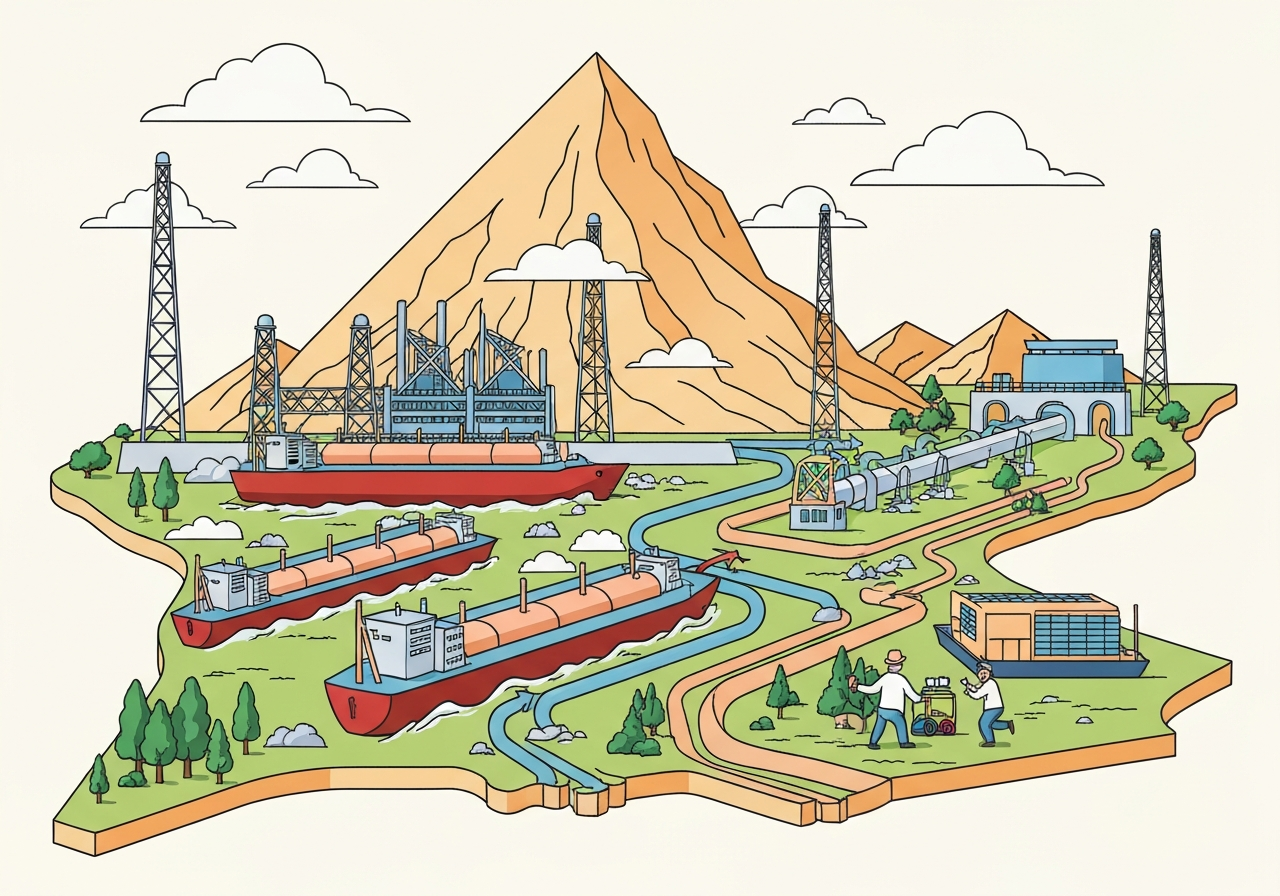
Lead: The recent conflict in the Middle East and a drone strike at Qatar’s Ras Laffan complex have forced QatarEnergy to stop LNG flows and issue force majeure notices to buyers, upending forecasts that predicted a near-term global LNG glut. Morgan Stanley analysts told Bloomberg that if Qatar’s outage stretches beyond one month the market would swing from surplus to deficit. The disruption coincided with tanker traffic through the Strait of Hormuz being effectively curtailed, sending oil toward $100 per barrel and pushing Asian and European gas prices sharply higher.
Key Takeaways
- Morgan Stanley warned that a Qatar outage lasting more than one month would “quickly bring a deficit” to the global LNG market, reversing prior surplus projections.
- QatarEnergy halted production at Ras Laffan and issued force majeure notices after a drone attack and constrained tanker movements through the Strait of Hormuz.
- Oil reached about $100 per barrel on Monday; Qatar’s energy minister warned oil could spike toward $150 per barrel within 2–3 weeks if the Strait remains closed to tankers.
- European benchmark natural gas jumped roughly 50% the previous week and climbed a further ~20% as Amsterdam trade opened, reflecting intense competition for flexible LNG cargoes.
- Asia is drawing most of the flexible‑destination LNG cargoes, exacerbating tightness in Europe and amplifying price volatility across regional gas markets.
- Even if hostilities stop immediately, Qatar’s minister said restoration to normal export schedules could take “weeks to months,” delaying any rapid market rebalancing.
Background
The global LNG market entered 2024 with many forecasters, including major investment banks, anticipating a wave of incremental supply that would outpace demand and create a temporary surplus. Large projects — notably Qatar’s ongoing expansions around the Ras Laffan hub, the world’s largest LNG complex — were central to those expectations. That baseline assumed steady export operations and unrestricted tanker routes through chokepoints such as the Strait of Hormuz.
Those assumptions broke down after a drone attack on the Ras Laffan facilities and a near‑halt of tanker traffic through the Strait, prompting QatarEnergy to suspend production and notify customers under force majeure. The scale of Qatar’s exports — second only to the United States — means outages there have outsized effects on short‑term global flows and price formation. Market models that priced in abundant 2024 cargo availability now face sudden revision.
Main Event
Last week QatarEnergy stopped LNG output at Ras Laffan, the LNG complex that accounts for a large share of the country’s export capacity. The company followed the shutdown with force majeure notices to buyers after a drone strike hit the site and maritime constraints reduced tanker transits through the Strait of Hormuz. Buyers and traders reported canceled or deferred liftings as contract positions were adjusted to the new risk environment.
Morgan Stanley analysts — as reported by Bloomberg — assessed that a prolonged outage beyond one month would flip the market into a deficit quickly, as forecast supply fails to materialize while seasonal and structural demand remains. Traders reacted within hours and days, repricing cargoes and swaps across Asia and Europe, where delivery windows tightened and competition for flexible cargoes intensified.
Physical markets saw immediate repercussions: oil prices climbed toward $100 per barrel and benchmark European gas returned double‑digit percentage gains after a steep weekly rise. Market participants highlighted that Asia, with its high willingness to pay and flexible receiving facilities, was absorbing many cargoes that might otherwise have gone to Europe, further tightening European inventories heading into the shoulder season.
Analysis & Implications
The immediate implication is that short‑term supply elasticity for LNG is limited. Cargo production and shipping cannot be restored on a dime; liquefaction trains require careful recommissioning and shipping lanes need to be secure and insured. Morgan Stanley’s assessment that a one‑month outage could create a deficit underscores how thin near‑term slack is in the system despite earlier project ramps that had been expected to create surplus tonnage.
Energy security concerns are now front and center for buyers and policymakers. Europe, which has been working to rebuild gas buffers since 2022, faces renewed pressure to secure alternative supplies and to stretch inventories through demand response measures. Meanwhile, Asian buyers that can pay premiums and redirect flexible cargoes will continue to outbid others, sustaining regional price divergence and fueling arbitrage flows.
For oil markets, the potential closure or effective closure of the Strait of Hormuz is an immediate shock scenario. Qatar’s energy minister warned that if tankers cannot transit the chokepoint, prices could surge materially within weeks. Such a supply shock in seaborne crude would propagate through refined fuels and could accelerate inflationary pressures tied to energy costs globally.
Comparison & Data
| Metric | Recent Reading / Change |
|---|---|
| Brent crude (approx.) | ~$100 per barrel (Monday close) |
| Potential oil spike (if Hormuz closed) | Up to $150 per barrel (2–3 weeks projection) |
| European benchmark gas | +50% week‑over‑week; +20% on Amsterdam open (following week) |
These values reflect market moves and analyst scenarios reported in the immediate aftermath of the supply interruption; they are volatile and subject to rapid revision as more production and shipping information becomes available. The table is intended to show directional impact rather than precise intraday levels.
Reactions & Quotes
Market commentary has been brisk, with analysts and officials emphasizing both the immediate supply shortfall risk and the uncertainty over restoration timelines.
“If the outage extends beyond one month, this quickly brings a deficit to the market.”
Morgan Stanley analysts (note reported by Bloomberg)
This line from Morgan Stanley encapsulates why traders revised expectations swiftly: projected surplus tonnage now sits idle, and the lead time to bring it back is non‑trivial.
“Even if the war were to end today, weeks to months would be needed to return to a normal schedule and cycle of energy deliveries.”
Saad al‑Kaabi, Qatar Energy Minister (Financial Times)
Al‑Kaabi’s assessment signals that technical and logistical constraints — not just political ones — will shape timing for supply normalization. Market actors are treating his timeline as a base case for planning and hedging decisions.
Unconfirmed
- Whether the Ras Laffan outage will exceed one month remains unconfirmed; official timelines from QatarEnergy are still evolving.
- The $150 per barrel oil scenario is a projection contingent on sustained Strait of Hormuz closure and is not a guaranteed outcome.
- The precise volume of LNG cargoes diverted from Europe to Asia in the most recent trading window has not been publicly released in a single consolidated figure.
Bottom Line
The conflict in the Middle East and the related operational disruptions at Qatar’s Ras Laffan plant have materially altered near‑term LNG balance expectations. What had been modeled as a probable surplus this year is now at risk of becoming a deficit within weeks if outages persist beyond a month.
Energy markets will remain sensitive to developments at the facility and to maritime security in the Strait of Hormuz. Policymakers and buyers should plan for heightened price volatility, accelerated competition for flexible cargoes, and the possibility that recovery of normal flows could take weeks to months even after hostilities subside.
Sources
- OilPrice.com — news report summarizing market and analyst commentary (news media)
- Bloomberg — reported Morgan Stanley note on LNG outlook (news media)
- Financial Times — interview with Qatar Energy Minister Saad al‑Kaabi (news media)
- QatarEnergy — official corporate site and press resources (official announcement repository)