
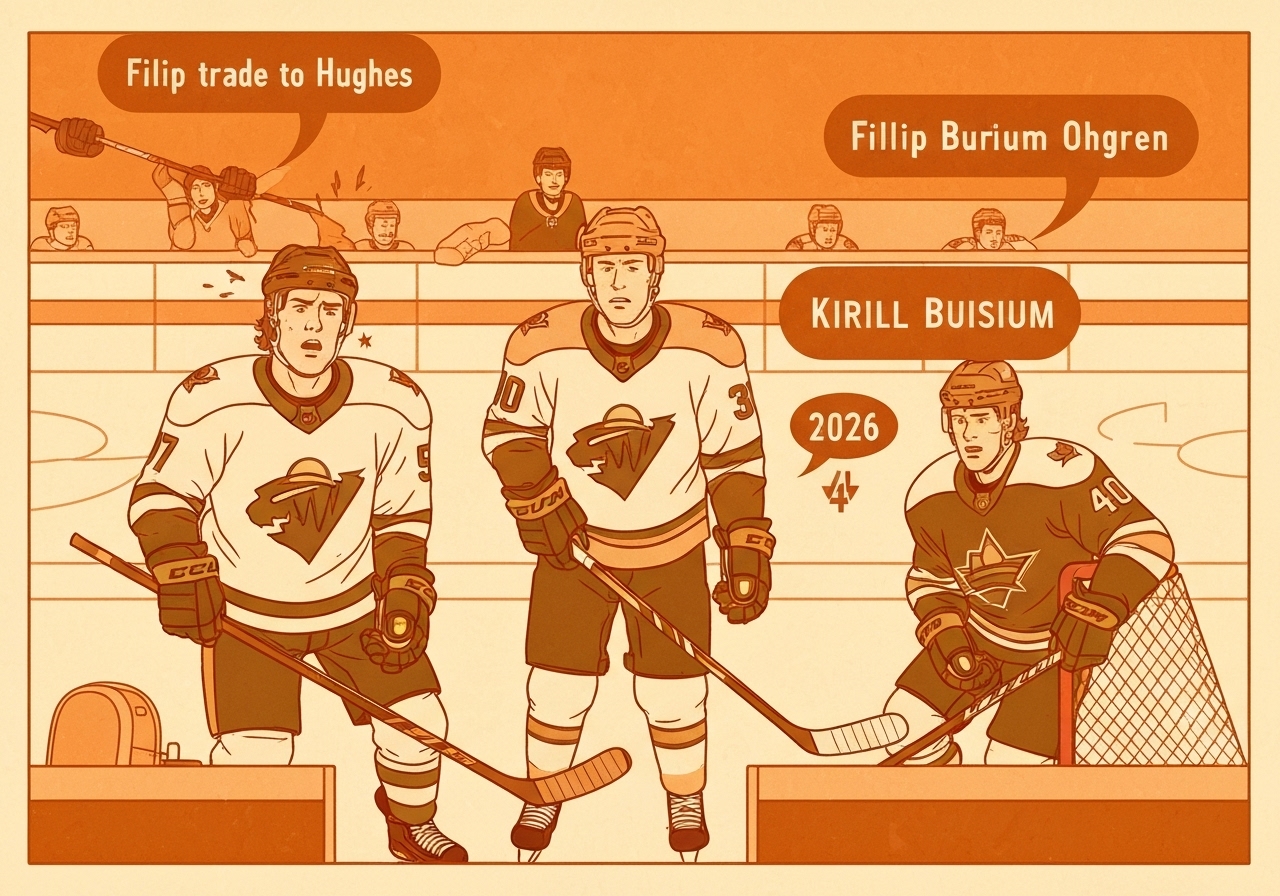
On December 13, 2025, the Vancouver Canucks traded captain and 2023-24 Norris Trophy winner Quinn Hughes to the Minnesota Wild. Vancouver received forwards Marco Rossi and Liam Ohgren, defenseman Zeev Buium and a first-round pick in the 2026 NHL Draft. The move, announced by both clubs on Friday, follows months of speculation about Hughes’ future as he approaches the final seasons of his contract. The deal alters each club’s immediate roster picture while shifting longer-term cap and development calculations.
Key Takeaways
- Trade terms: Vancouver sent Quinn Hughes to Minnesota for Marco Rossi, Liam Ohgren, Zeev Buium and a 2026 first-round pick announced Dec. 13, 2025.
- Hughes’ résumé: The 26-year-old defenseman and Canucks captain won the 2023-24 Norris Trophy after a 92-point season and has 432 points (61 goals, 371 assists) in 459 career games for Vancouver.
- Contract context: Hughes is in year five of a six-year, $47.1 million deal signed Oct. 3, 2021 ($7.85M AAV) and can reach unrestricted free agency after 2026-27.
- Return package: Rossi (24) has 114 points (49 goals, 65 assists) in 202 NHL games for Minnesota and signed a three-year, $15 million deal Aug. 22, 2025; Buium (20) has 14 points in 31 games this season and signed a three-year entry-level contract Apr. 13, 2025.
- Team records: At the time of the trade Vancouver was 11-17-3 (eighth in the Pacific), while Minnesota sat 17-9-5 (third in the Central).
- Playoff and international notes: Hughes had 26 points in 30 career playoff games and was among the first six players named to the U.S. roster for Milano Cortina 2026.
Background
Quinn Hughes emerged as Vancouver’s defensive cornerstone after being drafted No. 7 in 2018. He set franchise marks for defenseman scoring and became team captain, culminating in a 2023-24 season that earned him the Norris Trophy and a 92-point career high. The Canucks returned to the Western Conference Second Round that season but slipped to a 38-30-14 record in 2024-25, missing the playoffs by six points.
Vancouver’s slide and roster turnover — including the Jan. 31, 2025 trade of J.T. Miller and the departure of coach Rick Tocchet — intensified questions about the club’s direction. Management has publicly framed the club’s work as a measured rebuild; Jim Rutherford and GM Patrik Allvin said in team statements that acquiring younger, controllable assets was the goal during trade discussions that gained momentum over the past year.
Main Event
The trade was finalized and announced Dec. 13, 2025, with Minnesota receiving Hughes and Vancouver getting three players plus a future first-round pick. Minnesota adds a top-pair, right-shot offensive defender who led the Canucks with 23 points (two goals, 21 assists) in 26 games this season at the time of the deal. Vancouver emphasized the combination of NHL-ready players and a draft asset as the rationale.
Rossi arrives as Minnesota’s established forward prospect who has already produced 114 points in 202 NHL games; he signed a three-year contract on Aug. 22, 2025. Buium, a 2024 first-round pick, broke into the NHL during last year’s playoffs after two strong seasons at the University of Denver, and the Canucks’ staff highlighted his power-play potential. Ohgren, a 2022 first-rounder, offers depth and youth on a longer-term entry-level structure.
The timing reflects both clubs’ priorities: Vancouver seeks assets for a reset that Rutherford described as keeping the rebuild constructive and on a shorter timetable, while Minnesota strengthened its blueline immediately as it contends in the Central Division. The Wild, which had rallied to a 14-3-2 run over 19 games after a slow start, added an elite puck-moving defenseman to accelerate their current push.
Analysis & Implications
On-ice impact: Hughes’ departure removes a premier transition and power-play driver from Vancouver’s top defensive pair. His 92-point peak and consistent assist numbers made him the focal point of the Canucks’ breakout offensive structure in 2023-24. Minnesota gains a player capable of quarterbacking an elite power play and driving tempo, which could increase expected goals and scoring chances for the Wild.
Cap and contract calculus: Vancouver traded an established, high-AAV asset with two seasons remaining on a contract that will require a significant commitment if extended. In return, Rossi carries a $5.0M AAV through 2027-28 and Buium and Ohgren are on more team-friendly deals, giving Vancouver short-term cap flexibility and longer-term controllable pieces.
Development pathways: Buium’s profile — young, offensive-minded defenseman with NCAA and brief NHL playoff experience — fits a timeline where defensemen typically require more seasoning. Vancouver’s coaching and development staff will be tasked with refining his positioning and decision-making, while Rossi is expected to step directly into a top-6 role if recovered from typical young-player variability.
Broader league effect: The trade signals how contending clubs are willing to pay premium assets for defensemen who can influence possession and transition. For rebuilding teams, it shows an evolving market where multiple younger roster pieces plus a future pick can replace a single elite incumbent while maintaining a chance at competitive turnaround in a shorter window.
Comparison & Data
| Player | GP (career) | Points (career) | Notable 2023-25 seasons |
|---|---|---|---|
| Quinn Hughes | 459 | 432 (61 G, 371 A) | 92 pts (2023-24, Norris winner) |
| Marco Rossi | 202 | 114 (49 G, 65 A) | 13 pts this season (as of trade) |
| Zeev Buium | — | 14 pts this season (31 GP) | NCAA champion 2024; NHL debut in 2024 playoffs |
The table highlights the scale of production Vancouver exchanged for aggregate youth and a draft asset. Hughes’ career totals and peak season stand out clearly, but the combined upside of Rossi’s forward scoring and Buium’s projected defensive play offers a diverse return that may equate to long-term value if development follows projection.
Reactions & Quotes
“It’s difficult trading a player like Quinn. We love him as a person and as a player, one of the greatest players that’s ever played for the Canucks.”
Jim Rutherford, Vancouver president of hockey operations
Rutherford framed the move as part of a directional rebuild while acknowledging Hughes’ stature within the organization.
“It’s definitely not an easy day for the franchise. Quinn Hughes has been a big part of the organization and a great person and a great hockey player.”
Patrik Allvin, Vancouver general manager
Allvin emphasized the Canucks’ belief in the incoming prospects and the need to continue building with younger assets.
Unconfirmed
- Whether Minnesota plans to negotiate a long-term contract extension for Hughes immediately is not yet confirmed; the Wild have not released a timeline.
- The exact projected lottery range for the 2026 first-round pick (conditioned or unconditioned) was not specified in public releases and remains unclear.
- Any internal role projection for Rossi, Buium or Ohgren within Vancouver’s top-six or special-teams units is subject to coaching decisions and has not been finalized.
Bottom Line
The trade transfers an elite, award-winning defenseman from a rebuilding Vancouver roster into a Wild team positioned to compete now, while Vancouver collects a package of young, controllable players and a future first-round pick. For Minnesota, Hughes provides immediate upgrade-level talent on the back end and a power-play catalyst; for Vancouver, the return prioritizes flexibility and potential upside over a single established star.
How the deal ages will hinge on three variables: Hughes’ short-term fit and production in Minnesota, Rossi and Buium’s development trajectories in Vancouver, and the eventual value of the 2026 first-round pick. Fans and analysts should expect both teams to see measurable effects this season and to continue evaluating the trade across the next two-to-four years.
Sources
- NHL.com (media report)
- Vancouver Canucks (team site / official statements)
- Minnesota Wild (team site / official statements)