
Lead
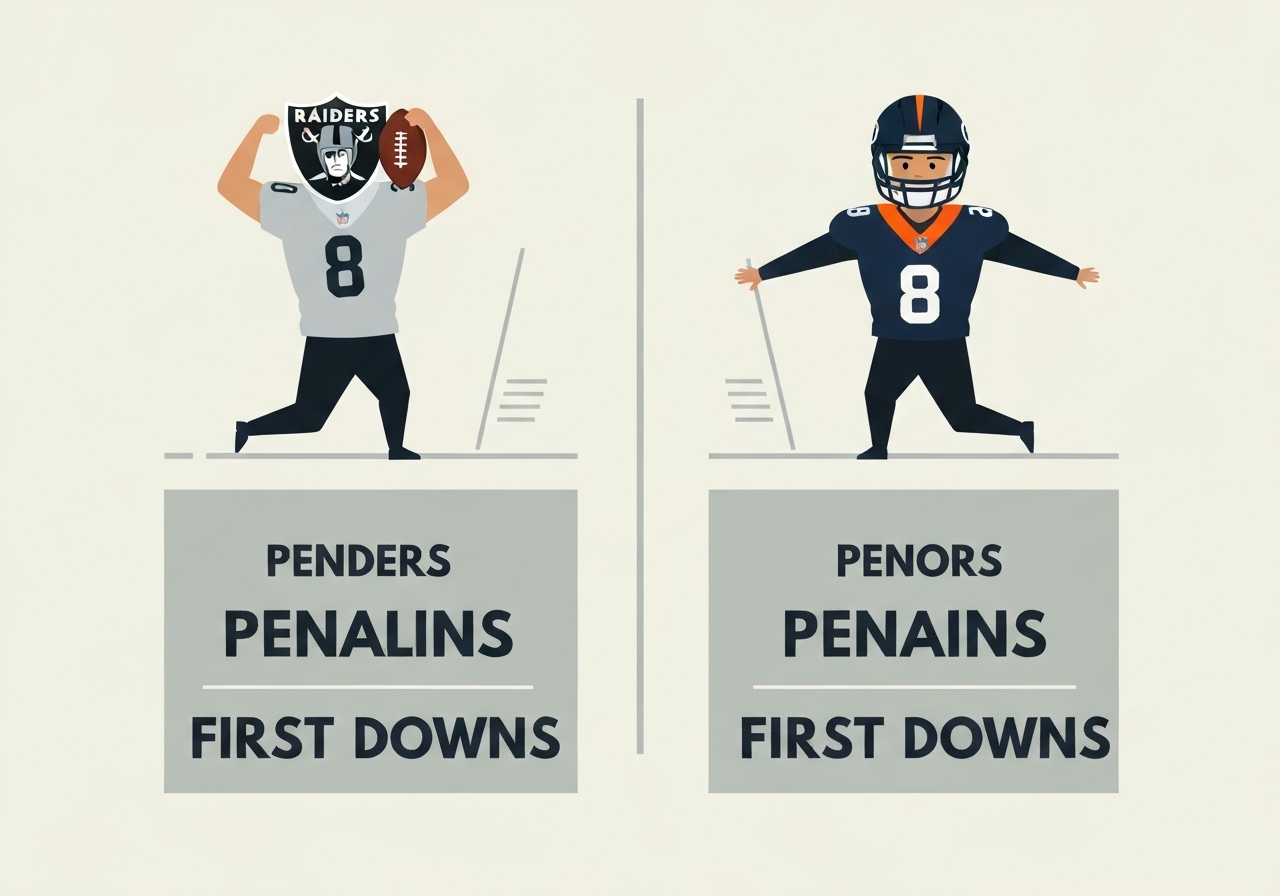
In the Week 10 Thursday-night opener, the Las Vegas Raiders and Denver Broncos produced an unusual box score: each team recorded 11 penalties and just 10 first downs. The game, played on Thursday night, finished 10-7 in favor of Denver. According to NextGenStats analyst Bill Smith, this marks only the second time such an outcome has been recorded since 1950. The result moves the Broncos to 8-2 and drops the Raiders to 2-7.
Key Takeaways
- Both teams committed 11 penalties apiece in the Week 10 opener; each team also had 10 first downs.
- Denver won the low-scoring contest, 10-7, improving its record to 8-2.
- The loss leaves Las Vegas with a 2-7 mark through ten games.
- NextGenStats notes this is only the second recorded instance of teams having more penalties than first downs since 1950.
- The only other known occurrence was the 1976 matchup between the Tampa Bay Buccaneers and the Seattle Seahawks, both expansion franchises that season.
- Both teams also logged more penalties than points scored in the game.
Background
Penalty volume and offensive production are core measures of game flow in the NFL: penalties disrupt drives and can swing momentum, while first downs indicate sustained offense. Over the decades since 1950, it has been rare for both teams in a single game to commit more penalties than they achieve first downs; NextGenStats flagged the Thursday Night result as the second such case. The 1976 Buccaneers-Seahawks matchup is the only prior instance recorded in the modern statistical era, a noteworthy historical footnote because both clubs were expansion teams that year and struggled on offense.
League trends in recent seasons have shown fluctuations in foul calls and enforcement emphasis from game to game, influenced by rule changes, officiating emphasis, and team discipline. Teams that rely on aggressive defensive play or lack offensive rhythm are likelier to accumulate penalties and stall drives. For playoff implications, accumulation of such anomalies within a season can reveal coaching and execution problems that carry beyond one result.
Main Event
The Thursday night matchup featured tidy uniforms but a disorderly game, with both squads hampered by penalties that repeatedly erased positive yardage or extended opponent drives. Built-in parity in scoring produced a defensive, field-position-oriented contest where special teams and turnovers would have mattered, yet the final scoreboard read just 10-7. Denver’s offense managed enough to reach double-digit points while limiting the Raiders to a single scoring drive.
Statistically, each team finishing with 11 penalties and 10 first downs is notable because penalties typically number lower than first downs for teams that sustain drives. The Broncos converted opportunities when they presented themselves, and their defense held firm late. Las Vegas could not convert yardage into consistent first downs and was penalized at critical moments, which compounded short-field situations for Denver.
When the final whistle blew, the Broncos improved to 8-2, strengthening their standing in the division and playoff picture. The Raiders, now 2-7, face a steeper climb and will need to address both discipline and offensive consistency in coming weeks. Coaches and coordinators on both sidelines will review tape to identify which penalties were avoidable and which reflected officiating interpretation.
Analysis & Implications
From a coaching standpoint, a game in which penalties outnumber first downs suggests breakdowns in execution and discipline. For the Raiders, the 2-7 ledger means such games cannot be frequent if the team hopes to climb back into playoff contention; avoiding pre-snap and procedural penalties is a low-hanging target for improvement. For Denver, an 8-2 mark indicates that even when offensive production is limited, complementary defense and special teams can sustain a winning season.
League officials and analysts will likely note the rarity of the stat combination and consider whether it reflects a temporary officiating tilt, a matchup-specific stylistic clash, or symptomatic problems for the teams involved. If penalties continue to be a deciding factor in multiple games, coaches may adjust practice emphasis to reduce hand-fighting, illegal contact and delay infractions that kill drives.
Financial and personnel implications matter as well: teams that repeatedly lose close, low-scoring games risk roster changes, while playoff-caliber teams that win such contests maintain momentum and coaching stability. For bettors and analytic models, an outlier like this affects short-term predictive accuracy but is unlikely to alter long-term franchise trajectories unless it recurs.
Comparison & Data
| Team / Game | Penalties | First Downs | Points | Postgame Record |
|---|---|---|---|---|
| Denver Broncos (Week 10) | 11 | 10 | 10 | 8-2 |
| Las Vegas Raiders (Week 10) | 11 | 10 | 7 | 2-7 |
| Buccaneers vs Seahawks (1976) | Noted as the only other instance since 1950 where penalties exceeded first downs for both teams | |||
The table highlights the core numeric oddity: equal penalty counts (11) and identical first-down totals (10) for both teams in the Week 10 game. The 1976 reference is included to underscore rarity; contemporary play-by-play and penalty-tracking systems are far more granular now than in 1976, which complicates direct statistical comparisons but does not change the anomaly’s significance.
Reactions & Quotes
Observers pointed to the statistical rarity and the effect of penalties on the contest outcome.
“Only the second time since 1950 that both teams recorded more penalties than first downs in the same game.”
Bill Smith / NextGenStats (analytics)
Game records and the final score underline the defensive nature of the contest.
“Denver 10, Las Vegas 7 reflected a game decided more by mistakes and defense than by offensive prowess.”
Official box score / NFL statistics
Unconfirmed
- Whether a specific officiating crew emphasis contributed materially to the elevated penalty totals has not been confirmed by league statements.
- Any single coaching decision as the primary cause of the penalty accumulation remains unverified without team internal reviews.
Bottom Line
The Thursday Week 10 matchup between the Raiders and Broncos was statistically anomalous: both teams recorded 11 penalties and only 10 first downs, and Denver won 10-7. That combination — penalties outnumbering first downs for both clubs — has been recorded only once before since 1950, per NextGenStats, which highlights the game’s rarity rather than indicating an immediate rule-change issue.
For the Broncos, the victory and an 8-2 standing sustain playoff momentum even when offense is limited. For the Raiders, a 2-7 record underscores the need for corrections in discipline and offensive execution. League analysts, team staff and fans should watch whether penalty frequency normalizes in coming weeks or signals deeper, systemic problems for either club.
Sources
- NBC Sports — (sports media: game report and summary)
- NextGenStats — (analytics: historical statistical context via Bill Smith)