
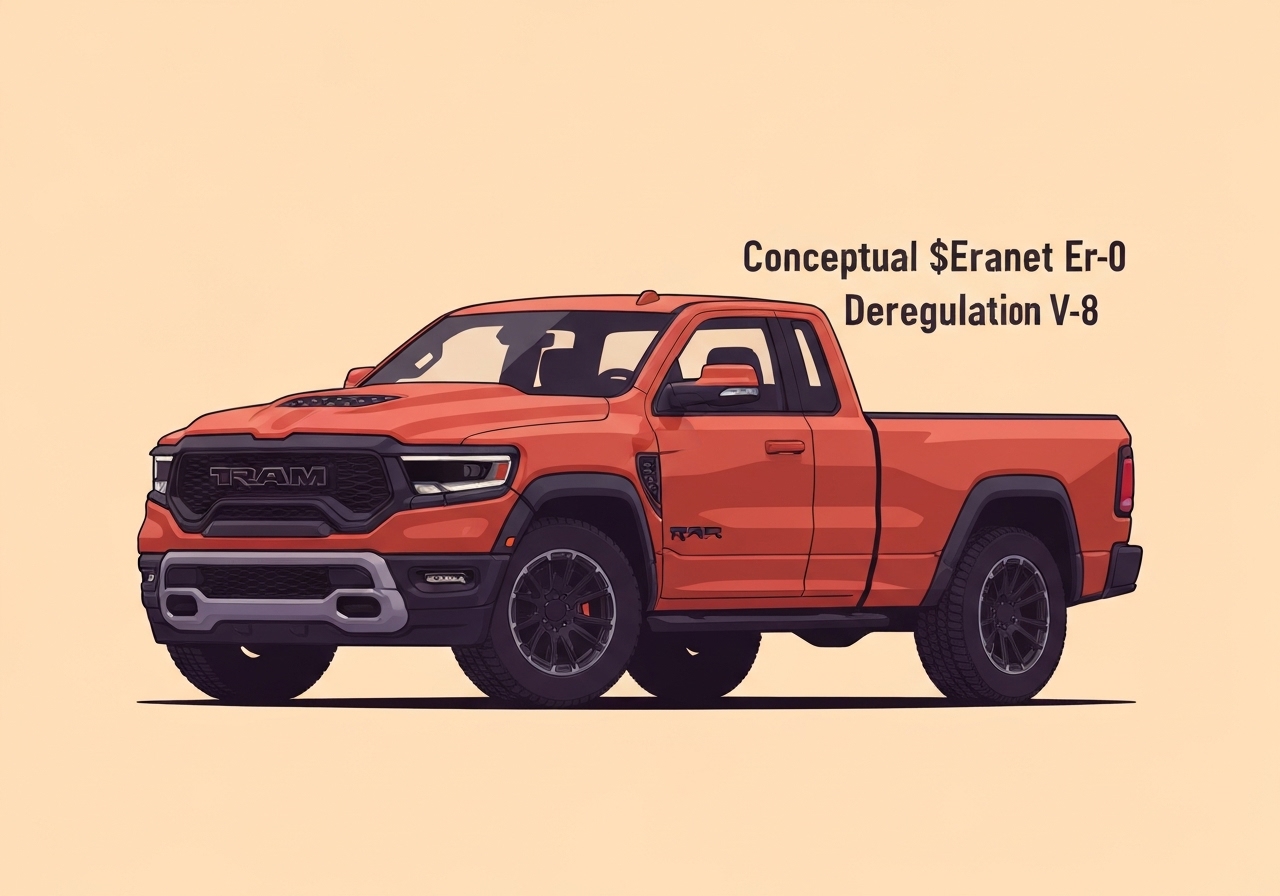
Stellantis announced on Jan. 1, 2026, that the 2027 Ram 1500 SRT TRX will return to showrooms late in 2026, reviving a V‑8 pickup that was discontinued after the 2024 model year. The truck will start at $99,995 plus a $2,595 destination charge, bringing the on‑road price to $102,590. Powered by a supercharged 6.2‑liter “Hellcat” V‑8 rated at 777 horsepower and 680 lb‑ft of torque, the automaker calls it the fastest production gas pickup, with a 0–60 mph time of 3.5 seconds and a top speed of 118 mph. Stellantis frames the TRX comeback as part of a broader U.S. sales turnaround under CEO Tim Kuniskis amid eased federal emissions enforcement.
Key Takeaways
- The 2027 Ram 1500 SRT TRX returns late 2026, priced from $99,995; mandatory destination increases the sticker to $102,590.
- The TRX uses a supercharged 6.2L Hellcat V‑8 with 777 hp and 680 lb‑ft; claimed 0–60 mph in 3.5 seconds and 118 mph top speed.
- The TRX was previously produced for 2021–2024 before being shelved when V‑8 emphasis waned.
- Stellantis also announced a 6.7L Cummins high‑output diesel for the 2027 Ram Power Wagon: 430 hp and 1,075 lb‑ft.
- Leadership says the return is a halo‑strategy move during a U.S. turnaround that has included more than 25 planned announcements.
- Regulatory rollbacks at the federal level have eased prior pressure to phase out large gas V‑8s—an environment Kuniskis says factors into product decisions.
- Cox Automotive projects Stellantis U.S. sales around 1.25 million for the year, down 4.4% from 2024 and well below 2020 levels exceeding 2 million.
Background
Stellantis formed in 2021 from the merger of Fiat Chrysler and PSA Groupe, and its U.S. footprint has seen notable shifts since. Under former CEO Carlos Tavares, the company moved away from large‑displacement V‑8s amid tighter fuel‑economy targets; as a result the TRX was discontinued after the 2024 model year. The automaker’s U.S. ranking slipped from the No. 4 seller in 2020 to No. 6 in the years that followed, and sales through the third quarter of last year were about 6% lower than the prior year.
Political and regulatory changes have altered the policy landscape. Many federal fuel‑efficiency and emissions initiatives that encouraged electrification were weakened or rescinded under the prior administration, changing the regulatory calculus for new product investment. Ram leadership, led by Tim Kuniskis since his return to the company a year ago, has pursued aggressive brand actions—some symbolic, others product‑focused—to rekindle buyer attention and restore momentum in the U.S. market.
Main Event
On Jan. 1, 2026, Stellantis confirmed the 2027 Ram 1500 SRT TRX will rejoin the lineup late in 2026 with a base price of $99,995 and a mandatory $2,595 destination fee. The company emphasizes that the truck is designed as a high‑performance halo model meant to attract attention and potentially drive sales across the Ram range despite historically modest volumes for the segment. The original TRX debuted with a lower starting price in 2020—about $71,690 including destination—making the new entry substantially more expensive in real terms.
Stellantis highlighted the TRX’s powertrain: a supercharged 6.2‑liter Hellcat V‑8 tuned to 777 hp and 680 lb‑ft of torque. The automaker touts the truck as the most powerful production gasoline pickup, citing a 0–60 mph time of 3.5 seconds and a 118 mph top speed. Ram also announced a new 6.7‑liter Cummins high‑output turbo diesel for the 2027 Ram Power Wagon heavy‑duty model, rated at 430 hp and 1,075 lb‑ft of torque, signaling investment across both gasoline and diesel performance plays.
Tim Kuniskis framed the TRX return as part of a broader U.S. turnaround plan, promising more than 25 announcements through the next year. Some of those moves have been cultural and promotional—returning to NASCAR with a new race truck and other brand activations—while others include product repositioning such as reviving Hemi V‑8 badging and canceling a previously planned battery‑electric version of the Ram 1500.
Analysis & Implications
The TRX revival underscores a strategic pivot: Stellantis is intentionally leaning into high‑performance, high‑margin products to reestablish brand excitement in the U.S. market. Halo models typically account for small unit volumes but can sharpen consumer perception and benefit showroom traffic for mainstream models. Given historical TRX sales were limited by price, the measure of success will be whether the publicity translates into a broader uplift for Ram and Stellantis’ U.S. brands.
Regulatory shifts are central to this decision. With federal emissions and fuel‑economy penalties relaxed relative to prior administration plans, the cost and risk of reintroducing large gas engines fall. Kuniskis has publicly noted that regulatory easing helps, but also asserted the company would pursue the TRX comeback on its own strategic merits. That leaves Stellantis exposed to future policy reversals: any renewed tightening could force different product or compliance strategies and alter long‑term fleet averages.
Economically, the TRX’s high sticker price creates a twofold outcome: higher per‑unit gross margins on the TRX itself, but limited volume and potential customer resistance in a flat or contracting market forecasted by many analysts for 2026. Cox Automotive’s projections of a modestly smaller U.S. market mean Stellantis will need to take customers from rivals rather than rely on market expansion. The brand’s broader plans to streamline Jeep and Ram lineups aim to reduce internal overlap and sharpen product value, which could help in conquest sales.
Comparison & Data
| Model | Engine | HP | Torque (lb‑ft) | 0–60 mph | Price (base) |
|---|---|---|---|---|---|
| 2027 Ram 1500 SRT TRX | 6.2L supercharged Hellcat V‑8 | 777 | 680 | 3.5 s | $99,995 ($102,590 with dest.) |
| 2021–2024 Ram TRX (original) | 6.2L supercharged V‑8 | 702 | 650 | ~4.0 s (varied) | ~$71,690 (2020 start, incl. dest.) |
| 2027 Ram Power Wagon (new diesel) | 6.7L Cummins turbo | 430 | 1,075 | N/A | TBD |
The table illustrates power gains for the new TRX relative to its earlier run and highlights Stellantis’ parallel investment in diesel torque for heavy‑duty applications. Although the updated TRX substantially ups horsepower and price, the Power Wagon diesel focuses on torque and towing capability—two different commercial and marketing targets within Ram’s portfolio.
Reactions & Quotes
Ram leadership positioned the move as a deliberate brand play rather than a purely regulatory reaction. Before the announcement, Kuniskis told media the TRX was advanced beyond its prior iteration and that the company is glad to bring it back.
“We had to push it to the next level. We’re super happy about this one coming back,”
Tim Kuniskis, Ram CEO
Kuniskis also said the regulatory rollback eases the environment for such models, but he indicated the decision was part of a larger commercial plan rather than solely a response to policy changes.
“This is going to be the last piece of the puzzle… it’s a much better Jeep,”
Bob Broderdorf, Jeep CEO
Broderdorf was speaking about broader brand resets at Jeep, which are running in parallel with Ram’s product moves. Industry analysts cited by media note that halo vehicles can boost brand relevance but are insufficient by themselves to reverse deep sales declines.
Unconfirmed
- Exact production volumes and allocation by dealer for the 2027 TRX have not been released; Stellantis has not published firm unit targets.
- The permanence of the canceled Ram 1500 BEV program has not been fully detailed; company statements indicate the project is shelved but future EV plans remain unclarified.
- Whether the TRX will be offered in multiple trim/weight configurations, or limited runs, is not yet confirmed by Stellantis.
Bottom Line
The return of the Ram TRX signals Stellantis’ strategic pivot to reignite consumer interest with high‑performance halo vehicles while capitalizing on a regulatory environment that temporarily lowers the cost of carrying large gas engines. The truck’s specs and price position it as a statement product rather than a mass seller; its success will be measured by its ability to drive showroom traffic and uplift broader Ram and Stellantis sales.
Longer term, the move increases Stellantis’ exposure to future policy reversals and to marketplace shifts toward electrification. Executing the broader turnaround—streamlining Jeep and Ram lineups, managing pricing and content, and converting attention into sustainable sales growth—will determine whether the TRX is a catalyst or a costly showcase.
Sources
- CNBC (media report covering Stellantis announcement).
- Stellantis (official corporate site / newsroom for product releases).
- Cox Automotive (industry analysis / sales forecasts referenced by media).