
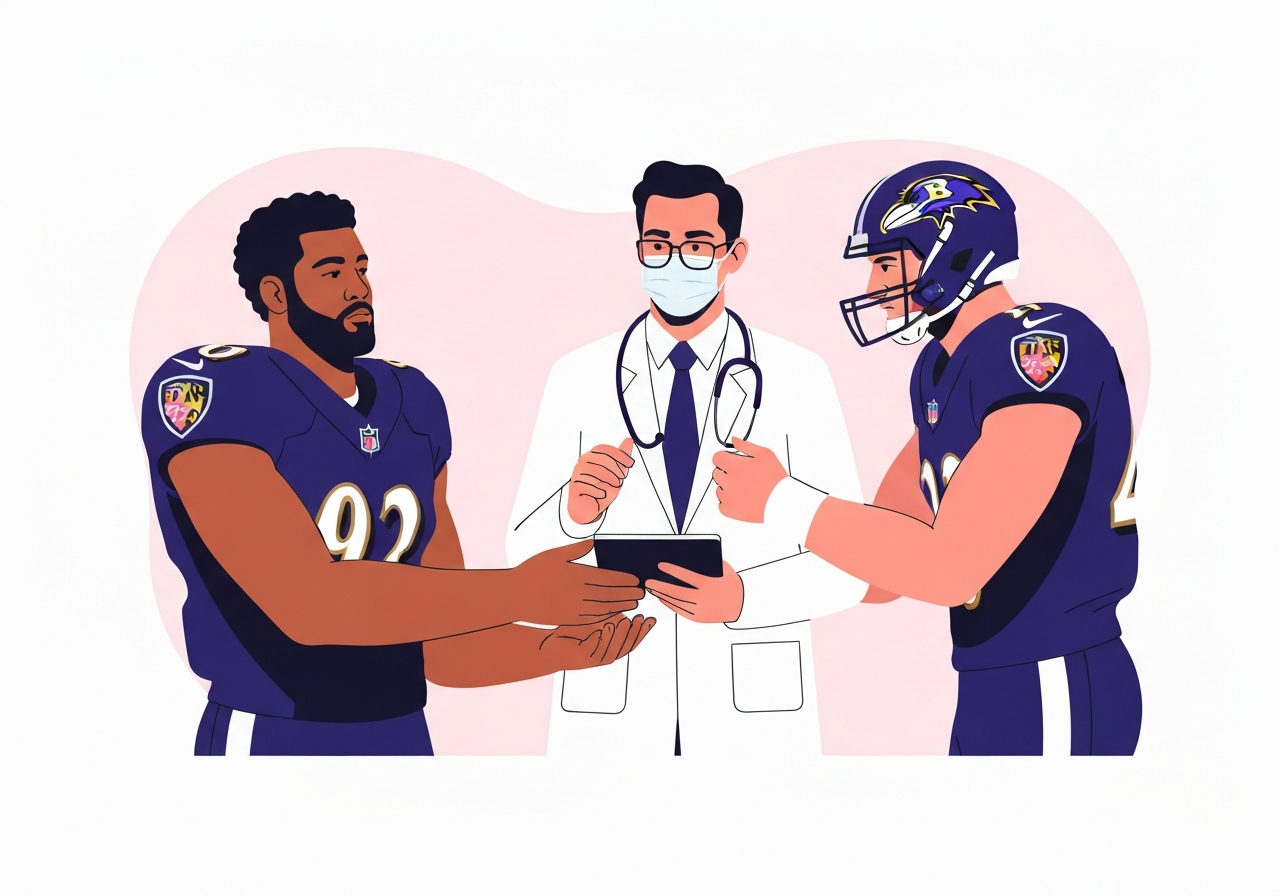
Lead: The Baltimore Ravens decided not to finalize a trade for edge rusher Maxx Crosby after consulting multiple physicians this week, sources say. The review included MRI assessments and in-person examinations by several doctors, among them Dr. Daniel Cooper. The medical input led the Ravens to decline a deal that would have cost them the 14th overall pick in the 2026 draft plus next year’s first-round selection. Team officials characterized the choice as a medically driven exercise of due diligence rather than a simple reneging on terms.
Key Takeaways
- The Ravens halted a proposed trade for Maxx Crosby after seeking multiple medical opinions, including MRI reviews and physical exams.
- Dr. Daniel Cooper — the Cowboys’ team physician who has operated on high-profile players — was among the doctors consulted.
- The trade on the table would have sent the 14th overall pick in 2026 plus Baltimore’s first-round pick in 2027 to acquire Crosby.
- Sources describe the decision as based on current physical-readiness concerns and projections about Crosby’s short-term availability rather than a definitive career prognosis.
- Ravens officials emphasized the importance of protecting a rare asset: they have never surrendered a first-round pick for a player without strong assurance of long-term value.
- Historical context: teams have previously passed on acquisitions after adverse medical findings, notably when the 2000s Dolphins doctor failed Drew Brees on a physical following shoulder surgery.
- Despite the medical caution, observers note Crosby could still be ready by Week 1 and that the situation may motivate a strong on-field response in 2026.
Background
The proposed transfer of Maxx Crosby attracted widespread attention because of the high draft capital involved: a top-15 pick in 2026 plus another first-rounder the following year. For the Ravens, who have avoided surrendering a first-round selection for a player in franchise history, those assets represent a significant long-term cost. That backdrop raised the stakes on any medical uncertainty tied to Crosby’s knee and recovery timeline.
Medical clearances can hinge on two related but different assessments: whether a player is physically able to perform today and whether the injury will be reliably healed in time to justify a trade that leverages future picks and salary expectations. Clubs commonly consult multiple specialists — both to verify findings and to form a projection about future performance — before completing major transactions.
There is precedent in the NFL for teams walking away after medical red flags. Two decades ago, the Miami Dolphins’ doctor declined to clear Drew Brees following offseason shoulder surgery, a decision that then-coach Nick Saban publicly criticized. That episode is often cited inside league circles as an example of how medical judgments can shape roster construction and long-term planning.
Main Event
According to reporting by Adam Schefter and other league sources, the Ravens sought several medical opinions after reviewing Crosby’s MRI scans. Those reviews included participation from physicians who both analyzed imaging and performed hands-on examinations. Dr. Daniel Cooper — widely respected around the league and affiliated with the Dallas Cowboys — was among the consultants whose input was considered.
Sources indicate the medical consensus suggested Crosby would not clear a physical if the test were assessing whether he could practice and play immediately. Club physicians and outside consultants distinguished that present-day assessment from a forward-looking projection about whether the player will be healthy later in the season.
The implication for Baltimore was clear: terms that made the trade contingent on Crosby passing a physical created unacceptable risk. With two first-round picks on the line, Ravens decision-makers opted to step back rather than convert draft capital into a player whose near-term availability was uncertain.
Team and league sources also stressed that the move was procedural rather than adversarial — an exercise of prerogative grounded in medical judgment. The involvement of multiple respected doctors was cited to counter narratives that a single clinician had decided the deal should collapse for nonmedical reasons.
Analysis & Implications
The immediate consequence is a missed opportunity for the Raiders to convert Crosby into future draft capital and for the Ravens to rapidly upgrade their pass rush. For Baltimore, preserving first-round picks maintains long-term roster flexibility and trade leverage, particularly given the premium on cost-controlled, high-impact players under rookie-scale contracts.
Medically driven transaction reversals also shape future negotiations. Teams acquiring players with recent surgeries or uncertain timelines often insist on more conditional terms — protections tied to games played, active roster status, or microscopic milestones in imaging reports. The Crosby episode may push clubs to bake more explicit medical contingencies into deals.
From a market perspective, the situation could affect Crosby’s leverage in contract talks. If teams perceive near-term risk, they may be reluctant to offer large immediate guarantees or may structure deals to offset that risk with performance incentives. Conversely, Crosby’s camp could argue that projected readiness by the season opener mitigates those concerns, preserving his market value.
Broader league effects include increased reliance on a small group of high-profile orthopedic specialists. When multiple clubs and agents turn to the same consultants, their opinions can effectively set transaction parameters across the NFL. That concentration can sharpen disputes when interpretations of imaging and physical exams diverge.
Comparison & Data
| Element | Ravens Proposed Cost | Typical Trade Benchmark |
|---|---|---|
| 2026 Draft Capital | 14th overall pick | Top-15 pick for established edge rusher |
| Additional Cost | 2027 first-round pick | Often a swap of mid-round picks or conditional picks |
| Medical Contingency | Trade contingent on passing physical | Varies; increasing use of performance/availability conditions |
This table illustrates why the Ravens’ medical caution is economically rational: converting two first-round picks into one player lacks upside if that player’s availability in the near term is uncertain. Teams frequently shift to conditional structures or withdraw when medical opinions conflict.
Reactions & Quotes
“My understanding is there were multiple doctors that reviewed his MRI scans. There were doctors that examined him.”
Adam Schefter / ESPN (reporting)
“That doctor didn’t know his ass from a handful of sand.”
Nick Saban (recounting the 2000s Dolphins-Brees episode)
The first quotation reflects reporting that multiple clinicians were involved; the second is a historical remark from Nick Saban referenced to illustrate how medical findings have shaped major personnel moves in the past. Team spokespeople in Baltimore and Las Vegas have not released a detailed joint medical summary, and both clubs declined to comment beyond confirming standard procedural checks.
Unconfirmed
- Whether Maxx Crosby will be ready to play by Week 1 of the 2026 season remains unconfirmed; medical projections differ in timing and certainty.
- It is not independently verified that the Cowboys’ refusal to re-engage in trade talks was solely due to Dr. Cooper’s input rather than broader roster or contractual considerations.
- Reports that Crosby or his representatives expected an imminent contract adjustment in parallel with a trade have not been substantiated by direct documentation.
Bottom Line
The Ravens’ decision to step away from the Crosby trade underscores how medical judgments can override even aggressively structured roster moves when high draft capital is at stake. With two first-rounders potentially exchanged, Baltimore prioritized managing long-term risk over an immediate roster upgrade.
For the Raiders and for Crosby, the episode leaves multiple open paths: a future trade with different terms, a re-engagement if subsequent medical evaluations align, or a scenario in which Crosby recovers and demonstrates his value on the field in 2026. Until more definitive medical reports are publicly disclosed, teams will likely continue to treat similar transactions with heightened caution.
Sources
- NBC Sports (sports reporting)
- Adam Schefter / X (ESPN reporter) (reporting)